
AIDA Framework Complete Guide: Marketers October 2026

By Bennett Cohen
Get Maintouch
Turn search and AI visibility work into a repeatable growth system.
Every week I see the same pattern: an ad gets clicks but the landing page converts at 1%. Email subject lines work but nobody responds. The AIDA model explains why. You're nailing one stage and bombing the next. Most people skip stages or assume they happen automatically, and that's where conversions die.
I've been doing SEO for over a decade, and Maintouch serves hundreds of marketers. I've watched AIDA work across every channel when executed correctly, and fail spectacularly when teams skip stages. My goal: you walk away understanding exactly how to apply AIDA to your content without the gaps that kill conversions.
TLDR:
- AIDA (Attention, Interest, Desire, Action) maps how buyers move from first exposure to conversion.
- Use AIDA for discovery content and top-of-funnel; PAS works better when buyers already know the problem.
- Campaigns using AIDA see up to 27% higher conversions by fixing each stage's drop-off points.
- AI automates AIDA execution speed through personalized messaging and real-time optimization.
What Is the AIDA Framework
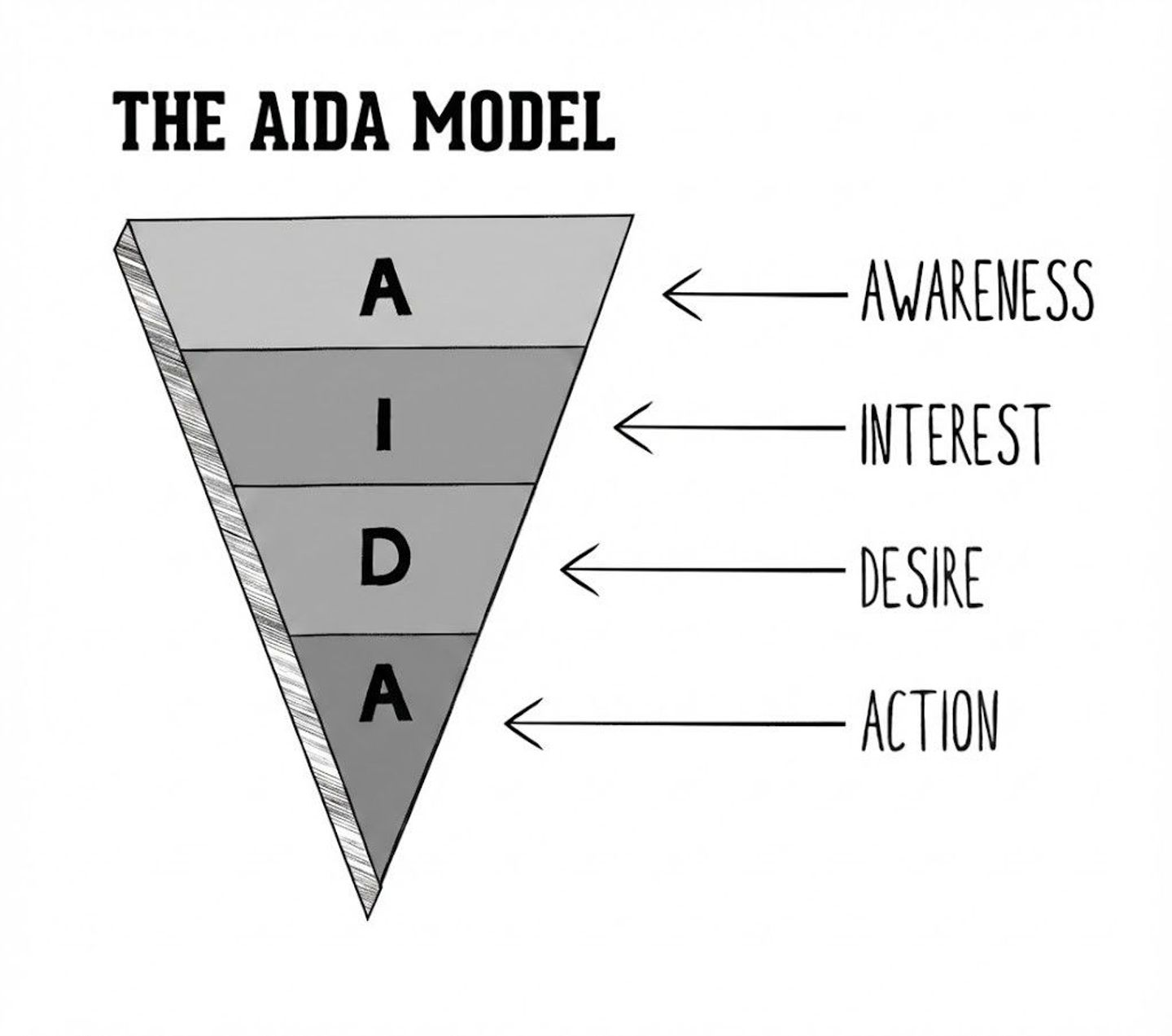
AIDA is a four-stage framework that maps how people move from first exposure to taking action. Attention, Interest, Desire, Action.
Created in the 1890s, still taught everywhere. The reason it survived isn't complexity. It's that the underlying psychology hasn't changed. People still need to know you exist before they can care, and they need to care before they'll act.
The History and Evolution of AIDA
Elias St. Elmo Lewis created AIDA in 1898 to explain how salespeople should structure their pitch: get attention, close the deal.
The model stuck because it maps something real about how humans process persuasion, and simple frameworks survive longer than complex ones. Print ads used it, radio spots used it, TV commercials used it, and every new channel that came along plugged right into the same four stages.
What changed over time was the execution, not the framework. In the 1950s, attention meant a catchy jingle. In 2010, a Facebook ad. In 2026, showing up in ChatGPT's response. The psychology hasn't moved an inch.
How the AIDA Model Works
Each stage filters people out, and that's the point. If everyone who saw your ad also bought your product, you wouldn't need a framework. AIDA exists because most people leave before they convert, and each stage is a specific place where you either keep them or lose them.
Attention interrupts the scroll or search. You need a hook that makes someone stop: a headline, an ad, a search result. Most people bounce here.
Interest proves you're worth the next 30 seconds. Context, relevance, maybe a benefit preview. Still losing people.
Desire is where logic meets emotion. You're building the case for why they need this. Social proof, specifics, outcomes. The pool shrinks again.
Action is the conversion point. Buy, sign up, book a call. Friction kills you here.
Here's what this looks like in practice:
| AIDA Stage | Primary Goal | Key Metrics | Common Drop-off Points |
|---|---|---|---|
| ATTENTION | Stop the scroll and get noticed | Impressions, CTR, time to first interaction | Weak headlines, poor visual hierarchy, slow load times |
| INTEREST | Prove relevance and earn more time | Dwell time, scroll depth, engagement rate | Irrelevant opening, no clear value prop, wall of text |
| DESIRE | Build emotional and logical case for need | Time on page, content completion, social proof clicks | Lack of specifics, no proof points, weak differentiation |
| ACTION | Drive conversion with minimal friction | Conversion rate, form abandonment, CTA clicks | Unclear CTA, too many fields, missing trust signals |
AIDA Framework Statistics and Effectiveness
The data is clear on this.
You have 7 seconds to make an impression online. That's the Attention stage.
AIDA campaigns see 27% higher conversions compared to unstructured approaches, making it easier to calculate ROI from your marketing efforts. The reason is simple: AIDA forces you to think about each drop-off point.
If your ad grabs attention but doesn't build interest, you're done. If you create desire but the conversion step has too much friction, same problem.
The catch is that most people skip stages or assume they're happening automatically. They aren't. Every stage needs work.
AIDA vs PAS: Choosing the Right Copywriting Framework
PAS (Problem, Agitate, Solution) starts from a different assumption than AIDA. AIDA assumes nobody knows you exist yet. PAS assumes they already feel the pain and are looking for relief.
Use AIDA when your audience doesn't know they have a problem yet. You're creating awareness first. Think top-of-funnel content, cold ads, or SEO posts where someone's just browsing.
Use PAS when your audience already knows the problem exists. They're searching for fixes. PAS skips the attention-grabbing and goes straight to empathy.
AIDA works better for discovery. PAS works better for conversion.
The mistake is picking one and forcing it everywhere. Match the framework to where your reader is in their journey.
Real World Examples of AIDA in Action
Theory is fine, but AIDA earns its reputation in execution. The four stages apply to every channel; what changes is how each stage shows up and where the drop-offs happen.
Email Campaigns
Subject line grabs attention. First line builds interest by naming a real problem. Body shows what changes. CTA asks for one thing.
The gap between a 2% and 15% reply rate is how well each stage connects to the next.
Slack's early growth emails nailed this. Subject line: "You're missing messages from [teammate name]" (Attention). First line called out the specific channel and thread (Interest). Body showed what conversations were happening without you (Desire). CTA was just "Jump back in" with a single button (Action).
Landing Pages
Airbnb's host signup page is textbook AIDA. Hero headline shows personalized earnings estimates for your specific location (Attention with a concrete dollar figure). Scroll down and you see three steps with real host photos (Interest). Testimonials from actual hosts in your city with their earnings (Desire). Form asks for one thing: your location to see earnings estimate (Action with minimal friction). As of 2026, average Airbnb host earnings sit at approximately $14,000 annually, with top performers reaching $44,235.
Common Criticisms and Limitations of the AIDA Model
Before you build your entire funnel around AIDA, you should know where it breaks. Some criticisms are fair, and ignoring them is how teams misapply the framework.
The biggest one: it's too linear. Real buyer journeys don't move in a straight line. People jump between stages, loop back, research across multiple sessions.
AIDA also oversimplifies complex purchases. If you're selling a $100K enterprise contract with a six-month sales cycle and seven stakeholders, mapping that to four stages feels reductive.
Another gap: AIDA stops at action. It doesn't cover retention, upsells, referrals, or post-purchase behavior.
Where AIDA still works: when you need a forcing function to structure messaging. If your landing page has a great hook but no clear CTA, AIDA catches that.
Applying AIDA to Digital Marketing Channels
SEO and Organic Content
For organic search, Attention lives in the SERP itself. Your title tag and meta description are doing the work before anyone clicks. Once they land, Interest needs to hit in the first 100 words or they're back to Google. Desire builds through the body: data, proof, specifics that make the reader feel like they found something worth their time. Action is wherever you ask for the next step, whether that's a CTA button, an embedded form, or a link to a deeper piece.
Social Media
On social, you have three words or a thumbnail to earn Attention. The caption hook decides whether someone stops scrolling long enough to build Interest. Desire is harder to measure here, but watch time, comments, and shares tell you it's working. Action is typically a link in bio or DM, and the gap between those two steps (Desire on the feed, Action somewhere else entirely) is why social conversion rates are lower than search.
Paid Ads
Shopify's Facebook ads show the formula. Creative shows a real store making a sale (Attention). First line presents a specific revenue milestone and timeframe (Interest with concrete achievement). Landing page breaks down exactly how they did it with store examples (Desire). CTA is "Start free trial" with no credit card required (Action).
Budget gets wasted when your ad and landing page don't match. Pair paid efforts with autonomous backlink building for long-term gains.
Product Launches
Apple's iPhone launches follow AIDA religiously. Keynote opens with a problem everyone has (Attention). Next 10 minutes show the new feature solving it (Interest). Demo videos and comparisons prove it works better than alternatives (Desire). Pre-order starts immediately after the event (Action).
They don't skip stages or assume you'll figure it out.
How AI Is Changing the AIDA Framework in 2026
AI didn't rewrite the AIDA playbook. It compressed the timeline. The stages are the same, but the speed at which you can test, personalize, and optimize each one went from weeks to hours.
As of June 2026, new research from StackAdapt and Ascend2 shows 93% of brands and 94% of agencies agree AI is improving personalization at every stage of AIDA, but only one in five have fully integrated it across channels. The gap between belief and execution is massive. Most teams are still running AI in isolated pockets (personalized email subject lines here, adaptive landing page copy there) instead of coordinating it across the entire buyer journey from first impression to conversion.
The data shows 87% of brands plan to increase personalization spend in 2026, but fragmented data and disconnected tools are killing execution. You can't run personalized AIDA at scale when your attention-stage ad system doesn't talk to your interest-stage content system, and neither connects to your action-stage conversion tools. The marketers who crack this are doing more than using better AI. They're unifying data, creative, and media activation into one system so each AIDA stage feeds the next automatically.
At the Attention stage, AI now analyzes what's getting surfaced in ChatGPT citations, Perplexity results, and Google AI overviews. Instead of guessing what gets noticed, you reverse-engineer what LLMs actually surface and optimize for that.
For Interest and Desire, AI platforms test dozens of messaging angles simultaneously, swap copy based on real-time behavior, and adapt content to match how someone landed on your page. What used to take a team of copywriters a quarter to test now runs in a week.
At the Action stage, A/B tests that took weeks run in days. AI flags friction points in forms, identifies where people drop off, and suggests fixes before you lose conversions you didn't even know were slipping.
The framework hasn't aged out. The execution speed went from manual and slow to automated and fast.
Using the AIDA Framework for Content Strategy
If you write blog posts, AIDA gives you a checklist for keeping readers on the page instead of bouncing back to the SERP.
Attention happens before the click. Your headline and meta description compete with nine other results, and if they don't create enough curiosity or promise enough value, the rest of your work never gets seen. Once someone lands, the first paragraph decides if they stay or hit the back button.
Interest builds in the next 200 words. Name the problem they searched for, preview what they'll get, and give them a reason to scroll. Dwell time either tanks or holds here, and Google notices which one happens.
Desire is your body content: case studies, data, specifics that make the reader think "this is exactly what I needed." Break it into scannable H3s so people can jump to the section that matters to them.
Action is the CTA, but think of it as continuation rather than conversion. Link to a deeper piece, offer a template, suggest the next step. The goal is forward motion, not a dead end.
How Maintouch Handles Content Creation at Scale
I built Maintouch to run AIDA across your content operation.
Attention starts with strategy. I pull queries from your sales calls and Google Search Console to find what people actually ask, then target long-tail searches that trigger AI overviews.
Interest gets built through competitor scraping and sales call mining. I load competitor sites and pull questions your prospects ask during demos.
Desire comes from first-party data. I infuse your knowledge base and custom sources into every piece.
Action happens through intelligent internal linking and CTA placement based on Search Console data.
The result is AIDA-driven content that ranks and gets cited by ChatGPT.
Final Thoughts on Applying AIDA to Your Content
AIDA forces you to think about drop-off points before they kill your conversions. Attention without interest dies fast. Desire without a clear action step wastes the work you just did. Your content either moves people to the next stage or it doesn't, and AIDA makes that painfully obvious.
I've been doing SEO for over a decade, and Maintouch serves hundreds of marketers running into the same conversion problems. If you want to talk through how to apply AIDA to your content operation at scale, shoot me a message. I'll walk you through how Maintouch surfaces what to do, ranks by impact, and executes automatically, from keyword research through content creation to backlink procurement.
FAQ
How do I know which stage of AIDA my content is failing at?
Check where people drop off. No clicks? Attention problem. Bounce in 10 seconds? Interest died. Read everything but didn't convert? Action stage has friction.
What's the difference between AIDA and PAS for cold traffic?
AIDA assumes zero awareness. PAS assumes they already know the problem. Use AIDA for discovery content, PAS when they're actively searching for fixes.
When should I update old content using the AIDA framework?
When impressions drop after 90 days. Refresh your headline, update stats, add new proof, and check your CTA still works.
Can AIDA work for long sales cycles with multiple stakeholders?
AIDA gets messy with B2B buying since nothing's linear. Use it as a checklist per asset, not per deal. Your comparison page still needs all four stages even if the sale takes months.
How does AI search change how I apply the AIDA framework in 2026?
Stages stay the same, execution changes. Attention means ChatGPT citations and Perplexity results. Interest and Desire happen faster through AI personalization. Action optimization runs in days, not weeks.
Should I use AIDA for every piece of content I create?
No. Use it for top-of-funnel discovery and awareness campaigns. Skip it for docs, support articles, or when someone just wants a fast answer.
What metrics should I track for each stage of the AIDA model?
Track impressions and CTR for Attention. Dwell time and scroll depth for Interest. Time on page and engagement with proof elements for Desire. Conversion rate and form abandonment for Action. Most analytics platforms split these out by default.
How do I write AIDA-driven email subject lines that actually get opened?
Name a specific problem or outcome in 6-8 words. "You're missing messages from [teammate name]" works because it creates urgency and names the cost. Generic benefit statements like "Improve your productivity" die in the inbox.
Can I skip the Desire stage if my product is obviously valuable?
No. "Obviously valuable" is your read, not the buyer's. Even if the benefit seems clear to you, the Desire stage is where you separate your solution from alternatives and prove it works. Skip it and conversions tank.
Does AIDA work differently for B2B versus B2C marketing?
The stages stay the same, execution changes. B2B Desire needs proof points and case studies because multiple stakeholders are reviewing the decision. B2C Desire leans harder on emotion and social proof. Action in B2B might be "book a demo" while B2C goes straight to purchase.
How do I fix an AIDA funnel when one stage is underperforming?
Isolate the drop-off point first. Low CTR means Attention failed. High bounce means Interest died. Long dwell time but no conversion means your Action stage has friction. Fix the broken stage before optimizing the ones that work.
What's the biggest mistake people make applying the AIDA framework?
Assuming stages happen automatically. You grab attention with an ad, then dump people on a homepage with six different CTAs and no clear path. Every stage needs intentional design, and each one should lead directly to the next.
How does the AIDA model apply to video content and social media?
First three seconds are Attention. Next 15-30 seconds build Interest through the hook. Middle section creates Desire by showing outcomes or social proof. Action happens in the caption CTA or pinned comment. Most videos fail because they nail Attention but never transition to Interest.

About the author
Bennett Cohen
CEO and Founder at Maintouch
Turn search into your best growth channel.
Maintouch tracks your visibility across AI and Google, creates and refreshes content, and gets your brand mentioned on the sites that shape discovery.
Book a demoRelated reading
All posts