
Does Google Penalize AI Content? [October 2026 Data Update]

By Bennett Cohen
Get Maintouch
Turn search and AI visibility work into a repeatable growth system.
Google doesn't penalize AI generated content. It penalizes low-quality content, and most AI output happens to be low-quality because people hit publish without editing. If your AI posts aren't ranking, you have a quality problem, not an AI problem.
TLDR:
- Google doesn't penalize AI content. Independent SERP studies in 2026 estimate a meaningful share of top-ranking pages are AI-assisted.
- You get penalized for low-quality content, not for using AI to create it.
- First-party data from sales calls, product analytics, and customer research makes AI content rank.
- Readers bounce from unedited AI phrases like "jumps into" and "detailed," killing your dwell time.
- Maintouch infuses your proprietary data into AI content so it ranks.
Google's Official Stance on AI Content in June 2026
Google doesn't penalize AI content. Full stop.
That's the answer you're looking for, and it's been consistent since their March 2024 helpful content guidance update and remains unchanged as of June 2026. Google cares about whether content is helpful, not how you made it.
Here's what Google Search's quality guidelines actually say: content should be created for people first, not to manipulate search rankings. Whether you wrote it yourself, had an agency write it, or generated it with ChatGPT doesn't matter. What matters is whether it answers the searcher's question better than the other results.
The confusion comes from people conflating two different things. Google penalizes low-quality content made to game rankings. That can be AI-generated, but it can also be human-written garbage. I've seen plenty of both. The penalty isn't about the tool you used. It's about the output.
Google's June 2026 search quality rater guidelines make this clearer. Raters are instructed to assess content based on helpfulness, accuracy, and user satisfaction. There's no checkbox for "was this made by AI?" because that's not the criteria that matters.
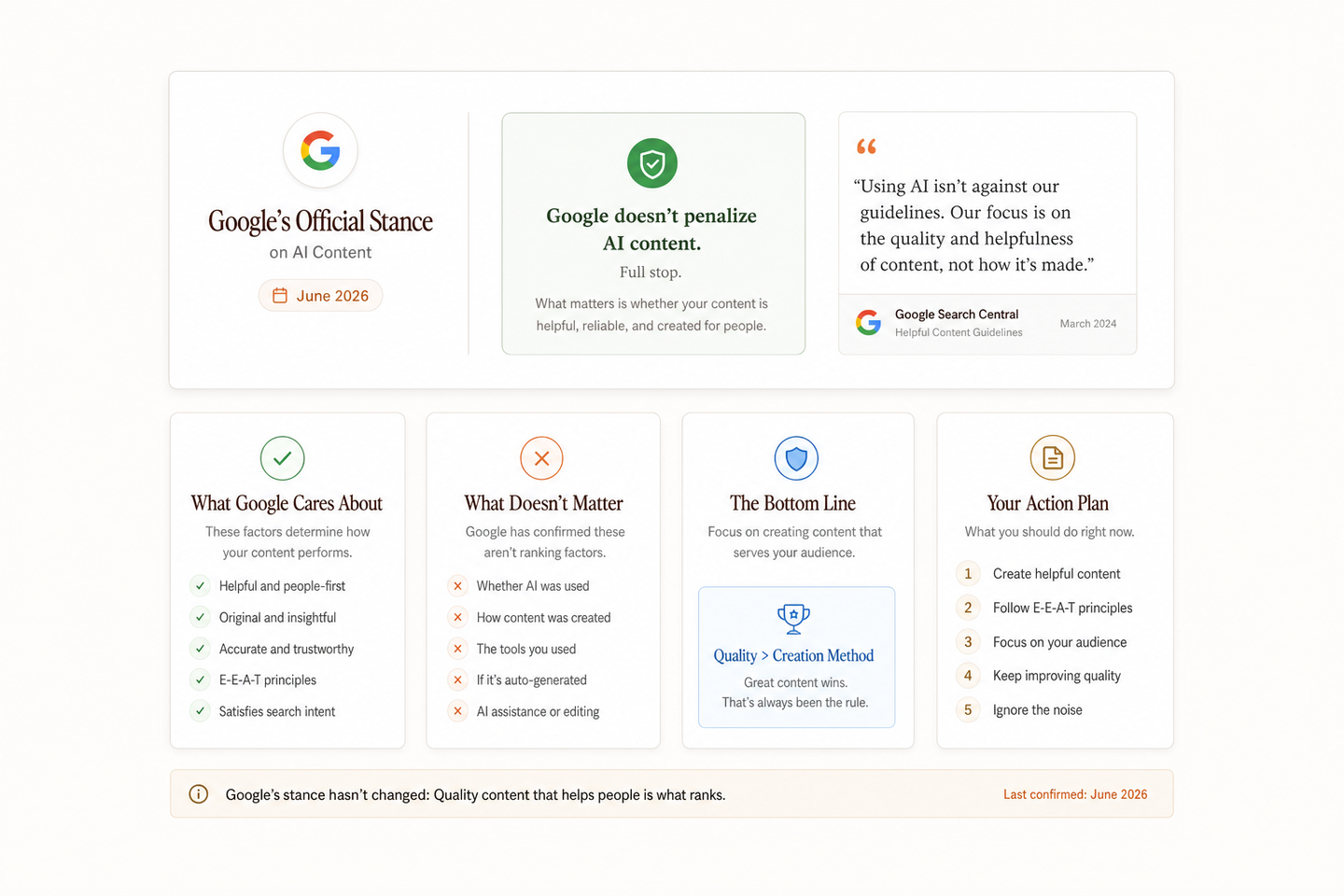
Google looks at:
- Does the content answer the query completely?
- Is the information accurate and up to date?
- Does it provide unique value compared to other results?
- Is it written clearly for the intended audience?
- Does the site have expertise in this topic area?
Notice what's missing? Any mention of how the content was created.
The problem is that most AI content fails these tests not because it's AI-generated, but because it's generic. If you prompt ChatGPT to "write a blog post about X" and publish the output without editing, you're publishing the same slop everyone else is publishing. Google's algorithms can spot that pattern, not because they detect AI, but because they detect sameness.
In my experience working with hundreds of companies, the ones who panic about AI detection are shipping generic content. The ones who rank are infusing first-party data, unique insights, and actual expertise into their content, whether they're using AI to draft it or not.
Google's public guidance, echoed by Search Liaison Danny Sullivan, has consistently been that the focus is on the quality of content, not how content is produced. That's still the policy in June 2026.
If you're worried about getting penalized for using AI, you're asking the wrong question. The right question is: "Is this content actually better than what's already ranking?" If the answer is no, you have a quality problem, not an AI problem.
Real Data: How Much AI Content Actually Ranks on Google
AI content is ranking on Google right now, in large quantities, across competitive queries.
The question isn't "can AI content rank?" anymore. The question is "why isn't yours ranking?"
From working with hundreds of companies publishing AI-assisted content, the pattern is consistent: they rank for competitive head terms, zero-volume queries, and everything in between. The difference isn't whether they used AI. It's whether they shipped something unique or just published what everyone else is publishing.
AI content ranks best for:
- High-intent commercial queries (like "Salesforce vs HubSpot pricing" or "best CRM for startups") where buyers compare solutions and features before purchase
- Technical how-to guides that walk through complex processes with step-by-step instructions and troubleshooting tips
- Industry-specific long-tail keywords that target niche topics with lower search volume but higher conversion intent
- Comparison and alternative pages that help users weigh different options against each other with feature breakdowns
- Question-based queries that trigger AI overviews and appear in featured snippets at the top of results
The same content ranking in traditional search gets cited in AI overviews, ChatGPT, Claude, and Perplexity.
Google isn't filtering AI content. It's filtering bad content. Most AI content is bad because people publish it raw.
I've reviewed hundreds of ranking AI pages. The common thread isn't hiding AI origins. It's including information you can't get from prompting ChatGPT: real examples, product data, customer insights, screenshots, charts from proprietary sources.
Edited to remove AI phrases like "jumps into," "detailed," "complex"
Includes first-party data from sales calls, product analytics, customer research
Raw ChatGPT output with no editing or proprietary information
Obvious AI patterns and corporate buzzwords signaling unedited output
Answers intent better than existing results with unique examples, screenshots, implementation details
Covers topics where 50+ results say the same thing
AI Content That Ranks (Top 17%) | AI Content That Doesn't Rank
Shows EEAT signals through customer quotes, product-specific context, and author expertise woven into the content | Reads like a generic explainer anyone could write by prompting an LLM with the target keyword
Updated regularly based on performance data, with new internal links and refreshed external sources | Treated as publish-and-forget content that decays over time as information becomes outdated
Structured to match what's currently ranking with proper headings, depth, and format aligned to user intent | Generic structure with no analysis of what Google is actually rewarding for that specific query
You're not competing against AI. You're competing against quality, wherever it comes from.
What Google Actually Penalizes: Low-Quality Content, Not AI
Google penalizes content that doesn't help users. That's the real trigger, and it shows up in predictable patterns.
Thin content gets demoted. If your page has 200 words and doesn't answer the query, it's not ranking. Doesn't matter if you wrote it or Claude did. Google wants depth where depth matters. A page about "how to set up Google Analytics" that skips half the steps is useless, and Google treats it that way.
Duplicative content gets filtered. If 500 sites publish the same take on a topic, Google picks a few winners and ignores the rest. You're being ignored for publishing the same thing as everyone else.
Spammy patterns get hammered. Publishing 100 blog posts in a week, stuffing keywords into every sentence, hiding text, buying links from sketchy directories. These trigger manual actions and algorithmic filters. I've seen sites do this with human writers and with AI. The penalty rate is the same. If you want to scale content the right way, see our comparison of the best programmatic SEO tools for scaling content. They bake quality controls in from the start.
Misleading content gets hit hard. Clickbait titles that don't match the page, false claims, outdated information presented as current. If your AI content says "as of 2026" but pulls facts from 2022 training data, you're giving Google a reason to distrust your site. That's a quality issue, not an AI issue.
When sites get penalized, they shipped hundreds of pages with no unique value. They targeted keywords with no search intent alignment. They didn't edit or add anything proprietary. Google's algorithm sees sameness, low engagement, high bounce rates, and drops them.
The sites that avoid penalties do a few things right:
- Editing AI drafts instead of publishing raw outputs that still have generic placeholder text or obviously AI-generated transitions
- Adding data Google can't scrape from other sites, like customer quotes, product screenshots, or original research
- Matching search intent by analyzing what's currently ranking and building content that answers the query better
- Updating content over time instead of treating publish dates as finish lines
Writing Prompts That Generate Rankable Content
The prompt determines output quality more than the model you use. Most people ask ChatGPT to "write a blog post about X" and wonder why the result reads generic. The fix is embedding quality requirements directly into the instruction.
Include first-party data in your prompts. Reference customer call transcripts, support ticket patterns, or product analytics in the prompt itself. "Use these three customer quotes about feature adoption challenges" beats "write about common challenges." The AI can't invent proprietary context, so you feed it in.
Specify depth and detail requirements. "Cover setup in 400 words with step-by-step instructions, expected errors, and troubleshooting tips" produces different output than "explain how to set this up." Tell the AI exactly how thorough you want each section.
Instruct the AI to avoid detection phrases. Add rules like "don't use: detailed, complex, sturdy, simplify, use, or jump into" and "replace fancy verbs with simple ones." This cuts the tells before they show up in the draft.
Ask for specific examples over generalizations. "Include three specific examples with company names and outcomes" forces concrete detail. "Explain common mistakes" gets you a list of abstract warnings.
Before: "Write a blog post about improving site speed for ecommerce."
After: "Write a 1,200-word guide on improving ecommerce site speed. Include: 5 specific tactics with implementation steps, expected improvement ranges in seconds, common errors and fixes, and avoid these phrases: detailed, sturdy, simplify. Use these two customer examples: [paste examples]. Write for technical founders who've already tried basic caching."
The second prompt produces content closer to publishable because it defines what quality looks like before generation starts.
Google's June 2026 core updates targeted low-quality content at scale. If you happened to be scaling low-quality content with AI, you got hit. If you were scaling high-quality content with AI, you're probably fine.
I've seen companies freak out after traffic drops, convinced Google detected their AI content. Then I look at the pages and find 400-word blog posts with no depth, no examples, no internal links, and metadata that doesn't match the content. That's not an AI penalty. That's a quality penalty you would've gotten with human writers too.
The real penalty isn't what Google does to your site. It's the opportunity cost of publishing content that was never going to rank in the first place.
The EEAT Framework and Why It Matters More Than Ever
Google added Experience to its quality framework in December 2022. The shift separated firsthand knowledge from credentials. You can have expertise without experience. Google wants both.
What each piece means:
Experience is firsthand knowledge. A review of running shoes from someone who tested them beats a review from someone who summarized other reviews. Google scans for signals the author actually did the thing. Photos, specific details, personal observations. Anything that couldn't be scraped from existing content.
Expertise is deep knowledge gained through credentials, work history, or a proven track record. A cardiologist writing about heart health has expertise. So does someone who's been writing about SEO for 15 years with accurate predictions. Expertise can be formal or informal. It just has to be real.
Authoritativeness means other people in your space recognize you as credible. This shows up through backlinks from reputable sites, mentions in industry publications, and citations in other high-quality content. If nobody links to you, Google has less reason to treat you as authoritative.
Trustworthiness is the baseline. The site needs to be secure, transparent about who runs it, accurate in its claims, and straightforward with users. Sites with clear contact info, author bios, cited sources, and structured data for AI search score higher. Sites with spammy ads, broken pages, or sketchy affiliate disclosures score lower.
These criteria apply whether you're using AI or writing by hand. A human-written article with no experience, expertise, authority, or trust signals will lose to an AI-assisted article that has all four. Google doesn't care about the process. It cares about the output.
EEAT matters more now because the flood of AI-generated content forced Google to tighten its quality filters. Content that passes these tests ranks. Content that doesn't gets buried.
What this looks like in practice
A fintech startup we worked with published 50 AI-assisted blog posts. Half tanked. Half ranked. The difference was EEAT signals. The posts that ranked included customer data, product screenshots, quotes from their team, and links to authoritative sources. The posts that tanked read like generic takes anyone could've written.
The biggest EEAT mistake is skipping the experience layer. An LLM can be prompted to sound expert. It can cite authoritative sources. But firsthand experience can't be faked without adding it manually. That's the gap most content leaves open.
How to close each EEAT gap
- Experience: add examples from your own work, customer cases, and product screenshots.
- Expertise: cite your background, credentials, or link to credible sources.
- Authority: earn backlinks and get cited by others in your space.
- Trust: add author bios, contact pages, and source citations, and clean up technical issues.
Your AI Content Quality Checklist
Run every AI-generated post through these checks before you hit publish. Each one closes a gap that kills rankings or sends readers back to search results.
1. Add at least 2 examples from your direct experience or customer data. Product screenshots, sales call quotes, support ticket patterns, analytics findings. Anything that proves you've actually done the thing you're writing about.
2. Remove these AI phrases: detailed, complex, sturdy, simplify, use, jump into, showcasing, critical, smoothly, insights. These words flag unedited output. Swap fancy verbs for simple ones.
3. Verify all statistics are current as of 2026. Check external sources for updated numbers. Flag outdated claims and either update them or cut them entirely.
4. Include at least one screenshot or original image. Stock photos don't count. Product UI, analytics dashboards, process diagrams. Visual proof you're showing real work.
5. Cite 3+ authoritative external sources with inline links. Google's official docs, peer-reviewed research, reputable industry publications. Not blog posts from 2019.
6. Add internal links to 2-3 related posts using target keywords as anchor text. Check what those pages already rank for in Search Console and use those phrases.
7. Write a custom meta description under 155 characters. Don't let Google pull random sentences. Control what shows up in search results.
8. Cut introductory filler like "In today's digital age" and "it's important to note that." Start sections with the actual information, not scaffolding.
9. Check that every H2 and H3 answers a specific search intent. Headings should match questions people ask, not generic topic labels.
10. Have someone who didn't write it review for readability. If they bounce after two paragraphs, readers will too. Fix it before publishing.
AI Content Detection Phrases That Kill Dwell Time
Readers can smell AI slop content from a mile away, and when they do, they leave.
The problem isn't that Google penalizes these phrases. Humans do. Someone lands on your page, reads two sentences packed with AI clichés, and hits the back button. Your dwell time tanks, your bounce rate spikes, and Google notices that pattern.
How Detection Actually Works
Google doesn't run your content through an AI detector. They track what happens after someone clicks your result. Pages with under 30 seconds dwell time send a clear signal: this didn't answer the query. When that pattern repeats across dozens of pages, your site's quality score drops.
Engagement metrics are the first layer. Bounce rate, time on page, SERP click-through behavior. If users land on your page and immediately return to search results, Google sees that as a failed result. Do that consistently, and you lose visibility. I've seen posts ranking position 4-6 with 8% click-through rates because users scan the snippet, recognize the AI pattern, and skip to the next result.
Content fingerprinting catches passages repeated across sites. When 500 pages publish the same three-paragraph explanation of a concept, Google clusters them as duplicates and picks winners based on domain authority and freshness. Your AI-generated content isn't unique if it matches what ChatGPT told everyone else. The algorithm spots identical sentence structures, repeated transitional phrases, and copy-pasted explanations even when individual words differ.
Semantic analysis measures depth and original insight. Google's language models check whether your content adds information beyond what's already ranking. If your 2,000-word post covers the same five points as the top result but uses different words, you're not providing new value. Pages that rank include data, examples, or perspectives that don't exist in the other results. That's what semantic uniqueness means in practice.
Here's what AI detection tools flag and why it matters for keeping readers on your page.
The Usual Suspects
LLMs overuse specific words that humans avoid. If your content hits too many of these, readers spot the pattern:
- Words like "jumps," "showcasing," and "stresses" appear way more often in AI content than human writing
- "Critical," "environment," and "solid" show up in nearly every generic AI business post
- "Detailed," "complex," and "smoothly" are LLM safety words that sound professional but say nothing
- "Insights," "solutions," and "new" get dropped into sentences where more specific words would work better
The issue isn't that these words are wrong. AI uses them in places where you wouldn't. A human writer might say "the report shows" while an LLM writes "the report stresses." Same meaning, different vibe. Readers pick up on that vibe fast.
Sentence Structure Giveaways
AI content follows predictable patterns that feel mechanical. Similar sentence lengths throughout the piece. Heavy reliance on hedging phrases like "it is important to note that" or "from a broader perspective." Transitions that sound formal instead of natural.
When every paragraph starts with "In today's digital age," readers check out. Those openers don't add information. They're filler, and your audience knows it.
Same with verbs. AI defaults to fancy synonyms when simpler words work better. Humans pick simpler words when they're trying to communicate, not impress.
The Engagement Drop
When your content reads like unedited AI output, someone searches for "how to fix broken backlinks," clicks your result, and sees this:
"In today's digital world, it's important to note that broken backlinks can hurt your site's SEO performance. From a big-picture view, implementing a solid strategy to identify and fix these issues is necessary for maintaining site authority."
They're gone before the second sentence.
Compare that to: "Broken backlinks hurt your rankings. Here's how to find and fix them fast."
Same information. One keeps readers, one loses them.
I've reviewed hundreds of blog posts from companies wondering why their traffic isn't converting. The content ranks fine, but average session duration is under 30 seconds. Every time, the posts are packed with AI tells. The information is fine, but the writing feels like a robot trying to sound human.
Why Dwell Time Matters More Than You Think
Google tracks how long people stay on your page after clicking from search results. If users bounce back to search immediately, that signals your content didn't answer their query. Do that across enough pages and enough queries, and your site's overall quality score drops.
You can have perfect EEAT signals, great backlinks, and clean technical SEO. If your content reads like unedited ChatGPT output, people leave. When people leave, Google stops sending traffic.
The fix isn't running everything through an AI detector. It's editing like a human actually reads your stuff. Cut the fluff. Use normal words. Write like you're explaining something to a friend, not submitting a college essay.
First-Party Data: The Competitive Advantage AI Cannot Replicate
First-party data is the only moat you have.
When you publish content built on information that exists nowhere else on the internet, you've created something unreplicable. ChatGPT can't scrape your customer calls. Claude can't access your product analytics. Perplexity can't pull insights from your internal research.
First-party data that moves the needle:
Sales call transcripts show you the exact language your customers use when describing their problems. Questions during demos that never show up in keyword research. Pain points with specific phrases your competitors don't know about.
Product usage data tells you how customers really use your product versus how you think they use it. Feature adoption rates, drop-off points, common workflows. That context turns a generic "how to use X" post into a guide based on what works for thousands of users.
Customer support tickets contain zero-volume queries at scale. Someone emails asking "how do I export data from X to Y using Z format?" That's a real question a real person asked. It has zero search volume in Semrush. Write a post answering it, and you own that query when others search for it.
Original research from surveys, experiments, or data analysis you run internally creates citable stats nobody else has. "We analyzed 10,000 customer sites and found X" is a sentence no competitor can write unless they run the same analysis. That becomes link bait and builds authority, especially when paired with a system that earns backlinks without manual outreach.
Internal documentation about how your product works, how your process runs, or how your team solved specific problems contains information your competitors don't have access to. Turn it into public-facing content, and you're publishing insights that can't be generated by prompting an LLM.
First-party data introduces new information into the ecosystem. Google has nothing to compare it against, so it can't be duplicate or thin.
I've seen this play out with companies we work with. A developer tools company published 20 AI-generated blog posts using ChatGPT with no editing. Zero traffic. Same company published 10 posts where they infused product screenshots, error messages from their logs, and code examples from their docs. Those 10 posts drove more traffic than the first 20 combined.
The reason is simple. The first 20 posts covered topics with 50 existing results that said the same thing. The second 10 covered the same topics but included details you couldn't find anywhere else. Google ranked them because the information was unique.
First-party data also solves the EEAT problem. Experience shows up when you write about what your customers do. Expertise shows up when you explain how your product works. Authority builds when others cite your original research. Trust comes from transparency about where your data comes from.
You don't need original data for every post. But the posts with it will always outperform the posts without it. If you're competing in a space where everyone's publishing AI content, first-party data is the difference between page one and page nowhere.
How Maintouch Turns AI Content Into Ranking Assets
We built Maintouch to solve this problem: AI content that ranks requires context beyond prompts.
The system works by ingesting everything that makes your company's content unreplicable. Knowledge base about your product. Sales call recordings (Read.ai, Grain, Circleback, and Gong) where customers explain their problems in their own words. Competitor battle cards that explain why you're better. Custom data sources where you can dump proprietary research, testimonials, product directories, anything you want the AI to know that it can't learn from training data.
EEAT Signals Get Built In Automatically
Experience comes from sales call data. When customers ask questions during demos, those questions become content angles. General Agent references real scenarios from your customer base, not hypothetical situations scraped from Reddit. That firsthand perspective shows up in the writing because it's pulling from real conversations.
Expertise shows up through your knowledge base. When your product changes, the content reflects it. When you ship a new feature, the knowledge base updates, and existing content gets flagged for updates. You're always publishing from current information about what you build.
Authority builds through intelligent internal linking. The system analyzes what each page on your site already ranks for, identifies the primary keyword based on Google Search Console data, and creates links using those keywords as anchor text. You're not guessing what to link where.
Trust signals come from the blog rules and brand voice settings. You define prohibited phrases, required language, citation standards, and formatting preferences. The AI follows those rules on every post. No AI detection phrases. No generic filler.
The Recipes system lets you codify your content production standards into reusable automation workflows. Recipes are custom templates that define specific sequences of actions the system executes automatically, so consistent execution happens across all content. Configure recipes through the General Agent or set them as blocking rules in blog settings that must be satisfied before content can proceed through the workflow.
First-Party Data Gets Infused at the Prompt Level
The custom data sources feature works as a CMS for context. Drop in customer testimonials, product screenshots, internal research, support ticket patterns, anything proprietary. When General Agent generates content, it references that data.
You're not publishing posts that anyone could write by prompting ChatGPT. You're publishing posts that include information only your company has.
Sales call integration is the unlock most companies miss. Hook up your call recording tool, and Maintouch mines those transcripts for customer language, common objections, and questions. Those become zero-volume queries and content angles your competitors don't know exist. You're targeting search intent based on what your actual customers ask, not what keyword tools say people search for.
The Content Stays Good Over Time
The self-learning engine watches how you edit AI drafts. Every time you change something, the system analyzes the difference between what it generated and what you shipped. It updates the knowledge base, blog rules, and brand voice based on your edits. The system learns your style without manual training.
Content updates run automatically. When content has been live for over 90 days (measured from Google index date) and impressions are declining, the system flags that post for an update. It suggests what to add based on current rankings, runs deep research to find new external sources, adds internal links based on new content you've published, and updates the metadata to reflect the current month and year.
Final Thoughts on Google's Stance on AI Writing
Google's position on AI content hasn't changed since 2024. Does Google penalize AI generated content? No, but it penalizes content that doesn't help users, and most AI output falls into that bucket because people publish it raw. The companies ranking with AI content are infusing it with information Google can't find anywhere else, matching search intent better than human competitors, and editing like actual humans will read it. You can keep wondering if Google will crack down, or you can start building content that ranks regardless of how you made it. Check out how Maintouch does this if you want to see the system we built to solve it.
Frequently Asked Questions About AI Content and Google
Can Google detect if my content is AI-generated?
No. Google doesn't have an AI detection tool, and they've said repeatedly they don't care how you create content. Their algorithms check whether content answers the query better than other results, not whether a human or an LLM wrote it. Independent SERP studies in 2026 estimate a meaningful share of top-ranking pages are AI-assisted, so if Google was filtering AI content, those pages wouldn't be ranking.
The confusion comes from people seeing traffic drops and assuming Google detected their AI content. What Google actually detected was low-quality content at scale. If you're publishing generic posts with no unique value, you'll get demoted whether you wrote them yourself or used ChatGPT. The penalty is for sameness and thin content, not for the tool you used.
How can I tell if my AI content is high quality enough to rank?
Compare it to what's already ranking. Open an incognito window, search your target keyword, and read the top 5 results. If your content answers the query better, includes information they don't have, and provides more specific examples or data, you've got a shot. If it says the same thing in slightly different words, you don't.
Check for EEAT signals. Does your content show firsthand experience through specific examples? Does it cite credible sources? Does it include proprietary data from your customer base or product? Can readers tell an expert wrote this, or does it read like a generic explainer anyone could've generated? If you can't answer yes to those questions, the content isn't ready to publish.
Do I need to disclose that I used AI to write content?
No. Google doesn't require it, and readers don't care if the content actually helps them. Disclosing AI usage just signals you're worried about quality. If your content answers the query better than what's ranking, publish it without a disclaimer.
The only exception is YMYL content where expertise and credentials matter. Health, finance, legal advice. For those topics, your disclosure should focus on author qualifications and source citations, not whether you used AI to draft the structure.
How often should I update AI-generated content?
Update any post that's been live for over 90 days and shows declining impressions in Search Console. Add new data, refresh internal links based on what your newer posts rank for, run deep research for current external sources, and update the publish date to the current month. Google gives ranking boosts to recently updated content, and outdated information kills trust.
I've seen posts that ranked well for 6 months drop to page 3 because the information decayed. Competitors updated their content, added new examples, and Google rewarded the freshness. Set a calendar reminder to review your top 20 posts every quarter. If impressions are down, refresh them.
What are the AI phrases I should remove before publishing?
Cut filler verbs like "jumps into," hollow adjectives like "detailed" and "complex," vague nouns like "environment" and "critical," and tic words like "showcasing," "solid," "smoothly," and "stresses." Readers bounce when they spot these patterns. Your dwell time tanks, Google sees the engagement drop, and your rankings follow.
How long does it take for AI content to start ranking?
Typically 2 to 6 weeks for low-competition, long-tail queries and 3 to 6 months for competitive head terms, depending on your domain authority, how well you matched search intent, and whether you're competing against entrenched pages. Refreshing internal links and adding first-party data after the first month tends to compress that timeline.
Can I use AI content for YMYL (Your Money Your Life) topics?
Only if you have real expertise and can back everything up with credible sources. Health, finance, and legal content gets held to higher EEAT standards. AI can draft structure, but you need a qualified human to verify accuracy, add experience, and cite authoritative sources.
How much content should I publish per week without triggering a penalty?
There's no magic number. Publishing 50 posts in a week with unique value is fine. Publishing 5 posts that are all thin and duplicative will hurt you. Google penalizes patterns of low quality at scale, not publishing frequency. Ship as much as you can maintain quality for.
Does AI-generated content get cited in Google AI Overviews?
Yes, all the time. AI Overviews pull from pages that answer the query directly and clearly, regardless of how the page was written. In my experience auditing AI-cited pages, the ones that get pulled state the answer in the first sentence under each heading and include first-party data the model can't find elsewhere. If your content is generic, it gets skipped whether a human or an LLM wrote it.
Do I need schema markup for AI content to rank?
Schema isn't required for ranking, but it helps both Google and AI search systems parse your content faster. Article, FAQPage, and HowTo schema map your content's structure to something the algorithms can read without guessing. For pages you want cited in AI Overviews or ChatGPT, structured data raises the odds the right passage gets picked. It's cheap insurance, not a ranking factor on its own.
My traffic dropped after publishing AI content. How do I recover?
Pull the pages that lost rankings and read them out loud. If they sound generic, rewrite them with first-party data, real examples, and tighter editing. Then resubmit them to Google Search Console. In our experience, recovery typically takes 4 to 8 weeks once you've shipped the better version, depending on how many pages were affected and your domain authority.
What's the ideal word count for AI-generated blog posts?
Match what's currently ranking for your target query, not a universal number. If the top 5 results average 1,800 words, aim for 1,800 to 2,200 with more depth or unique data. Padding a 600-word topic to 2,500 words tanks engagement and signals filler. Length follows intent, not the other way around.
When should I not use AI to write content?
Skip AI for original research where you're publishing new data, highly technical YMYL topics that require credentialed expertise, and any piece where your voice or firsthand experience is the entire value. AI can help with structure and research grunt work on those, but the writing itself needs a qualified human. If the content's whole edge is "a human who's actually done this wrote it," don't hand the draft to a model.
Do AI content detector tools like Originality.ai actually matter for SEO?
Not for Google. Detector scores don't factor into rankings, and Google has said it doesn't use them. They matter for readers and editorial teams who want a sanity check before publishing. If a detector flags your content, treat that as a signal to edit for voice and specificity, not as a penalty risk.

About the author
Bennett Cohen
CEO and Founder at Maintouch
Turn search into your best growth channel.
Maintouch tracks your visibility across AI and Google, creates and refreshes content, and gets your brand mentioned on the sites that shape discovery.
Book a demoRelated reading
All posts