
AI-Powered Content Creation: Complete Guide for Marketers (September

By Bennett Cohen
Get Maintouch
Turn search and AI visibility work into a repeatable growth system.
You're already using AI to write. The volume is there. You're drafting faster, covering more topics, generating more assets than you ever could manually.
But the quality curve is flattening, and you're not sure why.
The answer is editing. Teams shipping AI content without a review layer are watching their citation performance tank and their engagement signals flag content nobody wants. The draft is fast. The edit is what separates content people cite from the generic stuff your competitors already published.
I'll walk through the tools that actually matter, the workflow you need when scaling across formats, and the human layer AI can't replace. Whether you're testing free tools or paying for a platform, you'll know what to use and how to edit it before it ships.
TLDR:
- AI tools speed up drafting and let teams cover more topics without more headcount, but Google ranks well-edited AI-assisted content 12% better in citations while unedited AI drafts perform 34% worse
- Text generators, image builders, video editors, and audio tools each solve different format bottlenecks, so pick the one that matches your current production jam
- Build your workflow in five stages: research keywords and competitor angles, draft with AI, edit for accuracy and brand voice, optimize for search, then distribute across channels
- AI gives you the first 70% fast, but you own fact-checking, strategic angles, brand voice, and the judgment calls that make content worth reading
- Maintouch handles the full stack from strategy to technical fixes to backlink procurement, feeding from your CRM data, brand docs, competitor signals, and analytics to separate cited content from generic drafts
What Is AI-Powered Content Creation
AI-powered content creation is what it sounds like: using AI to draft, generate, and improve content across formats. Written articles. Images. Video. Audio. Work that used to take a writer, a designer, and an editor now gets a first pass from a model in seconds.
Different tools handle different jobs. Text generators predict the next word from your prompt. Image tools build visuals from a description. Video tools stitch clips, voiceovers, and motion from a script. What ties it together is the input: you describe what you want, and the model gives you a starting point to shape.
What separates AI content creation from templates or stock libraries is generation, not retrieval. A template fills slots in a fixed layout. A stock library hands you the closest existing asset. An AI model produces a new output every time, conditioned on your prompt, brand inputs, and any reference material you feed it. That's why the same tool can draft a blog post, a product description, and an ad headline from the same brief, with different angles in each.
The output is a starting point, never a finished asset. Models predict what's plausible, not what's true or on-brand for your company. The work you keep is shaping that prediction into something accurate, specific, and worth reading.
The full range:
- Text: blog posts, landing pages, ad copy, email, captions
- Visual: graphics, illustrations, product imagery, infographics
- Video: short-form clips, explainers, talking-head content
- Audio: voiceovers, podcast edits, music beds
The model handles volume. You stay in charge of direction, accuracy, and whether any of it's worth reading.
The Business Case for AI Content Creation
Speed comes first. AI compresses a multi-day drafting cycle into hours. Volume comes second, with more pages, more often, without proportional headcount.
What that buys you:
- Lower cost per piece, since one editor shapes what used to take a full writing team
- Faster turnaround on time-sensitive content like campaign copy
- Coverage of long-tail topics you'd never staff manually
A rough cost comparison helps frame the shift. A mid-market content team running fully in-house typically pays a writer, an editor, and an SEO strategist to produce a single 1,500-word post. Loaded salaries plus contractor fees land most teams between $400 and $1,200 per piece, depending on quality bar and topic complexity. An AI-assisted workflow with one editor reviewing drafts collapses that to one role across many pieces, so the per-piece cost typically drops by 50% or more even after factoring in tool subscriptions.
Time-to-ROI is the other shift. A 15-piece monthly cadence that used to take a three-person team a full quarter to brief, draft, and ship can land in weeks with an AI-assisted workflow, which means topics start earning rankings and citations sooner. The catch: every piece still needs the editing layer. Skip it and the volume works against you, because unedited drafts erode trust signals across the whole domain.
How AI Content Creation Tools Actually Work
Every AI tool starts with training. A model gets fed billions of web pages, books, images, or video frames, and learns the patterns inside that data: which words follow which, which shapes make a face. It doesn't memorize your industry. It learns statistical relationships, then predicts what comes next.

Your prompt is the starting condition. Vague prompt, generic output. Specific prompt with context and constraints, sharper result.
Iteration is where the real work happens:
- Prompt with clear intent and any reference material
- Read the draft and spot what's off (tone, facts, structure)
- Refine the prompt or edit directly
- Repeat until it holds up
Two limits worth naming. A model only knows what it was trained on, so it lags on recent events unless connected to live search. And it states wrong things confidently, predicting plausible text without checking truth. That's why you edit instead of trusting blind.
Types of AI Content Creation Tools by Format
Four format categories cover almost everything you'll produce:
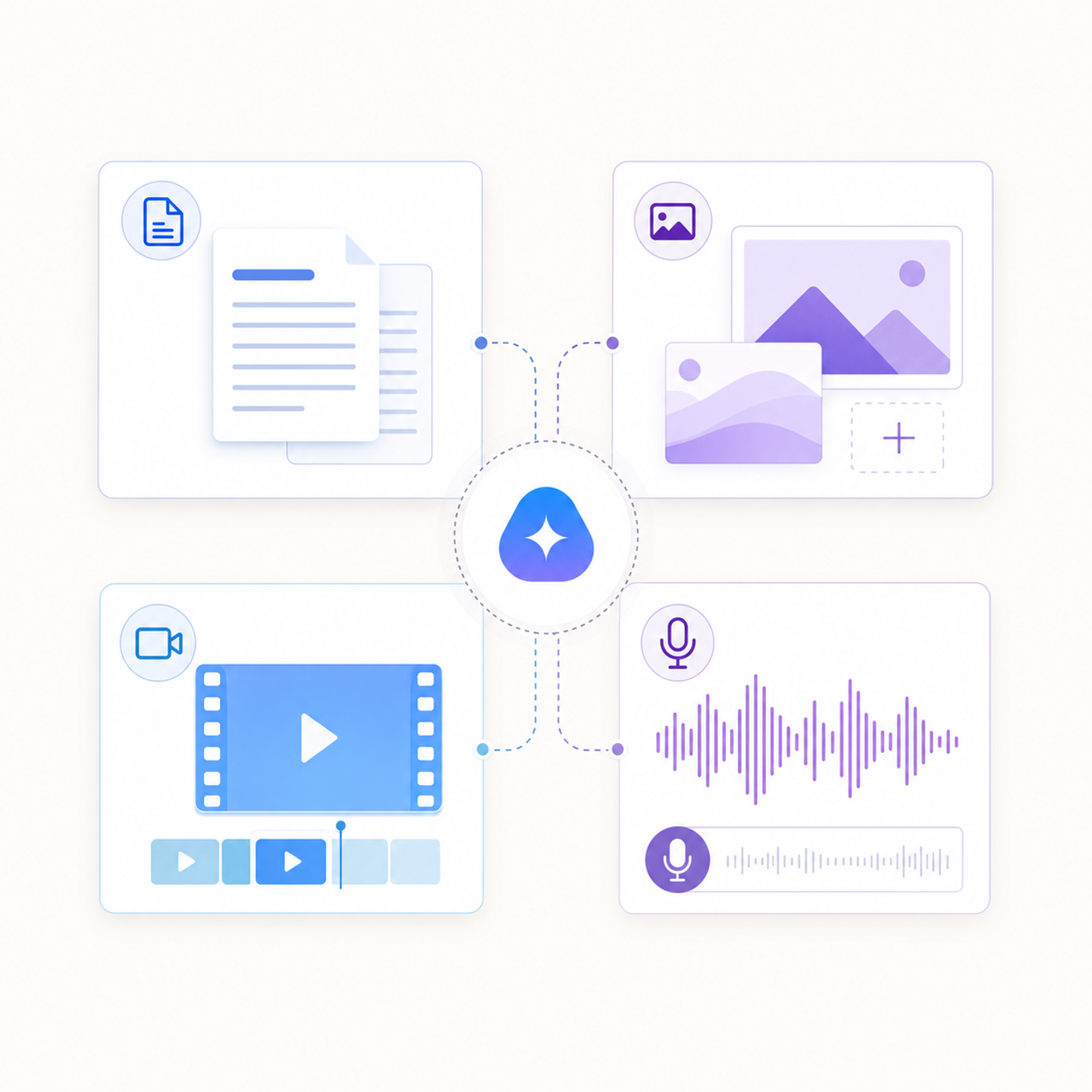
| Format | What it makes | Common use cases |
|---|---|---|
| Text | Articles, social copy, email, ad headlines | Blog drafts, captions, newsletters, product descriptions |
| Image | Graphics, photos, illustrations | Featured images, ad creative, social posts, infographics |
| Video | Text-to-video, clip editing, AI avatars | Short-form clips, explainers, talking-head spokesperson content |
| Audio | Voiceovers, podcast cleanup, music beds | Narration, dubbing, background tracks for video |
Text tools handle the heaviest lifting, since most campaigns run on words first. Image tools fill the visual gap when you don't have a designer on call. Video tools turn a script into watchable content without a camera or editor. Audio tools cover the voice work: narrating a clip, scoring it, whatever you need.
Pick the category that matches your current bottleneck.
AI Content Quality and the Google Question
Will Google penalize AI content? No. The correlation between AI content and ranking penalties sits at 0.011, near zero. Google penalizes low quality. The origin doesn't matter.
Editing matters. Unedited AI content performs 34% worse in AI search citations. Well-edited AI-assisted content performs 12% better than purely human work. That gap is the entire game.
A large share of business web content published in 2026 involves AI assistance. The teams winning aren't avoiding AI. They're reviewing every draft before it ships.
Building an AI Content Workflow (Step by Step)
The workflow most teams land on:
- Research: pull keywords, competitor angles, and customer questions to brief the draft
- Drafting: generate the first pass from that brief
- Editing: cut errors, add first-party detail, fix tone
- Optimization: structure for search and AI citations
- Distribution: publish and adapt for each channel
Set one approval gate before publish. A single editor signs off on accuracy, brand voice, and structure before anything goes live.
Then track performance per piece (rankings, citations, engagement) and feed what works back into your brief template, so the next round of drafts starts from a sharper starting point.
The Human Layer: What AI Can't Replace
A model hands you a starting point. It doesn't know your customer's real objections, the angle no competitor has tried, or whether a claim holds up.
Where you stay in charge:
- Original strategic angles the training data has never seen
- Fact-checking, since models state wrong things with full confidence
- Brand voice that reads like you, not the average of the internet
- Emotional resonance and the ethical call on what's worth publishing
Treat the output as a draft, never a decision. The model gets you to 70% fast. The last 30%, the part that makes anyone care, is still yours.
Common Pitfalls When Scaling AI Content
Scaling breaks teams in predictable ways:
- Publishing unedited output, which tanks citation performance and erodes the trust signals that drive rankings
- Letting brand voice drift as volume climbs, so every piece reads like it came from a different writer
- Ignoring engagement signals that flag content nobody wants, then doubling down on formats that already fell flat
- Skipping first-party data, leaving you with generic copy your competitors already published
Catch these early and volume works in your favor.
Maintouch: The System of Action for AI-Powered SEO and Content
Most AI writing tools stop at the draft. That leaves you holding the whole stack yourself.
I built Maintouch to handle the whole stack. Agents build strategy, write content optimized for traditional rankings and AI citations in ChatGPT, Claude, Perplexity, Google Gemini, and Google AI Overviews, push technical fixes through your CMS, and run backlink procurement. A self-learning engine watches every human edit and updates your brand voice and knowledge base, so output sharpens over time.
What makes content rank is the input:
- Knowledge: your docs, brand guidelines, and product context
- Customer signals: CRM data and sales call recordings, capturing the language buyers actually use
- Competitor signals: Reddit, G2, Capterra, and review sites
- Search and analytics data: Search Console, GA4, Semrush, Ahrefs
That first-party context separates content people cite from the generic stuff your competitors already shipped.
Every account gets a dedicated strategist. Regular standing meetings to align on priorities, review results, and steer execution. The agents do the work. Time commitment from your side: roughly 15 to 20 minutes per week.
Final Thoughts
The draft is fast. The edit is what matters. AI gives you a head start, but the last 30% is still yours to shape: context, fact-checking, brand voice, the judgment calls that separate cited content from noise.
If you need a system that connects strategy to execution without shipping generic output, bang my line.
FAQ
Can I build AI content workflows without hiring a writer?
Yes. AI handles drafting, you shape the output through editing. One editor manages what used to take multiple writers. You still need judgment for fact-checking, brand voice, and strategic angles the model can't see.
AI-generated content vs human-written content for SEO performance?
Unedited AI content performs 34% worse in AI search citations. Well-edited AI-assisted content performs 12% better than purely human work. The editing gap is the game.
Google penalizes low quality regardless of origin. The correlation between AI content and ranking penalties sits at 0.011, near zero.
What's the best AI-powered content creation tool for B2B SEO?
Maintouch if you need the full stack: strategy, content optimized for traditional rankings and AI citations in ChatGPT, Claude, Perplexity, Google Gemini, and Google AI Overviews, technical fixes, backlinks, and reporting.
Text-only tools like Jasper or Copy.ai work if you already have SEO strategy handled and just need drafting speed. Pick based on whether you're buying a writing assistant or replacing your entire growth team.
How long does it take to see ranking improvements from AI content?
For new content, most sites see meaningful organic traction within roughly 6 to 9 months from day one, depending on site age, crawl budget, and competitive pressure. Refreshes on existing URLs can move faster, once the page is recrawled and reindexed.
Speed comes from volume and consistent publishing cadence, not individual piece performance.
What should I look for in free AI tools for content creation?
Check whether the tool connects to live search data or just predicts from training cutoff dates. Free tiers usually cap output volume or lock features like SEO optimization and multi-format support.
If you're testing workflows, free works. If you're scaling production, you'll hit limits fast and need either paid seats or a system that handles distribution and optimization beyond the draft.
How do I start building an AI content workflow from scratch?
Start with research. Pull keywords, competitor angles, and customer questions to brief your draft. Pick one text generation tool for the first pass, then set one approval gate before publish where you fact-check, fix brand voice, and cut errors.
Track performance per piece and feed what works back into your brief template.
Which AI tools handle video and image content, not just text?
Image tools like Midjourney and DALL-E generate graphics from text prompts. Video tools turn scripts into clips, handling editing, avatars, and voiceovers without a camera. Audio tools cover narration and podcast cleanup.
Match the tool category to your current format bottleneck. Most text generators don't cross into visual or video production.
How do I measure if my AI content is actually performing?
Track citation performance in AI search engines like ChatGPT and Perplexity alongside traditional ranking position and organic traffic.
Well-edited AI-assisted content performs 12% better in citations than purely human work, while unedited AI content performs 34% worse. The gap between edited and unedited output tells you whether your review layer is working.
Do I still need a content team if I'm using AI tools?
You need editors, not a full writing team. One editor manages what used to take multiple writers. You still need human judgment for fact-checking, brand voice, strategic angles, and the call on what's worth publishing.
The drafting bottleneck disappears.
Can I use AI to refresh old content that's losing rankings?
Yes. Refreshed content tends to regain rankings once Google recrawls and reindexes the page. Feed the old post into your AI tool with a brief on what changed in your product, market, or competitive environment, then edit for accuracy and current relevance.
The model speeds up the rewrite, but you still own verifying facts and updating examples.
What's the difference between AI writing tools and AI-powered content creation platforms?
AI writing tools like Jasper or Copy.ai handle text drafting and stop there. AI-powered content creation systems cover multiple formats, distribution, and optimization beyond the draft.
Maintouch goes further by executing strategy, technical fixes, and backlink procurement as a full growth marketing team. Pick based on whether you need a drafting assistant or the entire stack automated.
How much should I budget for AI content tools versus hiring writers?
Hiring writers, editors, and strategists stacks up fast. AI tools with paid seats typically range $50-200/month for text generation alone.
Systems handling the full stack from strategy to backlinks replace the entire writer-editor-strategist cost structure, beyond simply the drafting line item.
How much time should I spend editing AI-generated content before publishing?
Plan for the last 30% of effort after the model hands you the draft. The model gets you to 70% fast, but publishing unedited output tanks citation performance by 34%.
The editing layer is non-negotiable.
Turn search into your best growth channel.
Maintouch tracks your visibility across AI and Google, creates and refreshes content, and gets your brand mentioned on the sites that shape discovery.
Book a demoRelated reading
All posts