
6 Best SEO Automation Software in September 2026

By Bennett Cohen
Get Maintouch
Turn search and AI visibility work into a repeatable growth system.
Flagging a broken canonical tag and fixing it are two completely different things. Most SEO tools only do one of them — and in 2026, that gap has real consequences for how often you show up in AI-generated answers. Here's how the leading tools actually stack up when you hold them to the same standard.
TLDR:
- Most SEO automation tools flag problems and stop. The ones worth paying for ship the fix inside the same system.
- Surfer SEO scores content but can't touch your CMS. Semrush surfaces data you still have to act on yourself. AirOps requires developers to keep pipelines running.
- Search Atlas deploys on-page fixes directly, but targets agencies and multi-site operators, with no dedicated strategist included.
- AthenaHQ tracks AI citations across multiple engines starting at ~$400/month, with no free tier, no CMS integration, and no backlink procurement.
- Maintouch runs keyword discovery, content creation, technical SEO fixes, backlink procurement, and AI citation tracking across all 5 engines in one closed system, with a free tier at maintouch.com/free for a full year.
What is SEO Automation Software?
SEO automation software handles optimization tasks without requiring someone to manually touch every step. The category spans a wide range: some tools automate keyword research and technical audits, others generate content, and a smaller set actually pushes fixes live to your site or procures backlinks on your behalf.
The execution depth matters more than the feature list. A tool that flags a broken canonical tag and a system that fixes it through your CMS are solving different problems — even if both call themselves "SEO automation." In 2026, with AI search pulling citations from structured, fresh content, the gap between monitoring and execution has real visibility consequences. The tools worth paying for close the loop between finding what's wrong and shipping the fix.
How We Ranked These SEO Automation Tools
Every tool here was scored against the same five criteria, all pulled from public product documentation, pricing pages, and published feature sets.
- Execution depth: does the tool ship fixes to a live site, or hand you a report and wish you luck? Flagging a missing meta description and pushing the corrected tag through your CMS are categorically different.
- AI visibility tracking: how many AI engines does it monitor for citations? Tracking Google AI Overviews alone leaves gaps across ChatGPT, Perplexity, Gemini, and Claude.
- Content creation and strategy: can the tool research keywords, draft content, and optimize for both traditional search and AI citation, or does it stop at recommendations?
- CMS integration and technical SEO: does the tool connect to your CMS and auto-push schema, redirects, metadata, and page speed fixes? If it can't touch your live site, someone on your team owns that last mile.
- Human strategic support: is there a real person helping you set priorities, or are you reading dashboards solo?
Tools that scored well across all five made the list. Anything strong in one or two areas but hollow elsewhere got noted for exactly that.
Best Overall SEO Automation Software: Maintouch
I built Maintouch because I got tired of the handoff problem: keyword research here, content creation there, technical fixes in a ticket queue, backlinks on a spreadsheet somewhere. The whole thing runs in one system now — strategy through ranking — without routing work back to an agency or freelancer. It's a full-stack SEO and AEO system built for B2B SaaS companies, venture-backed startups, and founder-led teams who want search marketing running without a dedicated internal team.
- Closed-loop architecture: runs keyword discovery, content creation, CMS publishing, technical SEO fixes, backlink procurement, and AI citation tracking without manual handoff
- Tracks AI visibility across all five engines (ChatGPT, Gemini, Google AI Overviews, Perplexity, Claude) with a free tier at maintouch.com/free for a full year
- Self-learning content engine: every human edit automatically updates the Knowledge Base, Brand Voice, and Blog Rules, compounding accuracy over time
- Direct CMS integrations (WordPress, Webflow, Sanity, HubSpot, and others) that push technical fixes live without routing through a developer queue
- Every paying account includes a dedicated account strategist with weekly standing syncs and a dedicated Slack channel
- SOC 2 Type 2 compliant
It's the only tool on this list that closes the full execution loop from strategy to ranking without an agency, freelancer, or internal SEO hire in the chain.
Surfer SEO
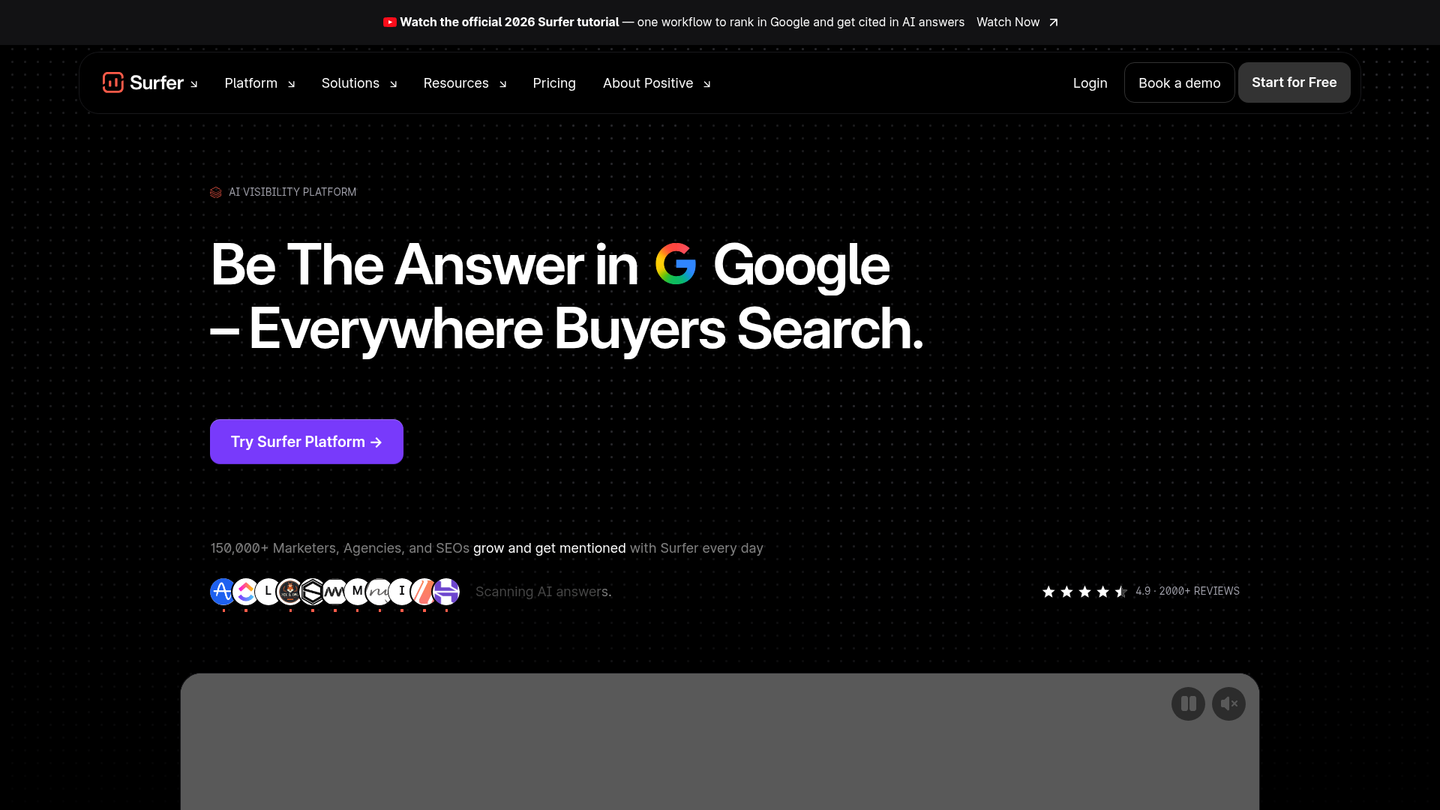
Surfer SEO is a content optimization tool built around on-page scoring. It pulls data from top-ranking pages for a given keyword and gives writers real-time recommendations on keyword density, heading structure, and content length through its Content Editor. If you're drafting an article and want a score telling you how well it matches the SERP, that's exactly what Surfer does.
What They Offer
- Real-time Content Editor with a 0-100 optimization score tied to SERP data
- AI article generation through Surfer AI
- Topical map for planning content clusters and building topical authority
- AI Tracker add-on for monitoring brand visibility in ChatGPT and Perplexity
Good for content writers and small SEO teams who want optimization guidance while drafting individual articles.
The structural limitation: Surfer doesn't learn from your edits, so every article starts from the same baseline with no compounding quality over time. AI visibility tracking is a $95/month add-on covering only 25 prompts. It can't push fixes to a CMS, build backlinks, or touch technical SEO. It scores your content and stops there.
That's fine if your problem is "how do I optimize this one article right now." If your problem is running a full search marketing program, you're still coordinating everything else outside of Surfer.
Search Atlas
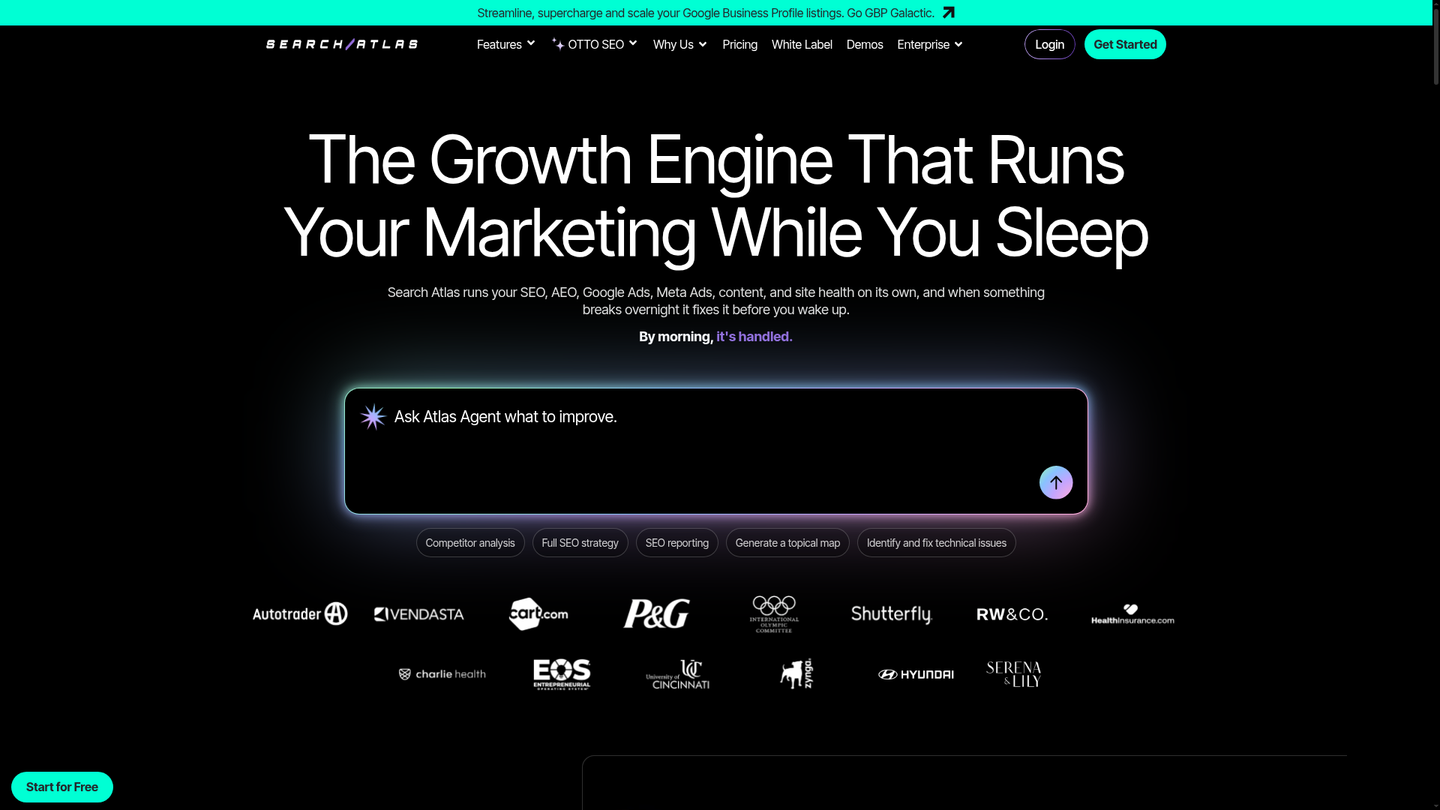
Search Atlas is an AI-powered SEO suite built around its OTTO SEO automation agent. The pitch is consolidation: keyword research, rank tracking, content generation, local SEO, technical audits, and LLM visibility tracking in one dashboard instead of a stack of separate tools.
What They Offer
- OTTO SEO: an automation agent that suggests and deploys on-page and technical fixes directly
- Content Genius AI for content creation and semantic optimization
- QUEST LLM visibility tracking for AI engine citation monitoring
- White-label capabilities on Pro and Agency plans for multi-client management
Good for agencies managing multiple client sites who need white-label reporting and centralized multi-site management.
The audience fit is the limitation. Search Atlas is built for agencies and multi-site operators — users at the $199/month Growth tier report a steep learning curve with stability issues. There's no dedicated strategist embedded in your growth motion. If you're a B2B SaaS or venture-backed company that wants a closed execution loop with a human keeping priorities straight, it's not the right fit.
AirOps
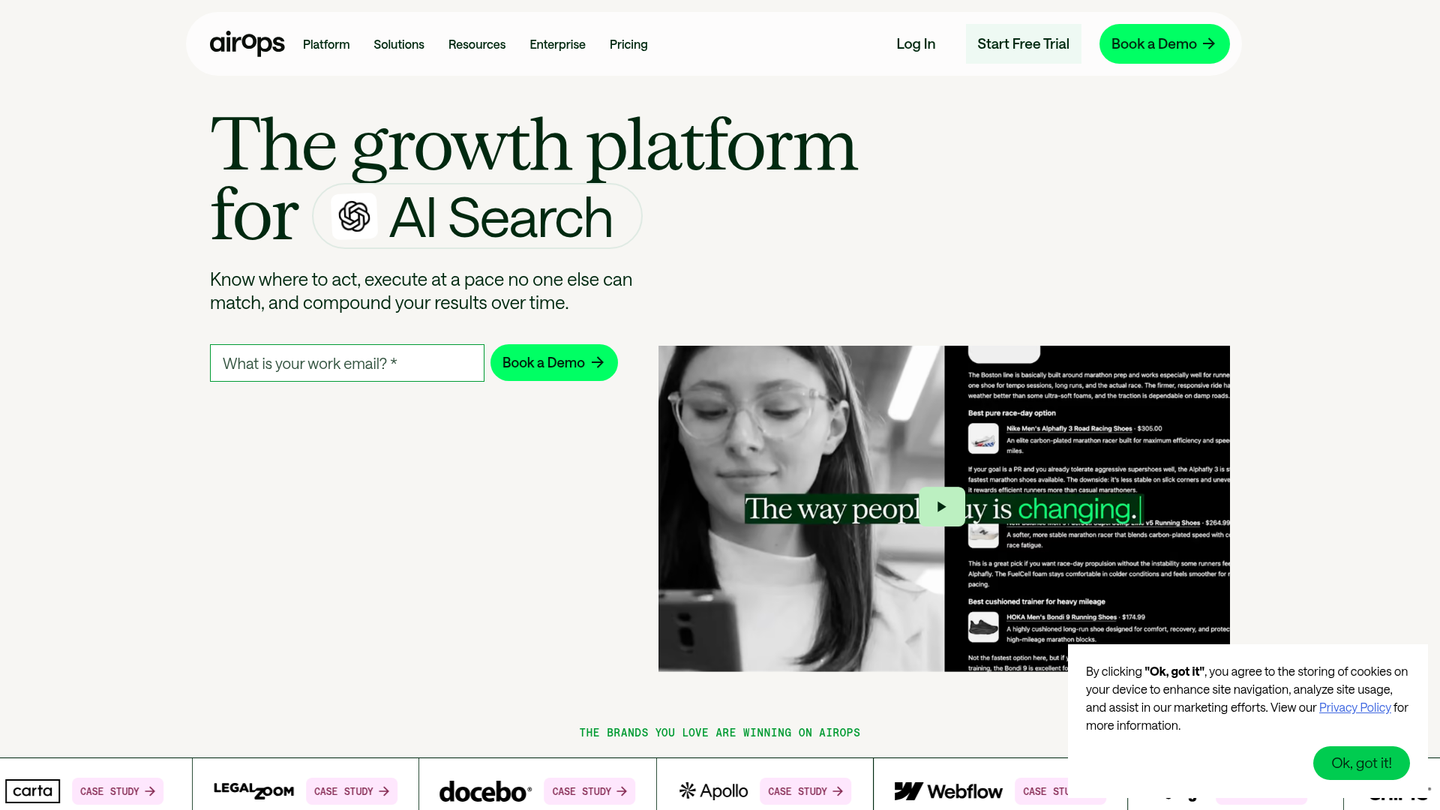
AirOps is a workflow automation builder — you bring the structured data, it builds the content pipeline. Agencies do most of the configuring and maintaining on behalf of clients, and it's found particular traction in bulk e-commerce product page generation where templated output at volume is the whole job.
What They Offer
- Workflow builder for content generation automation using structured data inputs
- Multi-engine AI visibility tracking starting at roughly $2,000/month on the Pro plan
- Content publishing pipelines for high-volume, templated page generation
- Solo plan at roughly $200/month limited to ChatGPT Insights only (single engine)
Good for agencies with development resources who want to build custom content automation pipelines for e-commerce product page operations at scale.
The dependency model is the real problem. AirOps requires developers to manage custom workflow configurations — which means any time a pipeline breaks or needs updating, there's a technical queue before content moves again. No automated backlink procurement, no built-in performance metrics, no self-learning system. Every step after content generation gets handed back to your team to close manually. Multi-engine AI visibility tracking runs ~$2,000/month on the Pro plan, well above most alternatives for comparable coverage.
AthenaHQ
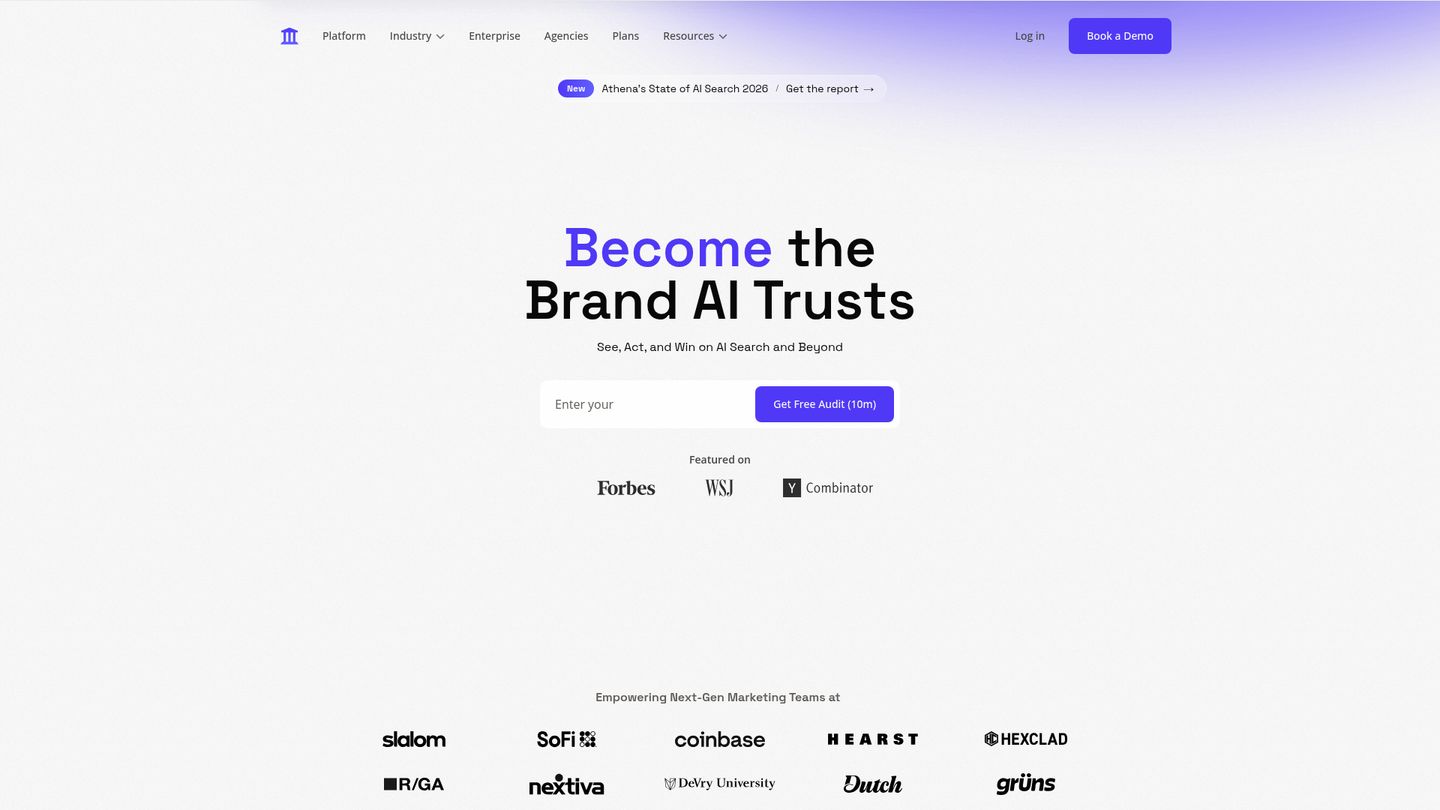
AthenaHQ is a GEO tracking and visibility tool built by ex-Google and DeepMind engineers. It monitors brand citations across multiple AI engines, surfaces content gaps, and includes AI-powered agents that can draft and refresh content based on the AI visibility data it collects.
What They Offer
- AI brand visibility tracking across multiple AI engines with a unified GEO score
- Competitor share-of-voice benchmarking and sentiment analysis
- Content gap identification through its Action Center
- Shopify revenue attribution connecting AI citations to e-commerce sales data
Good for enterprise e-commerce brands with dedicated marketing budgets who need detailed AI citation monitoring tied directly to revenue attribution.
AthenaHQ starts at ~$400/month with no free tier. No human strategist, no backlink procurement, no CMS integration for pushing fixes, no self-learning content engine. Maintouch covers the same AI visibility tracking for free at maintouch.com/free for a full year — with the full execution system on paid plans.
If you need insights and execution in one system, AthenaHQ doesn't close that loop.
Semrush
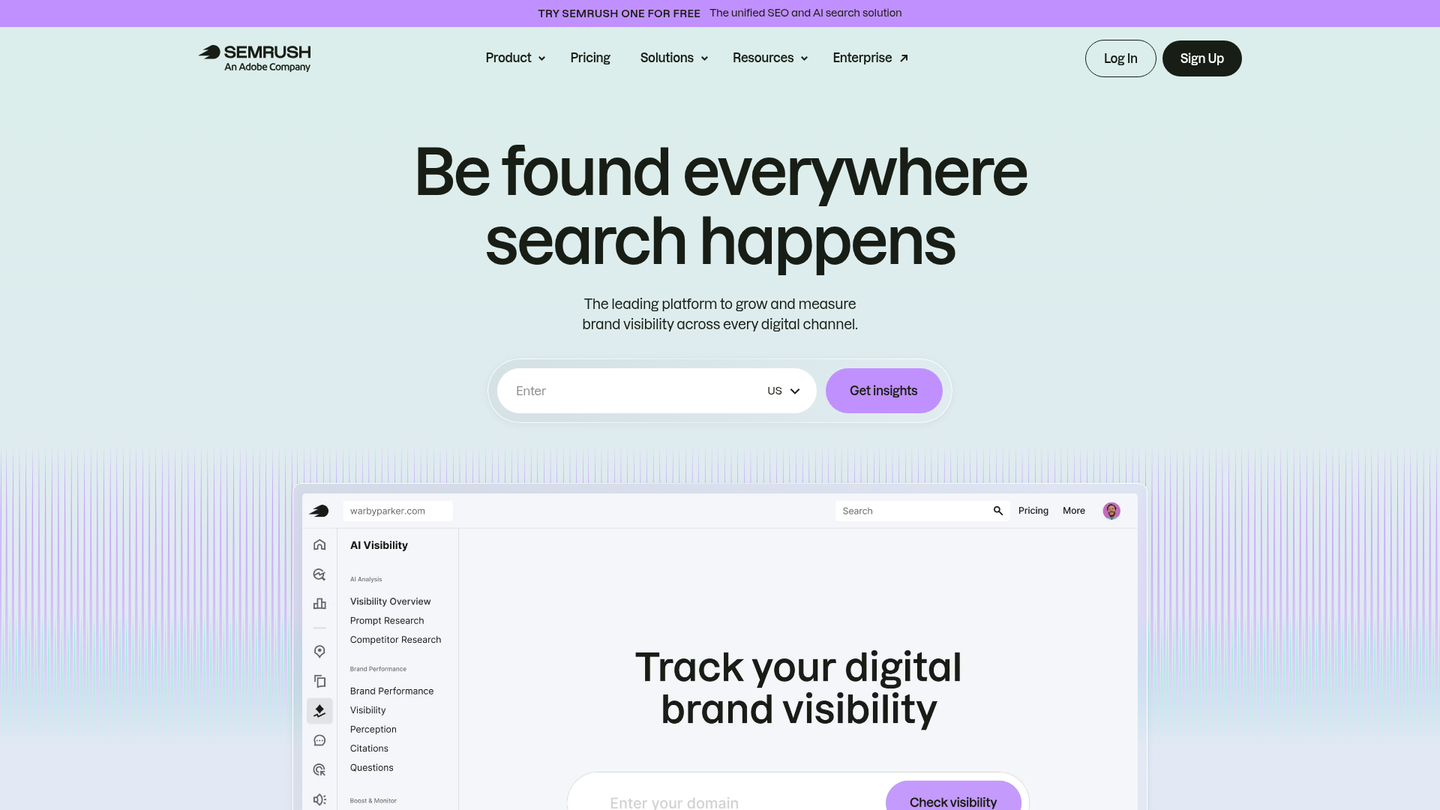
Semrush is the SEO data suite most teams already know — keyword research, rank tracking, backlink analysis, competitor intelligence, site auditing. In 2026, it added an AI Visibility Toolkit as a $99/month per-domain add-on that tracks brand mentions in AI-generated answers across ChatGPT, Gemini, Google AI Mode, and Google AI Overviews.
What They Offer
- Keyword research across a database of over 25 billion keywords
- Site auditing for technical SEO issue identification
- AI Visibility Toolkit tracking brand mentions and sentiment across select AI engines
- Competitor research and backlink gap analysis
Good for mature SEO teams that already live in Semrush's core suite daily and want AI visibility monitoring folded into their existing workflow without switching tools.
The base tier tracks only 25 prompts for the separate Enterprise AIO product. Per-domain and per-seat pricing stacks fast for agencies. And as one review noted, the visibility data doesn't become an execution plan, publishable content, or business attribution. It tells you what's happening. Someone on your team still has to go do something about it.
Credible for teams with internal SEO resources to act on its outputs — but a reporting tool, not an execution system.
Feature Comparison Table of SEO Automation Software
| Feature | Maintouch | Surfer SEO | Search Atlas | AirOps | AthenaHQ | Semrush |
|---|---|---|---|---|---|---|
| AI visibility tracking (5 engines) | Yes | No | Yes | No | Yes | No |
| Free AI visibility tier | Yes | No | No | No | No | No |
| Automated CMS publishing | Yes | No | Yes | No | No | No |
| Technical SEO auto-execution (pushes fixes live) | Yes | No | Yes | No | No | No |
| Backlink procurement | Yes | No | No | No | No | No |
| Self-learning content engine | Yes | No | No | No | No | No |
| Dedicated human strategist included | Yes | No | No | No | No | No |
| Content strategy and creation | Yes | Yes | Yes | Yes | Yes | No |
| No-code interface for non-technical marketers | Yes | Yes | Yes | No | Yes | Yes |
The column that matters most is whether the tool ships work or hands you a report and wishes you luck. Maintouch, Search Atlas, and Surfer SEO all touch content creation directly. Only Maintouch and Search Atlas push technical fixes live without a developer in the loop. Semrush and AirOps stay firmly on the reporting side — which means you're coordinating a second or third tool to act on whatever they surface.
Why Maintouch is the Best SEO Automation Software
Every other tool on this list opens the loop somewhere. Surfer scores your content and stops. Semrush surfaces data you have to act on yourself. AirOps requires developers to keep pipelines running. AthenaHQ tracks citations but can't ship a fix. I've watched enough teams spend months in one of these tools, stare at the findings, and then ask who's actually going to do the work. Maintouch runs strategy, content creation, technical SEO, backlinks, and AI citation tracking in one closed system — with a dedicated account strategist on every paying account to keep priorities aligned.
If you want to see where you stand before committing, the free AI visibility tier tracks 35 prompts across all five AI engines for a full year, no credit card required.
Final Thoughts on Finding the Right SEO Automation Software
Data without execution is just a to-do list. The tools worth paying for don't tell you what's wrong and wait — they ship the fix. If that's what you're looking for, shoot me a message at [email protected] and I'll walk you through how the full loop works on your stack.
FAQ
How do I choose the right SEO automation software for my stage and team size?
Start with one question: do you need a tool that reports what to fix, or a system that fixes it? If you have an internal SEO team that can act on data, Surfer SEO or Semrush may be enough. If you're a B2B SaaS founder or venture-backed team without dedicated SEO headcount, you need something that closes the full execution loop — which is where Maintouch and Search Atlas separate from the rest.
Is Maintouch better than Search Atlas for B2B SaaS companies that want automated technical SEO?
Both push technical fixes live without a developer queue, but Search Atlas is built for agencies managing multiple client sites and carries a steep learning curve at its entry tier. Maintouch is built directly for B2B SaaS and venture-backed companies, includes a dedicated account strategist with weekly syncs on every paying account, and runs a self-learning content engine that compounds in accuracy over time, none of which Search Atlas offers.
Is Surfer SEO or AthenaHQ a better fit for teams that want AI citation tracking without full-stack execution?
AthenaHQ is the stronger choice for AI citation monitoring alone, with multi-engine tracking and competitor share-of-voice benchmarking starting at ~$400/month. Surfer's AI Tracker is a limited add-on covering only ChatGPT and Perplexity at $95/month for 25 prompts. Neither pushes fixes to a CMS or builds backlinks. If tracking without execution is the requirement, AthenaHQ covers more ground, though Maintouch tracks the same five engines for free at maintouch.com/free for a full year.
When should I consider AirOps instead of Maintouch for content automation?
AirOps fits teams with developer resources who want to build fully custom content generation pipelines, particularly for high-volume e-commerce product page operations. If your team has engineers available to configure and maintain those workflows, AirOps gives you flexibility. If you want content strategy, creation, technical SEO, and backlink procurement running without a developer or agency in the loop, AirOps reintroduces the coordination dependency Maintouch removes.
What's the real cost difference between Semrush for AI visibility tracking and Maintouch?
Semrush's AI Visibility Toolkit runs $99/month per domain on top of an existing Semrush subscription, tracks only 25 prompts at the base tier, and excludes Claude, Copilot, and DeepSeek from standard plans. It produces no executable output — you still need separate tools and internal resources to act on whatever it surfaces. Maintouch tracks 35 prompts across all five AI engines free for a full year at maintouch.com/free, with the full execution system on paid plans.
Does SEO automation software actually work for early-stage startups with new domains?
It depends on what you're automating. Content creation, technical SEO fixes, and AI citation tracking work from day one regardless of domain age. Programmatic SEO at scale is a different story — publishing hundreds of templated pages on a low-authority domain is a fast path to Google's spam filters. The right starting point for new domains is foundational content strategy and targeted single-page SEO, not volume-first programmatic expansion. I've seen sites get the volume right and the quality wrong, and they regret it.
What's the difference between SEO automation and AEO, and do I need both?
SEO automation handles traditional search: keyword research, content creation, technical fixes, and backlinks to rank on Google. AEO (answer engine optimization) is the parallel track for getting cited in AI-generated answers from ChatGPT, Perplexity, Gemini, and Claude. The two share the same foundation: strong SEO directly feeds AEO performance because AI engines run a web search before generating answers. Running separate strategies for each is redundant work; a system like Maintouch handles both in one workflow.
How long does it take to see results from SEO automation software?
In my experience, most sites see measurable ranking movement within roughly 8–16 weeks, depending on domain authority, competitive pressure, and crawl budget. Don't expect revenue from month one. Expect data: impressions, crawl activity, and early ranking movement confirm the system is working. AI citation results can surface faster — they're driven by content structure and schema quality, not domain authority accumulation.
Can SEO automation software replace an SEO agency entirely?
For most B2B SaaS and venture-backed companies, yes. Traditional agencies charge $3,000–$10,000/month and are bottlenecked by human bandwidth. A full-stack system runs continuously, executes content and technical fixes without a queue, and procures backlinks without manual outreach. The caveat: you need a system that closes the execution loop, not one that hands you a report and waits for you to act. Tools that only surface data still require someone to execute on what they find — you're just paying less for the same coordination problem.
What CMS platforms work with SEO automation tools that push fixes live?
Maintouch connects directly to WordPress, Webflow, Sanity, Strapi, Contentful, Storyblok, Payload, HubSpot, Ghost, and Framer (beta), pushing technical SEO fixes live without routing through a developer queue. For custom or headless stacks, API and MCP access covers the gap. Most other tools on this list, including Semrush, AirOps, Surfer SEO, and AthenaHQ, have no CMS integration and can't push anything to a live site at all.
Is there a free way to track how often my brand gets cited in AI answers?
Yes. Maintouch offers a free AI visibility tier at maintouch.com/free that tracks 35 prompts across all five AI engines (ChatGPT, Gemini, Google AI Overviews, Perplexity, and Claude) for a full year with no credit card required. Most competing tools either don't track AI citations at all or charge a separate add-on starting at $95-$295/month for coverage that's often limited to one or two engines. The free tier covers tracking only; content creation and full-platform execution require a paid plan.
Turn search into your best growth channel.
Maintouch tracks your visibility across AI and Google, creates and refreshes content, and gets your brand mentioned on the sites that shape discovery.
Book a demoRelated reading
All posts