
5 Best AI Visibility Trackers [October 2026 Update]

By Bennett Cohen
Get Maintouch
Turn search and AI visibility work into a repeatable growth system.
I'm an engineer and marketer (and happen to run Maintouch too). I spend my days watching how AI systems cite the brands we work with.
There are a lot of tools in this space now, and most of them pitch the same thing: citation tracking, share of voice, AI coverage scores. Some of them deliver on it. A lot of them hand you a dashboard and stop there. I've tested most of them as a buyer, stress-tested the rest as a builder, and eventually built a product that competes with them. My goal: you walk away knowing exactly which tools close the loop and which ones hand you homework.
Let's get into it.
TLDR:
- Maintouch tracks all five engines free (35 prompts, one year, no credit card) and runs the full execution layer in the same system.
- AI visibility tracking measures citation frequency and share of voice across ChatGPT, Perplexity, Gemini, AI Overviews, and Claude: not rankings, presence.
- Most tools stop at reporting. The real question: does it ship content, fixes, and links, or hand you a dashboard and walk away?
- Claude is the engine most tools skip or gate behind premium tiers. It shouldn't be.
- Schema health is a binary qualifier for AI citation. One tool in this comparison automates monitoring and fixes. One.
What Are AI Visibility Tracking Tools?
Traditional rank tracking answers one question: where does your page sit on Google for a given keyword? Position 3, position 11, page two. Clean, numeric, easy to chart.
AI visibility tracking measures something else entirely. These tools watch how often, and in what context, your brand shows up inside the answers AI engines generate. The five that matter right now: ChatGPT, Perplexity, Google Gemini, Google AI Overviews, and Claude.
There's no ranked list to check. Ask Claude or Perplexity a buying question and the engine assembles an answer from multiple sources: it either names your brand or it doesn't. You're measuring citation frequency and share of voice against your competitors, across engines, for the prompts your buyers are actually typing. Your rank on Google tells you nothing about whether you show up in that answer.
How We Ranked AI Visibility Tracking Tools
Every tool here got measured against one organizing question: does it execute the work, or does it stop at telling you what's wrong? I'll come back to that in every write-up.
- Engine coverage. How many of the five (ChatGPT, Perplexity, Gemini, Google AI Overviews, Claude) the tool actually tracks. Claude is the one most tools skip.
- Prompt scale. Whether it handles a handful of prompts or runs thousands concurrently for real experiments.
- Competitor citation data. Does it show who else gets cited for your prompts, or only your own share of voice?
- Execution vs. reporting. Whether it ships content, fixes, and links, or hands you a dashboard and walks away.
- Schema health and technical SEO. Whether it monitors markup and pushes fixes, since schema is a binary qualifier for citation.
- Entry tier. Whether you can start free or have to commit budget blind.
Best Overall AI Visibility Tracking Tool: Maintouch
I built Maintouch because I kept watching brands get handed dashboards and told to figure it out. AI visibility tracking is part of it, running on top of a full SEO and best AEO tools system, not bolted on as a separate product.
- Tracking across all five AI engines: ChatGPT, Google Gemini, Google AI Overviews, Perplexity, and Claude. Copilot is excluded. Supports 1,000+ concurrent prompts for real citation experiments.
- A free tier at maintouch.com/free: 35 prompts tracked across all five engines for a year, no credit card. Claude coverage included, which competitors gate behind premium pricing.
- Fan-out query surfacing, so you see the sub-questions each engine breaks your prompt into, with Google ranking status checked for each.
- Competitor citation data on the same tracked prompts.
- AI sentiment monitoring and schema-to-content mismatch flags before they cost you citations.
- Automated schema generation, health monitoring, and updates via CMS webhook.
- A dedicated account strategist on every paying account, reachable through monthly syncs and a dedicated Slack channel.
- SOC 2 Type 2 compliance.
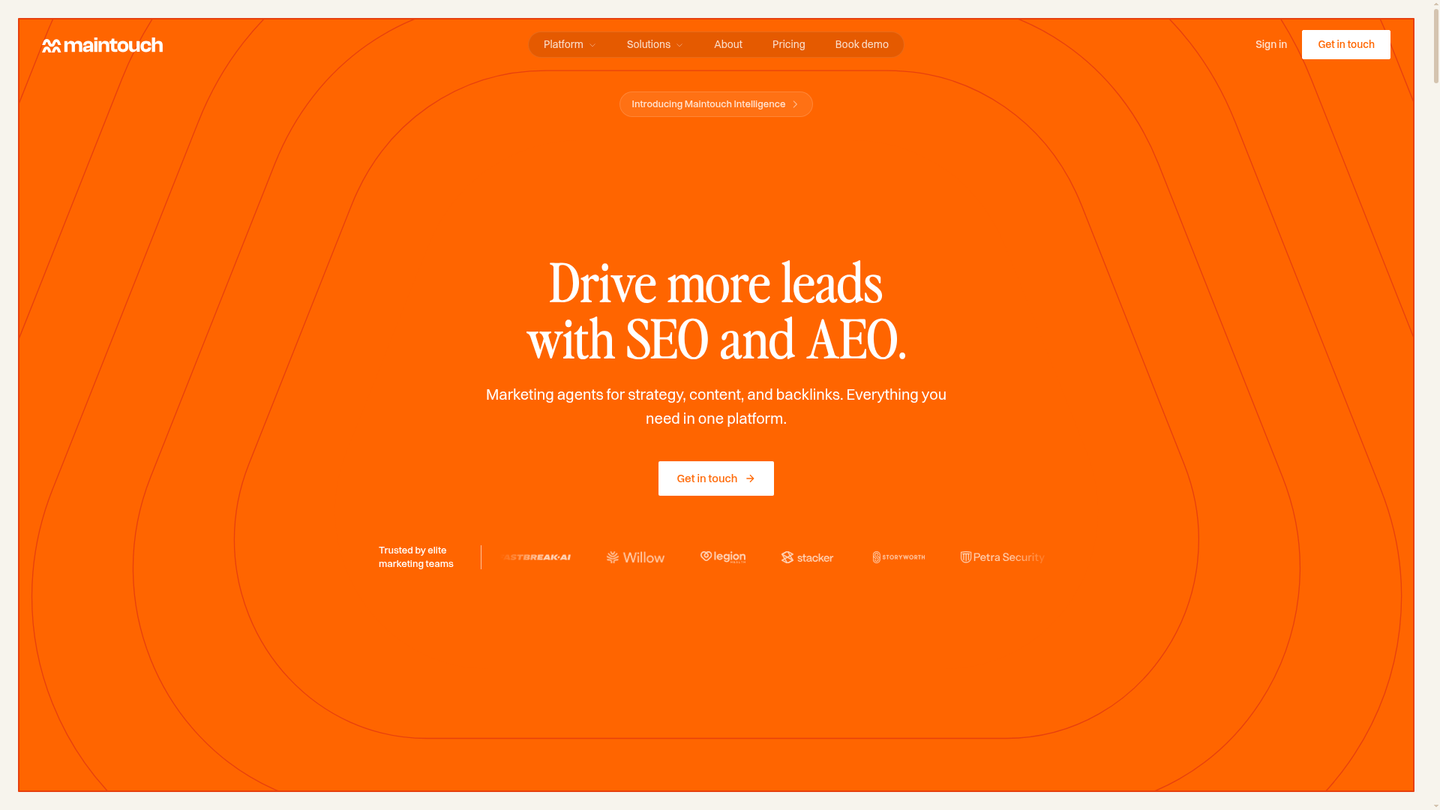
Bottom line: Maintouch is the only option here that pairs free AI visibility tracking across all five engines with the full execution stack (content strategy, content creation, technical SEO, backlinks, and a dedicated strategist) in one system. Tracking tells you the number. Maintouch moves it.
SEMrush
SEMrush built one of the largest SEO data platforms in the industry, with keyword research, site audit, backlink analytics, and competitive intelligence developed over years. In 2024 and 2025, it added AI visibility features through Brand Monitoring and its AI Toolkit to track when your brand appears in AI-generated answers.
- AI brand mention tracking across Google AI Overviews and select other engines via Brand Monitoring and AI Toolkit
- Keyword research, site audits, and backlink analytics at scale
- ContentShake AI for content creation and optimization suggestions
- Competitive research and share-of-voice data across organic search
Good for: teams already using SEMrush for traditional SEO who want to layer basic AI brand monitoring on top without adding another tool to the stack.
Limitation: SEMrush is a data platform. It surfaces what needs doing and stops there. AI visibility coverage skews toward Google AI Overviews; coverage across ChatGPT, Perplexity, and Claude is limited compared to purpose-built trackers. No CMS push for fixes, no backlink procurement, no dedicated strategist. You're buying a reporting layer, and someone still has to do the work.
Bottom line: SEMrush is the right call if your team can act on what it surfaces. If nobody is doing the execution, you're paying for a scoreboard nobody reads. Maintouch covers AI visibility free across all five engines and runs the execution underneath.
Orchly.ai
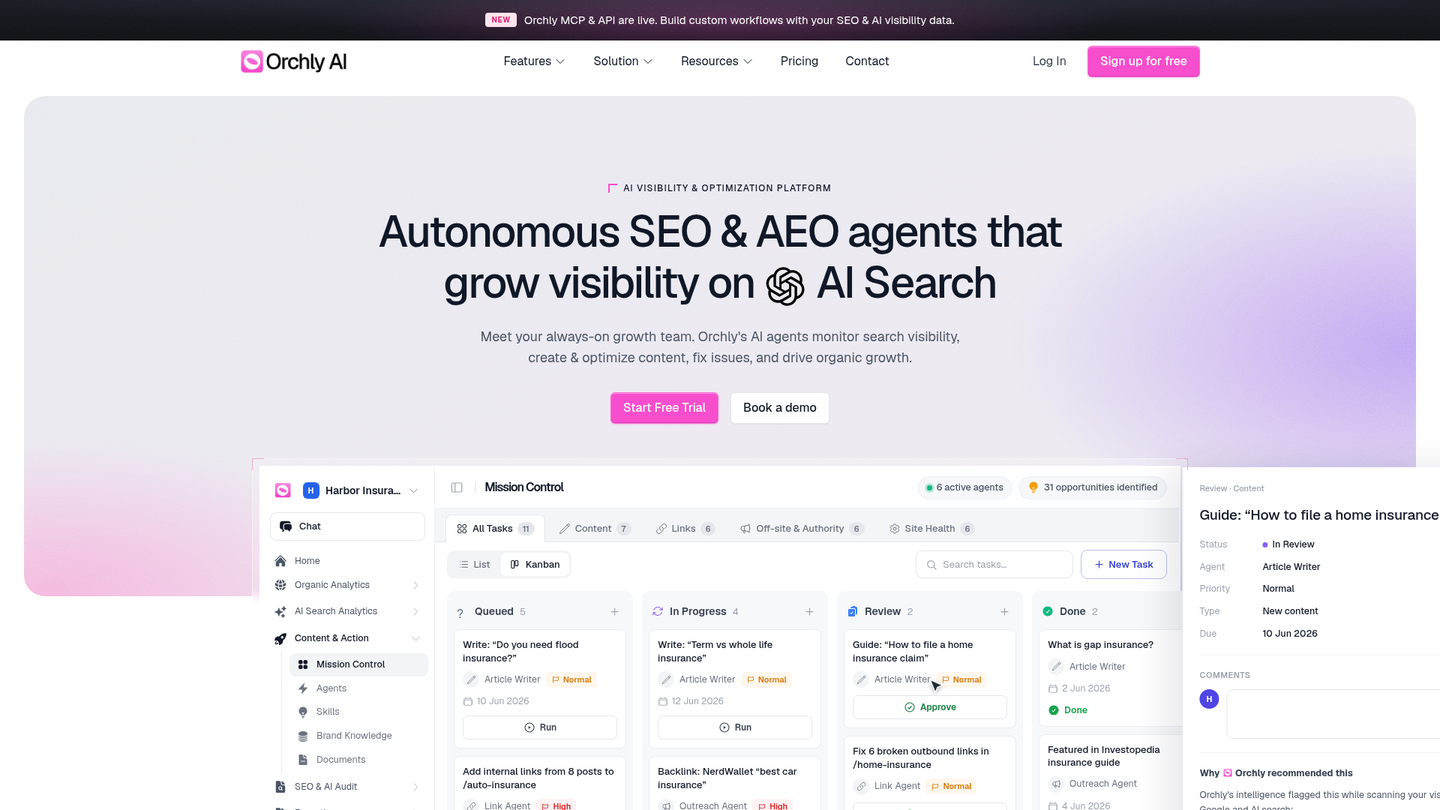
Orchly.ai is the closest thing in this list to a full-stack competitor. It's one of the best AEO tools that automates content creation, optimization, and visibility tracking across Google and the AI engines.
- Visibility tracking across ChatGPT, Claude, Perplexity, Gemini, and Google AI Overviews, with sentiment analysis
- AI content agents for strategy, creation, optimization, and publishing, with human-in-the-loop oversight
- Google Search Console integration reporting performance over 7, 30, and 90-day windows
- Automated content refresh when performance drops, schema updates included
Good for: content-heavy teams that want an automated production pipeline with basic visibility monitoring layered on top. The linked guide on getting cited in AI Overviews covers the execution side if you need it.
Limitation: the UI has real friction. Workflows require too many clicks and feel disjointed at scale. There's no dedicated strategist and no free tracking tier, so you're committing budget before you've seen a single citation data point.
Bottom line: Orchly.ai works for content-heavy teams who want an automated production pipeline with monitoring layered on. For B2B SaaS or venture-backed brands that need SOC 2 compliance, a dedicated strategist, and free citation tracking before they commit, Maintouch is the stronger fit.
Ahrefs
Ahrefs is one of the most respected SEO data platforms built, running on a proprietary web crawler and backlink index that a lot of practitioners treat as the benchmark for competitive link research. In 2024 and 2025 it added basic AI visibility features, tracking brand mentions in AI-generated answers alongside its traditional SEO data.
- Backlink analysis and competitor link profiling via one of the largest independent web crawler indexes
- Keyword research, rank tracking, and content gap analysis across organic search at scale
- Site audit covering technical SEO issues, metadata health, and structured data coverage
- Basic AI visibility monitoring for brand mentions in AI-generated responses, with limited engine coverage compared to purpose-built trackers
Good for: teams who need deep backlink intelligence and traditional SEO data, and want to layer basic AI brand visibility on top without adding a separate tool to the stack.
Limitation: Ahrefs is a data platform, and a genuinely strong one for what it is. The backlink index and keyword data are as good as it gets. AI visibility is a different story: the product is built around traditional organic search, and AI mention tracking is a light add-on, not a core capability. No CMS push for fixes, no content creation pipeline, no backlink procurement beyond surfacing opportunities. The data is solid. Someone still has to use it.
Bottom line: if your team has the execution capacity to act on what Ahrefs surfaces, it earns its keep as a data layer. If that capacity is thin, you're paying for a scoreboard. Maintouch covers AI visibility free across all five engines and runs the execution that moves the numbers.
Feature Comparison Table of AI Visibility Tracking Tools
Here's how the four stack up. The rows that matter most are the ones that go quiet fast.
| Feature | Maintouch | SEMrush | Orchly.ai | Ahrefs |
|---|---|---|---|---|
| AI engines tracked | 5 (ChatGPT, Gemini, AI Overviews, Perplexity, Claude) | Partial (Google AI Overviews primary) | 5+ | Partial (limited AI visibility, traditional search primary) |
| Free tier available | Yes (35 prompts, All engines, 1 year) | No | No | No |
| Competitor citation intelligence | Yes | Yes | Yes | Yes |
| Schema health monitoring and automation | Yes | Partial (audit reports, no CMS push) | Partial | Partial (audit reports, no CMS push) |
| Content creation and strategy | Yes | Partial (ContentShake AI) | Yes | No |
| Technical SEO execution | Yes | Partial (reports only) | Partial | Partial (reports only) |
| Backlink procurement | Yes | No | No | No |
| Dedicated account strategist | Yes | No | No | No |
| SOC 2 Type 2 compliance | Yes | Not publicly verified | No | Not publicly verified |
| Fan-out query tracking | Yes | No | No | No |
Read down the columns. Everyone tracks. Most report competitor share. Then the execution rows hit, backlinks, technical SEO, a dedicated strategist, fan-out tracking, and the field thins to one.
Why Maintouch Is the Best AI Visibility Tracking Tool
Every other tool here forces a compromise. You either pay for tracking and coordinate execution somewhere else, or you take a monitoring product and handle content, technical SEO, schema, and backlinks on your own. Either way, there's a seam you're managing.
Maintouch closes it. I built it to track AI visibility across all five engines for free, then run the full program underneath: content creation, technical SEO, automated schema, backlink procurement, and a dedicated strategist on every account. The tracking tells you the number. The execution moves it. Both live in one system.
Final Thoughts on AI Visibility Tracking Tools
I've watched enough teams pick a tracking tool, stare at the citation numbers for a quarter, and then ask who's actually going to do something about it. That's the real question. Every tool in this list gives you data. What separates them is whether that data becomes shipped work inside the same system, or hands off to a separate workflow you have to coordinate yourself. If you want the full picture on how to move that number, the answer engine optimization guide walks through the execution layer.
Monitoring tells you the score. Execution changes it. If you want a broader look at the tools that move the number, the best AEO tools roundup is a good next read. I've been doing SEO for over a decade and Maintouch serves hundreds of marketers running into exactly this problem. If you want to talk through what the execution layer looks like on your stack, reach out. I'll walk you through it.
FAQ
How do I choose the right AI visibility tracking tool from this list?
Start with one question: do you need a tool that tracks citations and hands you a report, or one that acts on them? If you have an in-house team already running content, technical SEO, and backlinks, a standalone tracker like SEMrush or Ahrefs may cover the gap. If you need the whole program to run, and most teams do, Maintouch is the only option here that closes the loop.
Is Maintouch better than SEMrush for AI visibility tracking?
For teams that need more than a data report, yes. SEMrush is a strong traditional SEO platform and its AI visibility coverage is real, but it skews heavily toward Google AI Overviews and stops at surfacing the data. Content execution, backlink procurement, and technical fixes are yours to coordinate separately. Maintouch covers all five AI engines free on the entry tier, runs the full execution program on paid plans, and includes a dedicated account strategist on every account.
When should I use Ahrefs or SEMrush as a standalone tool instead of a full-stack option?
Ahrefs and SEMrush make sense when your team already has strong execution capacity, in-house writers, technical SEO staff, and a link-building workflow in place, and you just need a solid data layer on top. Both are well-built platforms. The question is whether you have the people to act on what they surface. If you do, either earns its keep. If that capacity is thin, you're paying for insights that sit in a dashboard.
Does Claude coverage matter when picking an AI visibility tracking tool?
Yes, especially in enterprise B2B, where Claude is a default research tool for a lot of buyers. Several tools in this list either skip Claude entirely or gate it behind premium tiers, Profound, for example, gates Claude behind enterprise pricing. Maintouch includes Claude on the free tier at maintouch.com/free. No credit card, all five engines.
What's the difference between how SEMrush and Maintouch track AI visibility?
SEMrush tracks brand mentions in AI-generated answers primarily through Google AI Overviews, reporting on where you appear and where competitors do. It's a monitoring layer built on top of an existing SEO data product. Maintouch tracks citation share proactively by running prompts across all five engines, ChatGPT, Gemini, Google AI Overviews, Perplexity, and Claude, to show where your brand appears, where competitors get cited instead, and what fan-out queries each engine breaks your prompts into. Then it runs the execution to move that number.
What does "share of voice" actually mean in AI visibility tracking?
It's the percentage of relevant prompts where your brand gets cited, measured against your competitors. If AI engines answer 100 prompts about your category and your brand appears in 22 of them while your top competitor appears in 40, your share of voice is 22%. Tracking this across engines, not just Google, shows you where you're winning the citation game and where a competitor is quietly taking the answer instead.
How is AI visibility tracking different from traditional SEO rank tracking?
Traditional rank tracking gives you a position number for a keyword on Google. AI visibility tracking measures citation frequency, how often your brand is named inside AI-generated answers across ChatGPT, Perplexity, Gemini, Google AI Overviews, and Claude. There's no ranked list to check. You're measuring presence in the answer itself, not position on a results page. A brand can rank #1 on Google and still get skipped entirely in AI Overviews if its content isn't structured for citation.
Do I need to be tracking all five AI engines, or is Google enough?
Google is still the highest-volume channel, so Google AI Overviews matter most in raw traffic terms. But ChatGPT, Perplexity, and Claude are where a lot of top-of-funnel research happens, especially in B2B, where buyers use multiple AI tools before they ever run a branded search. If you're only tracking Google, you're missing a real slice of early consideration. Claude in particular is underserved by most tracking tools, which is why the Maintouch free tier includes it alongside the other four.
What is schema health and why does it affect AI citation?
Schema is structured markup, JSON-LD code on your page that tells AI engines and search engines exactly what the page is about. It acts as a binary qualifier: pages without clean, accurate schema are deprioritized before content quality is even evaluated. Schema health refers to whether your markup is present, error-free, and matches what's actually on the page. A price change that isn't reflected in your schema, for example, creates a mismatch that can suppress citations. Maintouch monitors schema coverage and automates fixes via CMS webhook on every publish or update.
Can a small team with limited content resources realistically improve their AI citation share?
Yes, and citation share is more about structure than volume. AI engines prefer self-contained passages that answer one question completely, formats like FAQ sections and comparison tables, and clean schema markup. A small team that fixes schema, restructures existing content into passage-level chunks, and tracks which prompts competitors are getting cited for can move the number without publishing dozens of new posts. Maintouch automates the schema and structural work, so the team's time goes toward strategy instead.
How do fan-out queries affect AI visibility, and how do I use them?
Fan-out queries are the sub-questions an AI engine generates internally before assembling an answer. When someone asks Perplexity "what's the best tool for tracking AI citations," the engine breaks that query into related sub-questions and pulls answers for each. If your content answers those sub-questions, you get cited. Maintouch surfaces the fan-out queries your tracked prompts generate and checks whether your pages rank on Google for each one, so you can see exactly where your content has a coverage gap versus a structure gap.
Is AI visibility tracking worth it for a brand that's still building its SEO foundation?
Start anyway. Tracking citation share surfaces which prompts your buyers are actually using in AI engines, and those prompts often map directly to content gaps you haven't addressed yet. You don't need page-one rankings to benefit from the signal. The free tier at maintouch.com/free covers 35 prompts across all five engines for a year, no budget required. SEO and AEO share the same foundation, fixing one strengthens the other.
Turn search into your best growth channel.
Maintouch tracks your visibility across AI and Google, creates and refreshes content, and gets your brand mentioned on the sites that shape discovery.
Book a demoRelated reading
All posts