
Should Series A Startups Use an AEO Tool or Agency? Sept 2026

By Bennett Cohen
Get Maintouch
Turn search and AI visibility work into a repeatable growth system.
Stop treating the AEO tool vs. agency question as a pricing comparison. The sticker prices are almost irrelevant once you factor in setup fees, contract lock-in, and the internal labor a monitoring-only tool quietly demands. The right answer comes down to one thing: how much execution capacity your team actually has right now. Most Series A teams only get clear-eyed about that number after they've already picked the wrong model.
TLDR:
- 73% of B2B buyers use AI tools in purchase research, making AEO a Series A priority before brand equity exists
- Choose an agency if you have zero internal execution capacity, a compliance-heavy vertical, or a hard launch window under 90 days
- Choose a self-serve tool if you have one person with 8-10 hours per week and need to move faster than sprint cycles allow
- A $400/month monitoring tool requiring 10 hours of weekly execution costs $3,600/month in labor before anything ships
- Maintouch runs citation tracking across ChatGPT, Gemini, Perplexity, and Claude with schema automation and CMS publishing in one system
What Answer Engine Optimization Actually Is (and Why It Differs from SEO)
SEO gets you ranked. AEO gets you cited. Different games, different rules.
When someone asks ChatGPT or Perplexity a question, those systems don't return ten blue links. They pull 3–5 sources, synthesize an answer, and name the brands they borrowed from. If you're not one of those sources, you don't exist in that response — regardless of where you rank on Google.
A few things actually drive citation wins:
- Passage-level content: self-contained blocks of roughly 130-170 words that answer one question directly, so AI crawlers can lift the answer without needing surrounding context.
- Schema markup that lets AI systems parse your page structure cleanly instead of simply indexing it. (See our answer engine optimization complete guide for a deeper breakdown of each mechanic.)
- Entity authority built through third-party mentions, so AI models recognize your brand as a credible source on a given topic.
- Structured formats like FAQ sections, comparison tables, and direct definitional answers placed under each heading.
The core mechanic is structural data quality, not ranking position.
Why Series A Is the Inflection Point for AEO Investment
Series A changes the math. A typical Series A runs $15,000 to $50,000 a month in marketing spend, and every dollar is being watched by a board that wants to see scalable demand before the next raise.
That pressure collides with an uncomfortable reality: 73% of B2B buyers now use AI tools in purchase research (per Loganix's 2026 multi-source analysis). Your buyers are already asking ChatGPT which tools to shortlist before they open a browser tab. The category narrative is being written right now by whoever earns citations first, and that window closes faster than most founders expect.
Early-stage companies can defer AEO because their sales motion is relationship-driven. Enterprise companies have brand recognition doing the heavy lifting. Series A sits in neither place. You need inbound demand to scale, but you don't yet have the brand equity that gets you cited by default. That's what makes this the right moment to get deliberate about AEO — and why the tool-versus-agency decision carries real consequences.
What an AEO Agency Delivers and What It Costs
Full-service AEO agencies typically cover citation audits, schema and entity optimization, third-party citation building across review sites and forums, and AI visibility reporting. On the content side, full-service shops run 20+ articles monthly, compared to the 4–8 you'd expect from a traditional SEO retainer.
Pricing is wide — most mid-tier engagements run $2,500–$20,000/month in retainer fees, carry setup costs of $2,500 to $12,000, and lock you into a 6–12 month contract before you see meaningful citation movement.
What you're buying is execution capacity and a team that already knows the citation mechanics. What you're not buying is speed or flexibility.
What an AEO Tool Delivers and What It Costs
Self-serve AEO tools generally cover prompt tracking across AI engines, citation share monitoring, schema health checks, and keyword gap analysis. Monitoring-only tools like AthenaHQ (around $400/month) or Meridian (around $350/month) surface where you're getting cited and where competitors are beating you. Useful data — but the remediation is still your job.
More full-featured tools add automated content creation, technical SEO fixes, and CMS publishing. Maintouch's Hypergrowth tier includes content agent workflows, automatic content updates, and backlink procurement at $799/month.
Self-serve tiers across the category run roughly $150 to $800/month. The real variable isn't price. It's execution depth. Most tools tell you what's broken. Fewer actually fix it.
The Execution Gap: Where Each Model Breaks Down
Both models have a failure mode. Knowing which one applies to your situation is the whole decision.
Where Agencies Break Down
Agencies are capped on bandwidth by design. Your retainer buys a slice of a team splitting attention across clients. When citation strategy needs to respond to a competitor's new content or a schema mismatch, you're waiting on a sprint cycle.
Worse, a lot of agencies are repackaging SEO deliverables under AEO branding. Same content calendar, same backlink outreach, new vocabulary. If an agency can't tell you how they measure citation share across ChatGPT, Perplexity, and Gemini separately — as separate numbers, not a blended figure — that's your answer.
Where Tools Break Down
Monitoring-only tools give you a dashboard, not a done thing. Seeing that a competitor is cited in 60% of your tracked prompts is useful exactly once. After that, someone has to write the content, update the schema, build the citations, and push it live.
If your team doesn't have that capacity, the tool just surfaces problems you can't act on. At Series A, headcount is thin and everyone is already overextended. That gap between insight and execution is where most self-serve AEO programs stall — and it happens quietly, because the dashboard always looks like it's working.
The True Cost Comparison for a Series A Startup
The sticker price is the wrong number to compare.

| Cost Category | Agency | Self-Serve Tool |
|---|---|---|
| Monthly fee | $2,500 to $20,000+ | $150 to $800 |
| Setup / onboarding | $2,500 to $12,000 | $0 |
| Contract lock-in | 6 to 12 months | Month-to-month |
| Internal time needed | Low | Medium-high |
| Execution headcount | Included | You provide it |
Agency math adds up fast. Setup fees, monthly retainer, and the coordination overhead of briefing an external team on your positioning every sprint. Some agencies expect you to hire a contractor alongside the engagement to get full value out of it — which adds another $3,000 to $6,000/month to the real number.
Tool math has its own hidden cost: your team's time. A $400/month monitoring tool that requires 10 hours a week of internal execution costs $3,600/month in labor at $90/hour for a senior marketer — before you've shipped a single thing.
Three variables worth modeling clearly:
- How much internal execution capacity does your team actually have, and can that realistically absorb the work a tool surfaces?
- Does the agency have AEO-specific measurement, or are they running SEO playbooks under a new name?
- Does the tool execute fixes, or hand recommendations back to you?
Run your own numbers against those three questions. The answer changes based on your headcount reality — not the headline price.
When an Agency Is the Rational Buy
Four conditions make an agency the rational call. Budget isn't one of them.
The first is zero internal execution capacity. If your team has no one who can write, update schema, or build citations, a monitoring tool just creates a backlog nobody clears. An agency ships the work.
The second is a compliance-heavy vertical. Healthcare, fintech, and legal AEO requires specialist knowledge: which claims you can make, which sources AI engines trust in those categories, and how to structure entity authority without triggering compliance problems. Most generalist hires can't do that on day one.
The third is a hard launch window. If you have 60 to 90 days before a product release and need citation coverage before competitors lock in the category narrative, an agency with an existing citation network can compress that timeline in a way a tool alone can't.
The fourth is a solo marketing function. If the founder is the only marketer — already carrying pipeline, product marketing, and demand gen — a self-serve tool requiring 10 to 15 hours a week of execution is a trap. The work won't get done.
When a Self-Serve Tool Is the Rational Buy
Four conditions flip the answer toward a tool.
The first is having an internal owner — one person who can spend 8 to 10 hours a week on AEO execution: reviewing content, approving schema updates, making editorial calls. A growth marketer or content lead fits. A founder already carrying five other jobs doesn't.
The second is iteration speed. Agencies move in sprint cycles. If your competitive position shifts, you're waiting on a briefing, a scope revision, and a production queue. A tool lets your internal owner respond the same week.
The third is brand voice control. Citation-optimized content has to sound like you, use your terminology, and reflect your actual product. External teams learn your positioning slowly, and when speed matters, handing content production to an agency creates a quality bottleneck that shows up directly in your citation share.
The fourth is ARR reality. A $10,000/month agency retainer is defensible at $3M ARR with strong unit economics. Below that, it consumes a disproportionate share of marketing budget before you've validated the channel.
One hybrid worth considering: a self-serve tool handling execution paired with a fractional AEO strategist for quarterly direction. You get the speed and cost structure of software with periodic expert input on citation strategy. That setup works well when your internal owner is capable but newer to AEO mechanics.
How to Vet an AEO Agency Before You Sign
Three questions cut through the noise faster than any pitch deck.
First: how do they measure citation share? Ask for a breakdown by engine — ChatGPT, Perplexity, Gemini, and AI Overviews separately, not a blended figure. If they quote keyword rankings as the primary metric, they're running an SEO engagement under an AEO label.
Second: are they cited themselves? Pull up their brand in Perplexity or ChatGPT before the second call. An agency that can't earn citations for its own services has no standing to promise them for yours.
Third: what's their content attribution model? You need to know which specific pieces of content drove citation movement — not just a quarterly report saying citation share went up.
Red flags worth walking away from:
- No schema audit in the onboarding scope. That means they're skipping the structural work that actually gets content pulled into AI responses.
- Reporting that shows domain authority but not citation share by engine. They're optimizing for a scoreboard AI doesn't read.
- Content deliverables that look identical to traditional SEO blog posts. No passage-level formatting, no entity optimization.
- Case studies that show traffic but not AI visibility outcomes. They can't prove the work moved the metric that matters.
Ask for a sample report from a current client. If it doesn't show prompt-level citation data across at least two AI engines, you're buying SEO with different terminology.
How to Vet an AEO Tool Before You Subscribe
Five questions worth running through before you commit to a trial.
Which AI engines are actually tracked? Coverage varies more than vendors admit. Some tools track Google AI Overviews only. Others add ChatGPT and Perplexity but omit Gemini and Claude. If your buyers are researching on Claude or Gemini and your tool doesn't cover those engines, you're blind to a real slice of your citation footprint.
Does it execute or just report? A tool that shows you a competitor is cited in 70% of your tracked prompts is useful once. After that, you need content written, schema updated, and fixes pushed live. Ask during the demo: can this tool push a schema fix directly to your CMS, or does it hand you a recommendation and stop there?
How deep is the CMS integration? Surface-level integrations export a CSV. Real integrations push metadata, schema, and canonical tags directly to your live site without a developer queue. Ask which CMS systems are natively supported and whether the tool can update existing pages — not just publish new ones.
Is schema automation included? Schema drift is one of the most common reasons sites lose AI citations without any obvious change in content quality. If a tool surfaces schema errors but requires manual fixes, you'll fall behind fast. Look for automated schema regeneration that fires on every publish or content update.
What makes the content citation-worthy? Generic AI output gets ignored — AI engines have already seen the same phrasing in training data. Ask how the tool infuses first-party data, whether it formats content at the passage level, and whether it supports structured formats like FAQ sections and comparison tables. If the demo content looks like a reworded Wikipedia entry, that's your answer.
What a 90-Day AEO Ramp Looks Like Under Each Model
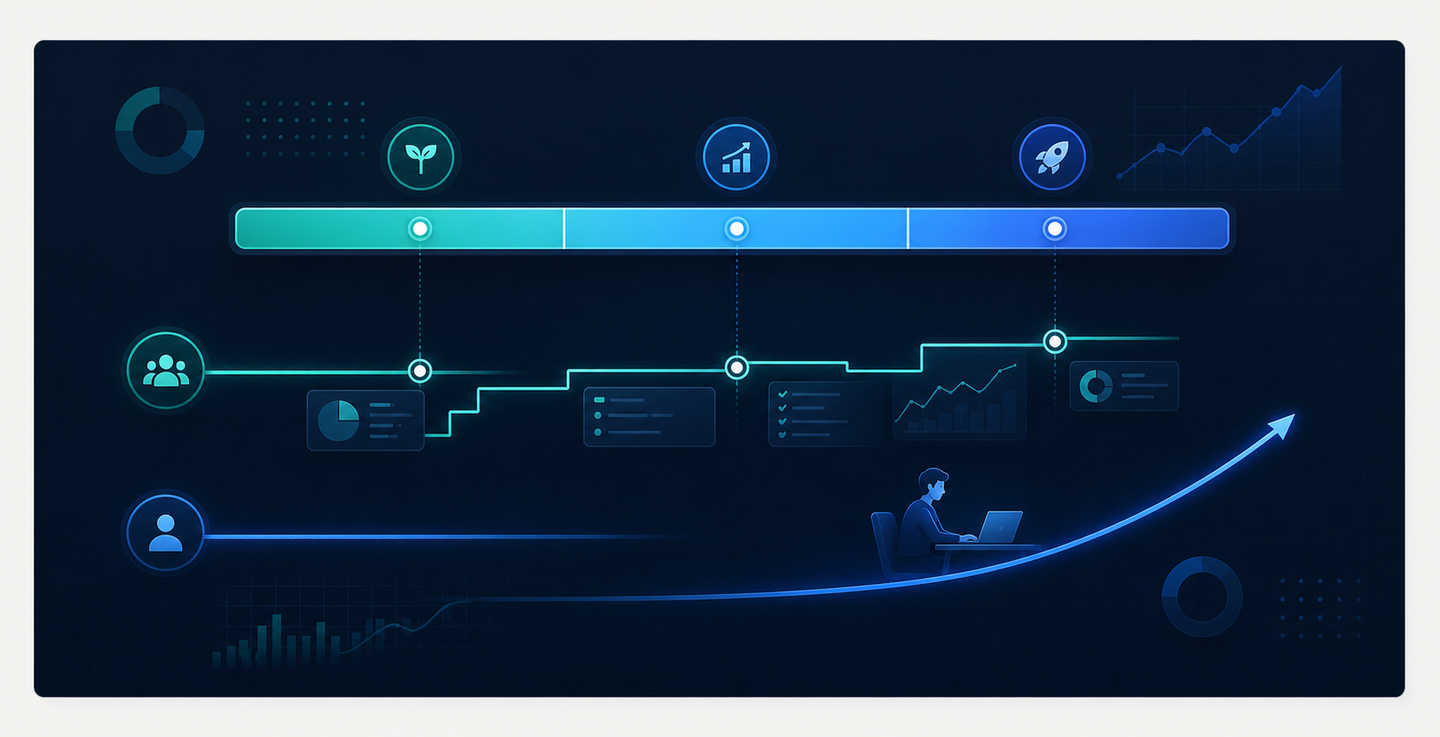
Both models require 60 to 90 days before citation share moves in any measurable way. The path there looks different, but the outcome window is roughly the same.
Agency Model
Month one is almost entirely diagnostic. Prompt-space mapping, schema audits, entity gap analysis, onboarding calls. No content ships until the roadmap is signed off. Month two is production: content written, citation building happening behind the scenes. By month three, if the agency built the right structured content and pushed schema correctly, you'll start seeing citation movement on your tracked prompts. Expect first measurable results between day 75 and day 90.
Self-Serve Tool Model
Setup is faster — sometimes under a week. But execution velocity depends entirely on your internal owner. If someone is actively writing, updating schema, and pushing fixes, you can compress the cycle and see early citation signals by week six. If the tool sits between competing priorities, month three looks the same as day one.
Don't expect revenue from month one under either model. Expect data: prompt impressions, crawler activity, early citation appearances on lower-competition queries. That's the signal the work is landing before the scoreboard catches up.
How Maintouch Approaches the AEO Tool vs. Agency Question
Human judgment matters most in strategy and editorial decisions. It matters least in production execution. Maintouch sits in the gap this post has been describing: past monitoring-only tools, short of a $10,000-plus agency retainer.
I built it for B2B SaaS and venture-backed teams at Series A who need full AEO execution without the coordination overhead of an external agency. Citation tracking across ChatGPT, Google Gemini, Google AI Overviews, Perplexity, and Claude — schema automation, content creation, technical SEO fixes, and backlink procurement — all run inside the same system. When a schema mismatch surfaces, Maintouch pushes the fix directly to your CMS. No developer queue, no agency sprint cycle.
The real comparison is labor cost. Replacing a full-time SEO employee, a content writer, or an agency retainer runs $200,000-plus annually. Maintouch starts at $149/month with a 5-day free trial. Teams that want a dedicated forward-deployed strategist embedded in their growth motion can move to the custom plan — same execution depth as an agency account team, without the contract lock-in or setup fees.
If you want to see how it fits your current setup, shoot me a message at [email protected].
Final Thoughts on Building Your AEO Strategy at Series A
I've watched enough teams spend three months running a monitoring tool, staring at the numbers, and then asking who's going to do the work. The category narrative for your product is being written right now. Whoever earns citations first has a real head start. Pick the model that matches your headcount reality — not the one with the better-looking pitch deck — and go execute.
FAQ
Semrush vs. Ahrefs vs. Maintouch: which actually moves the needle for a Series A B2B SaaS?
Semrush and Ahrefs give you data on AI Overviews but stop there: they can't push a schema fix to your CMS, write citation-optimized content, or build a backlink. Maintouch executes the full loop inside one system, which matters at Series A when your team is thin and the gap between insight and shipped work is where most AEO programs stall. If your real constraint is execution capacity and not information, a monitoring tool widens that gap instead of closing it.
How is an automated AEO platform different from hiring a freelance content person or a PR agency, and what does it actually cost?
A freelance content person writes; they don't track citation share across ChatGPT and Gemini, update schema on publish, or build backlinks. A PR agency builds mentions; they don't produce passage-level content formatted for AI retrieval. Maintouch starts at $149/month and runs the same scope autonomously, with a dedicated forward-deployed strategist included on the custom plan for teams that want ongoing human direction.
How do I get my brand cited in AI chatbot answers when people aren't searching directly for my product category yet?
Zero-volume queries are your signal. Queries showing one or two impressions in Google Search Console are what buyers are already typing into ChatGPT and Perplexity before they open a browser tab. Build self-contained passage-level content (130-170 words per block) that answers those exact questions directly, add FAQPage and HowTo schema, and get your pages mentioned on third-party sources AI engines already trust. That's the citation path when search demand in your category is still forming.
What is schema drift, and why does it cause brands to lose AI citations without any change to content quality?
Schema drift happens when content is updated but the structured data on the page isn't, leaving AI engines with a mismatch between the schema signal and the actual page. AI retrieval systems use that mismatch as a reason to deprioritize the page before content quality is even checked, so citation share drops even if the writing improved. Maintouch runs automated schema regeneration on every publish or content update, which closes the drift gap without requiring a developer or a manual review cycle.
AEO agency or self-serve AEO software: which is the right call for a Series A startup with a small marketing team?
The deciding variable is internal execution capacity, not budget. If one person can spend 8-10 hours a week writing, reviewing schema updates, and making editorial calls, a full-execution tool like Maintouch gives you faster iteration and better brand voice control than an external agency sprint cycle. If your team has no one who can absorb that work, a monitoring-only tool creates a backlog nobody clears, and an agency that ships the work becomes the rational call despite the higher cost.
How long does it realistically take for AEO work to start moving citation share?
Both agency and self-serve models typically require 60 to 90 days before citation share moves in any measurable way. Don't expect revenue from month one. Expect data: prompt impressions, crawler activity, and early citation appearances on lower-competition queries. That's the signal the work is landing before the scoreboard catches up. Timelines vary based on how competitive your category is and how consistently content is being published and updated.
What's the difference between AEO and SEO, and do I need to run both?
SEO gets you ranked on Google. AEO gets you cited inside AI-generated answers from tools like ChatGPT, Perplexity, and Gemini. The good news is they share the same foundation: strong SEO directly feeds AEO performance because AI engines run a web search under the hood before synthesizing answers. You don't need two separate programs, but you do need content structured at the passage level with schema markup, not just content optimized for keyword rankings.
Can I switch from an agency to a self-serve tool mid-engagement, or is the transition painful?
The transition is workable but requires a knowledge transfer window. The biggest friction is institutional context: a good agency has learned your positioning, your compliance requirements, and your content voice over months. A self-serve tool like Maintouch compresses that ramp because its self-learning engine builds brand voice and editorial rules from your existing content automatically. The practical move is to let the agency contract run out, extract the citation strategy, schema work, and content calendar they've built, and hand it to an internal owner who can continue execution with the tool.
What questions should I ask a self-serve AEO tool during the trial period?
Four things worth testing directly: whether the tool tracks citations across all five major AI engines (ChatGPT, Google Gemini, Google AI Overviews, Perplexity, and Claude), whether it can push schema fixes and content updates to your CMS without a developer queue, whether it surfaces the specific prompts your buyers are actually using in AI tools, and whether content it generates is formatted at the passage level rather than as generic long-form. A trial that only shows you a dashboard with competitor data isn't telling you whether the tool closes the loop or just opens one.
Is AEO only relevant for companies that already have strong SEO, or can early-stage startups benefit too?
Early-stage companies can benefit from AEO precisely because they don't yet have brand recognition doing the heavy lifting. AI engines cite based on structured data quality and entity authority, not just domain age. A Series A startup with well-structured passage-level content and clean schema can earn citations in AI-generated answers before it has a first-page Google ranking. The caveat: programmatic SEO at scale requires an established domain foundation, so early-stage teams should prioritize foundational content and schema work first before scaling output.
How do I know if an AEO agency is actually running AEO work versus repackaged SEO?
Ask for a prompt-level citation report broken out by AI engine: ChatGPT, Perplexity, Gemini, and AI Overviews separately. If they quote keyword rankings as the primary metric, or if their reporting shows domain authority without citation share data, they're running SEO under a new label. Also pull their own brand up in Perplexity or ChatGPT before the second call. An agency that can't earn citations for its own services isn't going to earn them for yours.
Turn search into your best growth channel.
Maintouch tracks your visibility across AI and Google, creates and refreshes content, and gets your brand mentioned on the sites that shape discovery.
Book a demoRelated reading
All posts