
6 Top Content Marketing Tools in September 2026

By Bennett Cohen
Get Maintouch
Turn search and AI visibility work into a repeatable growth system.
Most content marketing tools stop at the suggestion layer. They score your draft, flag your gaps, surface your keyword opportunities — and then hand everything back to you. This list is organized around one question: does the tool ship the work, or hand you a to-do list?
TLDR:
- Most content marketing tools stop at the suggestion layer. The key split is whether a tool ships the work or hands you a to-do list.
- Clearscope, Semrush, Surfer, Copy.ai, and Jasper all generate content but none push to a CMS, build links, or track AI citations across all five engines.
- AI visibility tracking varies sharply by tool: Semrush covers only Google AI Overviews, Clearscope covers 2 engines, and most tools cover none.
- Maintouch covers strategy, content creation, technical SEO, CMS publishing, backlink procurement, and AI citation tracking across all 5 engines in one closed system.
What Are Content Marketing Tools?
The category is broad. Some tools focus on one slice of the workflow — drafting, keyword research, optimization scoring. Others reach further into publishing, backlink building, or tracking how often AI engines cite your pages. All of them get called "content marketing tools."
The distinction that matters: does the tool do the work, or tell you what work to do? A keyword research tool shows you which terms to target, but you still need a writer, an editor, a dev to publish, and someone to build links. A content optimization tool scores your draft against competitors and hands it back. Useful, but the loop stays open.
A smaller set closes that loop — handling strategy, creation, technical fixes, CMS publishing, and link acquisition inside one system. That's the line I'll draw throughout this list.
How We Ranked These Content Marketing Tools
Every tool here was scored against five criteria that separate the ones you'll actually use from the ones that collect dust after month two.
- Execution vs. reporting: Does the tool ship the work, or hand you a to-do list? A content brief that says "add 300 words about topic X" is helpful. A system that writes, optimizes, and publishes those words is a different animal.
- Breadth of capability: Can it handle content creation, technical SEO, backlink procurement, and AI visibility tracking, or do you need three other subscriptions to cover the gaps?
- CMS integration: Does it push content and fixes directly to your site, or are you copy-pasting into Webflow at 11 PM?
- AI search coverage: Does it track citations across ChatGPT, Gemini, Perplexity, Claude, and Google AI Overviews, or only traditional rankings?
- Human strategic layer: Is there a real person helping you decide what to work on first, or are you on your own interpreting dashboards?
I didn't run controlled experiments. These rankings reflect publicly available capabilities and what I've seen work across hundreds of content programs.
Best Overall Content Marketing Tool: Maintouch
I built Maintouch because I got tired of stitching five subscriptions together and still ending up with a to-do list nobody was going to close. It's the only tool on this list that covers strategy, content creation, technical SEO, backlink procurement, and AI citation tracking inside one closed-loop system.
The Agentic Document Editor works like Cursor for SEO — slash commands, agentic chat, native image generation, deep research for external sourcing, and intelligent internal linking that pulls ranking data from Search Console to pick anchor text. The part that compounds over time: every time a human edits an AI draft, the system diffs the two versions and updates the Knowledge Base, Brand Voice, and Blog Rules automatically. Six months in, it knows your voice. No retraining required.
Every paying account also gets a dedicated account strategist — weekly standing syncs, dedicated Slack channel. Not tiered support. Not a help center. An actual marketer embedded in your growth motion.
Core Strengths
- Tracks AI citations across all five engines: ChatGPT, Gemini, Google AI Overviews, Perplexity, and Claude
- Pushes technical fixes and content directly to 10+ CMS options (WordPress, Webflow, Sanity, HubSpot, Contentful, and more) with no developer queue
- Acquires backlinks at zero-markup pass-through pricing through integrated marketplaces, no manual outreach required
- Self-learning engine compounds in accuracy and brand alignment from every human edit
- Free AI visibility tier tracks 35 prompts across all five engines for one full year, no credit card required
Maintouch replaces $200k+ in annual SEO headcount — full platform vs. agency breakdown here — and runs on under 30 minutes of human time per week. Keyword discovery, content creation, publishing, citation tracking: one loop, never open.
Clearscope
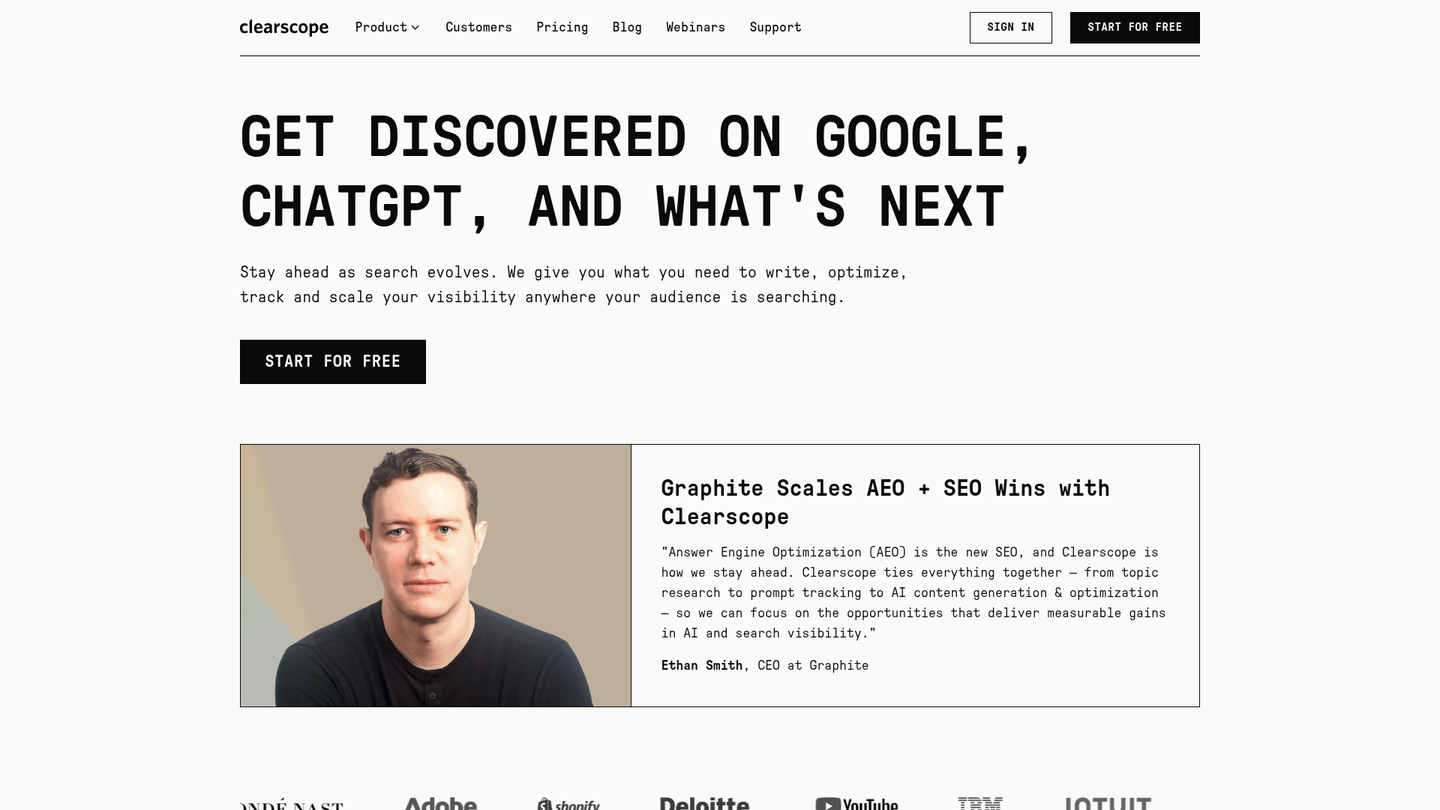
Clearscope solves one problem: keyword grading. Paste in a draft, it scores your term coverage against top-ranking pages and tells you what to add or cut. Enterprise teams at Adobe, IBM, and Shopify use it as a quality layer before content goes live.
What They Offer
- Term-grade scoring and keyword suggestions for individual content pieces
- Topic exploration and content cluster research
- AI writing assistant for drafting acceleration
- AI citation monitoring for ChatGPT and Gemini
If you've got dedicated writers, editors, and SEOs already in motion, Clearscope slots into that workflow cleanly. It's a grading layer, not an execution system.
The limitation is structural. There's no CMS integration — every recommendation requires someone to open a document and make the change by hand. AI visibility tracking covers ChatGPT and Gemini only; Perplexity and Claude are blind spots. No backlink procurement, no automated publishing, no technical SEO execution. The loop opens with every output and stays open.
For fully staffed teams that treat it as a final check before publishing, it works well. For teams that need the work done rather than scored, it's the wrong category.
SEMrush
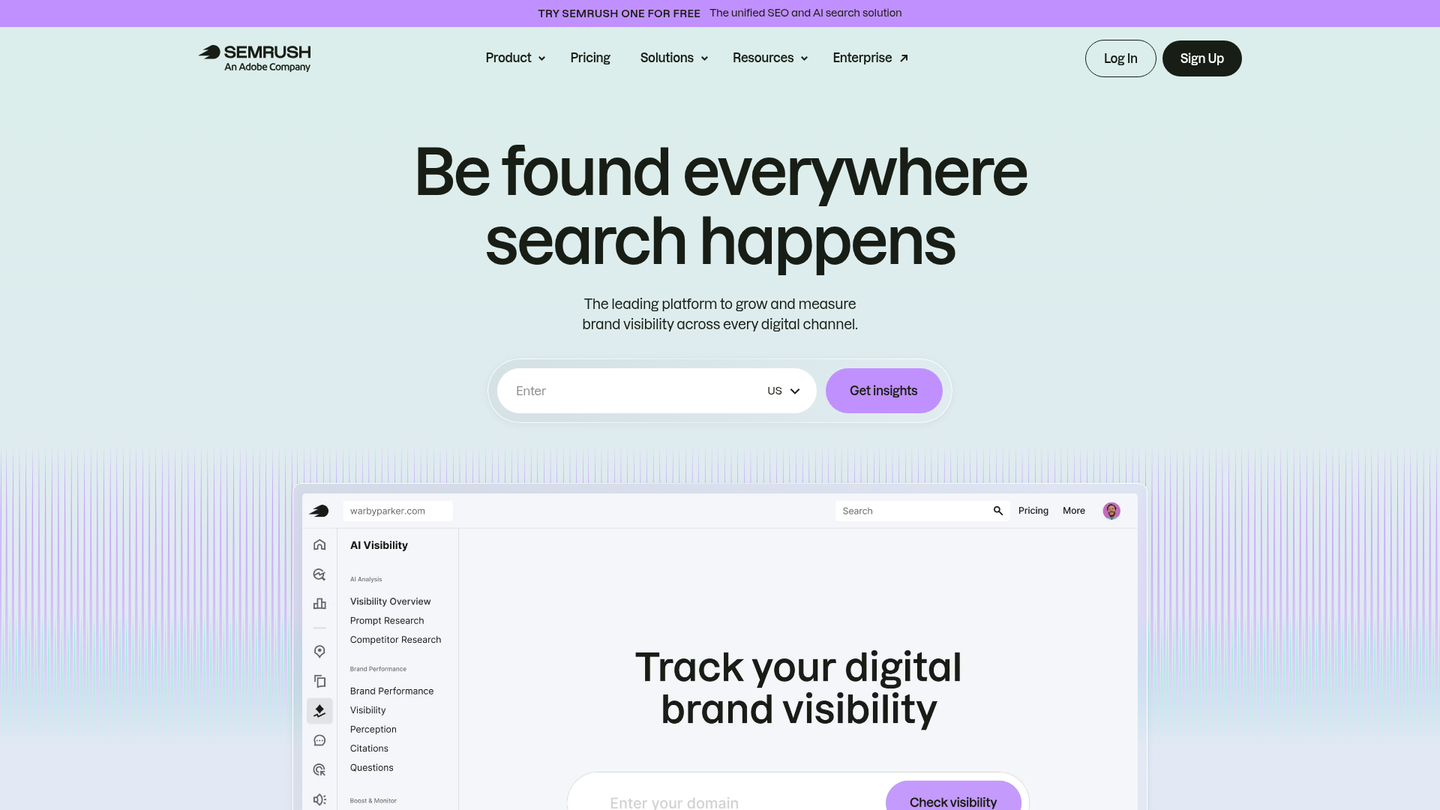
Semrush is the industry's default research console — deepest keyword database most SEOs will ever touch, site audit and rank tracking that's been standard-issue for over a decade.
What They Offer
- Keyword research, gap analysis, and rank tracking across an index of over 26 billion keywords
- Site audit and on-page SEO recommendations
- Backlink database and auditing
- Google AI Overviews visibility data
Good for in-house SEO specialists or agencies that have a dedicated team to translate insights into fixes and content. If you have the people, Semrush gives them excellent raw material.
The limitation defines the category: Semrush doesn't execute. It can't publish content, push metadata to your CMS, or acquire a backlink on your behalf. AI visibility tracking covers Google AI Overviews only — ChatGPT, Perplexity, Claude, and Gemini are missing. Every recommendation lands in a report that someone else has to act on. The real cost isn't the subscription — it's the subscription plus the labor to close every loop it opens.
For teams already staffed to run SEO execution, it's a strong data layer. For teams without that bench, you're paying for a dashboard full of things nobody's going to do.
Surfer
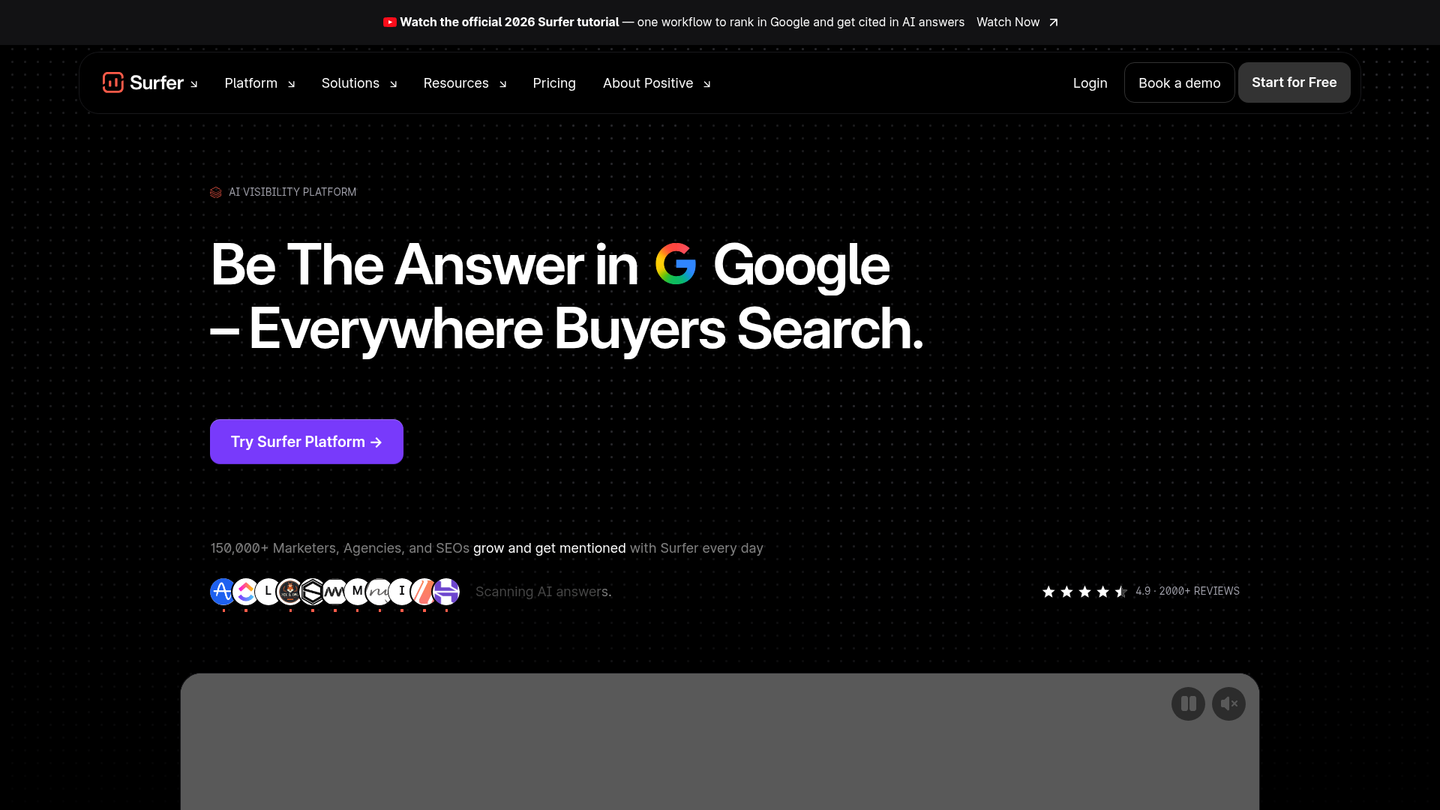
Surfer scores your draft against the top-ranking pages for a given keyword and tells you what to add, remove, or restructure. SERP analysis is what it's built around, and it does that part well.
What They Offer
- SERP-based content scoring and keyword density recommendations
- AI article drafting, billed per article
- Content editor with real-time optimization guidance
- Content planner for topic clustering
Good for individual writers or small teams that want a grading layer baked into the same interface where they draft. If you're producing five posts a month and want each one dialed in against competitors before publishing, Surfer keeps the feedback loop tight.
The limitation that compounds over time: Surfer doesn't learn from your edits. Draft 50 starts from the same baseline as draft one, so the manual optimization burden never shrinks. AI article generation runs $19 per article on base plans — scale to 30 or 40 articles a month and the cost climbs fast. No CMS publishing, no technical SEO fixes, no backlink procurement, no AI visibility tracking. Every recommendation stops at the suggestion layer.
Copy.ai
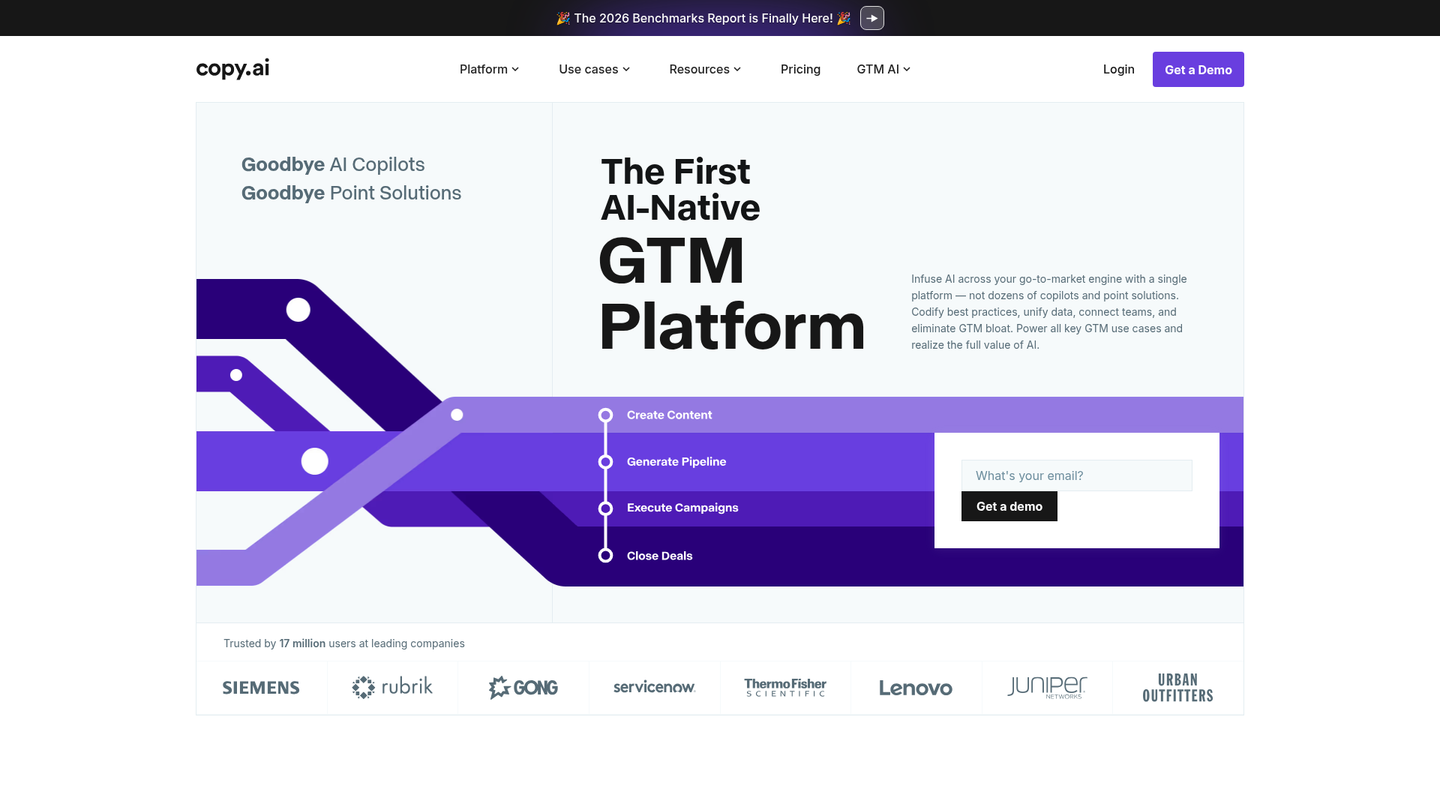
Copy.ai started as a short-form copywriting tool. It's grown into something closer to a go-to-market system — content generation, workflow automation, and CRM integrations wired together for sales and marketing teams.
What They Offer
- 90+ templates for blogs, ads, emails, social copy, and landing pages
- Brand Voice configuration and Infobase knowledge storage
- Workflow builder for multi-step content automation
- Native integrations with Salesforce, HubSpot, Zapier, and Slack
Good for sales and marketing teams that need high-volume, multi-channel copy generation with CRM-connected workflows. If your bottleneck is keeping up with campaign velocity — emails, ad variants, landing page drafts — Copy.ai is built for that.
Outside that use case, the gaps show fast. No CMS publishing, no technical SEO execution, no backlinks, no AI citation tracking. Long-form blog content typically needs heavy editing, and the system doesn't learn from those edits to improve future output. It's a GTM copy tool, not a search marketing execution system.
Jasper
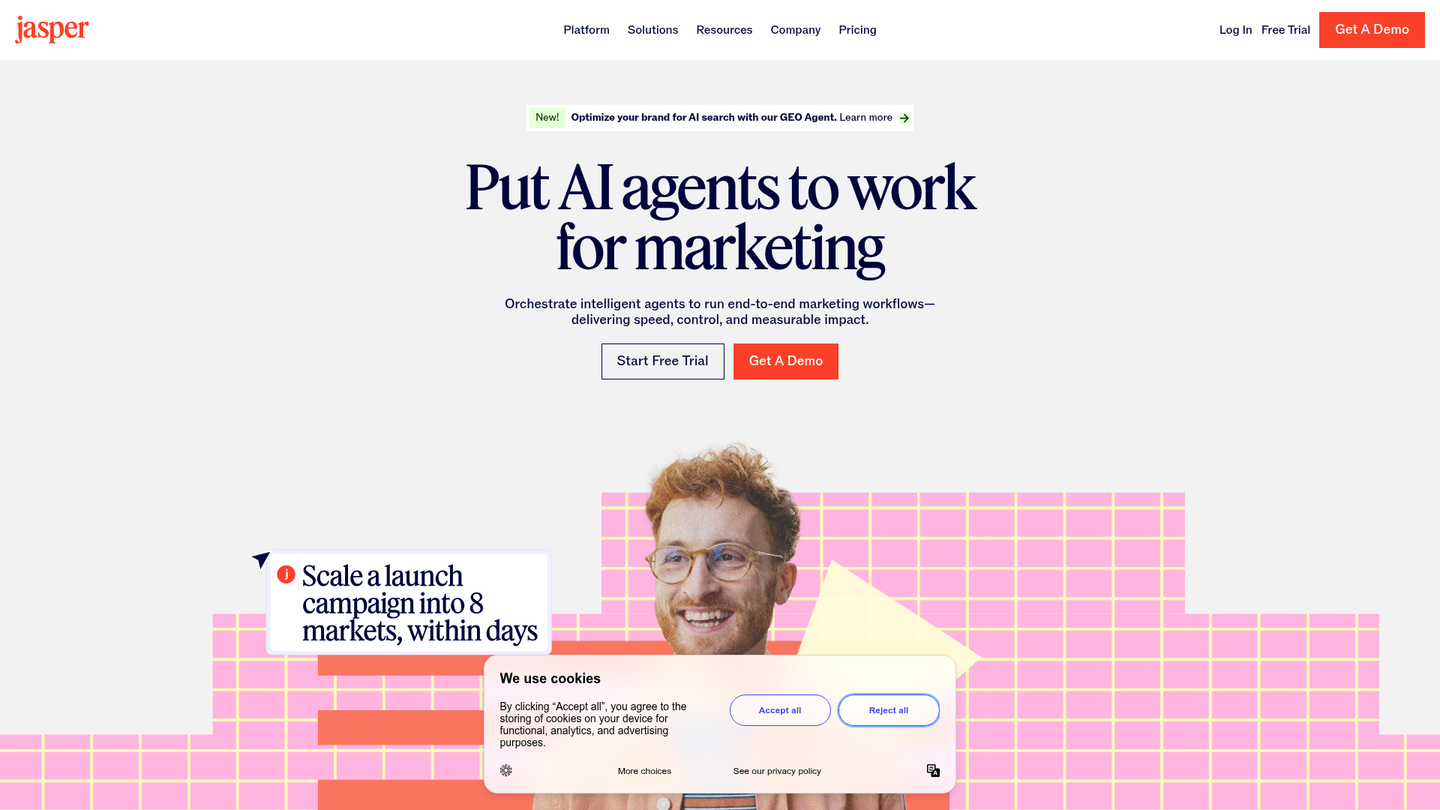
Jasper is built for one problem: brand-consistent copy at high volume across a large marketing team. Its Jasper IQ system trains on existing company documents and tone guidelines; Content Pipelines automate multi-channel campaign production across blogs, ads, email, and social.
What They Offer
- Brand Voice (Jasper IQ) trained on company documents and tone guidelines for consistent output across teams
- Content Pipelines for multi-channel campaign automation across blogs, ads, email, and social
- 50+ purpose-built marketing templates covering common content formats
- AI agents for executing end-to-end content workflows
Good for mid-size to enterprise marketing teams with dedicated content staff who need consistent copy across campaigns and channels. If brand governance at scale is the problem, Jasper's purpose-built for it.
The limitation: SEO optimization isn't native. You need a separate Surfer SEO subscription to close that gap, and full plagiarism checking requires additional paid integrations on top of the base seat cost. No CMS push, no backlink procurement, no AI visibility tracking. Jasper covers the drafting layer. Everything downstream of that draft lives somewhere else.
Feature Comparison Table of Content Marketing Tools
| Feature | Maintouch | Clearscope | Semrush | Surfer | Copy.ai | Jasper |
|---|---|---|---|---|---|---|
| AI content creation | Yes | Yes | Yes | Yes | Yes | Yes |
| CMS publishing integration | Yes (10+) | No | No | No | No | No |
| Technical SEO execution | Yes | No | No | No | No | No |
| Backlink procurement | Yes | No | No | No | No | No |
| AI visibility tracking | Yes (5 engines) | Yes (2 engines) | Yes (1 engine) | No | No | No |
| Self-learning from edits | Yes | No | No | No | No | No |
| Dedicated human strategist | Yes | No | No | No | No | No |
| Free AI visibility tier | Yes | No | No | No | No | No |
Every tool in this list can generate content. The separation starts at what happens after the draft exists: does the tool publish it, build links to it, track how AI engines cite it, and get smarter from your corrections? Most stop at the draft. A few extend into optimization. One closes the full loop.
Why Maintouch Is the Best Content Marketing Tool
Every other tool on this list does one or two things well, then hands the rest back to you. I've watched enough teams spend six months juggling Semrush, Surfer, a freelance writer, and a link-building agency — coordinating all of it over Slack — and still end up with a content program that moves at a crawl. Maintouch runs keyword strategy, content creation, technical SEO, CMS publishing, backlink procurement, and AI citation tracking in one closed system. No agency. No three-person team. No stitching five subscriptions together.
If you want to see where you stand in AI search before committing, the free tier at maintouch.com/free tracks 35 prompts across all five engines for a full year. No credit card, no sales call. When you're ready to replace $200k+ in annual SEO headcount with something that runs on 30 minutes a week, I'm at [email protected].
Final Thoughts on Content Marketing Tools Worth Using
The tools that collect dust are the ones that hand you a to-do list and call it done. That's the whole distinction. Does the work get shipped, or does it get scored? If you want to see what shipping it actually looks like, shoot me a message at [email protected].
FAQ
How do I choose the right content marketing tool from this list for my stage and team size?
Start with the execution question: do you have a dedicated content team that can act on recommendations, or do you need the work done for you? Clearscope, Semrush, and Surfer are built for staffed teams that treat them as a quality layer inside an existing workflow. Maintouch is built for teams that want the full operation run without hiring an agency or a three-person content crew.
Is Maintouch better than Semrush or Clearscope for tracking AI search visibility?
Semrush covers Google AI Overviews only, and Clearscope covers ChatGPT and Gemini. Maintouch tracks all five engines: ChatGPT, Google Gemini, Google AI Overviews, Perplexity, and Claude. If your buyers are using any AI engine beyond Google, the coverage gap in Semrush and Clearscope means you're missing most of the picture, which is why AEO tools that cover all five engines matter.
When should I consider Jasper or Copy.ai instead of Maintouch?
If your primary bottleneck is volume across sales emails, ad copy, and multi-channel campaign drafts, and you already have SEO staff to handle publishing and optimization, Jasper or Copy.ai fit that workflow. If the bottleneck is the full search marketing operation, including CMS publishing, technical fixes, backlinks, and AI citation tracking, those tools leave every step after the draft to someone else.
Can Maintouch push content and technical fixes directly to my CMS without going through a developer?
Yes. Maintouch connects directly to 10+ CMS options including WordPress, Webflow, Sanity, HubSpot, and Contentful, and pushes technical fixes, metadata, schema, and content live without a developer queue. No other tool on this list does that. Surfer, Semrush, and Clearscope all stop at the recommendation layer.
What is a closed-loop content marketing system and why does it matter?
A closed-loop system runs every step of the content operation inside one workflow: keyword discovery, content creation, CMS publishing, technical SEO fixes, backlink procurement, and AI citation tracking. The alternative is a stack of point tools where each one hands the next task back to you. Most tools on this list open a loop with every output. Maintouch closes it.
How much does it cost to run a full content marketing operation without a tool like Maintouch?
A realistic in-house stack runs a content writer at around $60K/year, an SEO specialist at $70K, an Ahrefs or Semrush seat at roughly $2,400/year, and an agency retainer between $3,000–$10,000/month for execution. You're looking at $200K+ annually before you've shipped a single piece of content. Maintouch replaces that entire stack at a fraction of the cost, with agents running the work on under 30 minutes of human time per week.
Do I need a dedicated SEO team to get value from Maintouch?
No. Every paying account gets a dedicated account strategist — a forward-deployed marketer who runs weekly standing syncs and stays accessible through a dedicated Slack channel. The agents handle execution, and the strategist helps you decide what to prioritize. You don't need an internal SEO hire or a content team to run the full operation.
Which content marketing tools are best for small teams or solo founders?
Tools like Clearscope and Surfer are built for teams that already have writers and editors in place — they grade output, they don't replace the workflow. For solo founders or lean teams that want the full operation run without hiring, Maintouch is the only tool on this list designed around that constraint specifically.
How do content marketing tools help with AI search visibility, not just Google rankings?
Most content marketing tools are built entirely around Google rankings and miss the parallel citation economy running across ChatGPT, Perplexity, Gemini, and Claude. The only way to show up in AI-generated answers is to have structured content, clean schema, and high domain authority — which means your content marketing tool needs to track citations across AI engines, not just monitor Google positions. Maintouch tracks AI visibility across all five engines and optimizes content at the passage level for citation, not just ranking.
Can any of these content marketing tools publish directly to my CMS without a developer?
Only Maintouch. It connects directly to 10+ CMS platforms — WordPress, Webflow, Sanity, HubSpot, Contentful, and more — and pushes content, metadata, schema, and technical fixes live without going through a developer queue. Every other tool on this list stops at the draft or recommendation layer and leaves publishing to you.
How does the self-learning feature in Maintouch actually work?
Every time a human edits an AI-generated draft in the Agentic Document Editor, the system automatically diffs the two versions and updates the Knowledge Base, Brand Voice, and Blog Rules simultaneously. Six months in, the system knows your voice, positioning, and preferences with high fidelity — without anyone manually retraining it. No other tool on this list does this; Surfer and Jasper start from the same baseline on draft 50 as they did on draft one.
Turn search into your best growth channel.
Maintouch tracks your visibility across AI and Google, creates and refreshes content, and gets your brand mentioned on the sites that shape discovery.
Book a demoRelated reading
All posts