
Localized SEO: Multi-Market Rankings September 2026

By Bennett Cohen
Get Maintouch
Turn search and AI visibility work into a repeatable growth system.
Most multi-market SEO breaks at the same point: the team gets the architecture right, configures hreflang, and then publishes content that's structurally identical across every locale. Localized SEO isn't a language problem. It's a market-fit problem, and no amount of correct technical setup compensates for pages that read like they were written for somewhere else. I'll walk you through the decisions that actually separate sites that rank locally from sites that just exist in a market.
TLDR:
- Localized SEO ranks you for how buyers in a specific city actually search, going beyond the country level to the exact local query
- Translating your keyword list into a new market triggers traffic loss; rebuild keyword research from scratch per locale
- 75% of hreflang implementations contain errors, and one error causes Google to ignore the entire cluster
- Machine-translated content generates quality penalties that suppress rankings across all language versions, including your existing markets
- Maintouch regenerates hreflang tags and LocalBusiness schema on every publish via CMS webhook, keeping structured data synchronized with live pages automatically
What Localized SEO Actually Means
Localized SEO is the practice of optimizing your site to rank for searches happening within a specific geographic and cultural context. It goes beyond translating copy or adding a city name to a page title. The goal is to match search intent as it exists in that market, which means understanding how people in Berlin search differently than people in Sydney, even when they're looking for the same thing.
Standard national SEO treats a country as a monolith. Localized SEO breaks that assumption. A user in Lyon may phrase a query differently than a user in Paris, expect different trust signals, and respond to different content formats. Those differences are real ranking factors, not edge cases.
The simplest frame: national SEO asks "how do I rank in France?" Localized SEO asks "how do I rank for someone in Marseille, in French, searching the way Marseille buyers actually search?" That specificity is what separates sites that surface in local results from sites that technically exist in a market but never show up when it matters.
Localized SEO vs. Standard SEO: Key Differences
Standard SEO optimizes for relevance and authority at scale. Localized SEO adds a third variable: proximity. Google weighs physical or geographic closeness as a ranking signal that national campaigns don't have to think about.
The practical differences show up fast:
- Standard SEO targets broad intent ("accounting software"). Localized SEO targets intent anchored to a place ("accounting software for small businesses in Austin").
- Standard SEO builds domain authority globally. Localized SEO builds local authority through citations, regional backlinks, and market-specific structured data.
- Standard SEO treats all sessions as equivalent. Localized SEO accounts for the fact that a user searching from Munich gets a different SERP than one searching the same query from Hamburg.
Local authority signals don't transfer automatically. A strong national SEO terms and definitions doesn't tell Google you're a trusted business in Rotterdam. That requires local directory listings, region-specific mentions, and geographic schema markup your national strategy was never built to produce.
Standard SEO wins impressions. Localized SEO wins the right impressions, from the right people, in the right place.
How Google Ranks Local and Localized Results
Google's local ranking algorithm runs on three signals: relevance, proximity, and prominence. Relevance is how well your business matches the query. Proximity is geographic distance from the searcher. Prominence is how well-known and trusted Google judges your business to be, based on links, reviews, citations, and your overall authority footprint.

The Map Pack runs on its own logic, separate from organic rankings. A business can rank third in the organic results and completely miss the Map Pack, because the Map Pack weights Google Business Profile signals, review volume, and NAP consistency more heavily than page-level content factors.
In 2026, AI-generated local packs added a fourth layer. Google's AI summaries for local queries now synthesize business information across your GBP, structured data, and third-party mention sources before surfacing recommendations. If your schema markup for AI citations conflicts with GBP or your reviews signal inconsistency, the AI layer often skips you for a competitor with cleaner signals.
The scale of local search makes this worth getting right. 46% of all Google searches carry local intent, and 76% of people who search for something nearby visit a business within 24 hours. Those aren't passive browsing sessions. They're decisions already in motion.
Localized Keyword Research: Why Direct Translation Fails
Translating your existing keyword list is one of the most expensive shortcuts you can take in a new market. A direct translation gives you the words. It doesn't give you the query.
The problem is intent mismatch. The same product need gets expressed differently across languages and cultures. German searchers may use formal compound nouns where English speakers use two-word phrases. Spanish speakers in Mexico phrase queries differently than those in Spain, even when searching for identical products. Direct keyword translation triggers severe traffic loss due to non-equivalent search queries and intent mismatches: you're targeting terms nobody types.
The fix is rebuilding keyword research from scratch per locale:
- Open local SERPs in the target country using a VPN or browser set to that region, so you're seeing actual results and not a personalized home-market view.
- Use native-language keyword research tools and check autocomplete suggestions from that country's Google instance, since those suggestions reflect real query behavior in that market.
- Look at what local competitors rank for, not what your home-market competitors rank for, because the competitive picture changes completely once you cross a border.
- Check search volume for the translated term and the native alternatives side by side before committing to either.
Intent also varies by market. A query that signals purchase intent in the buyer journey in the US might be purely informational in a market where the product category is newer. You can't inherit those signals from your source keyword research. You have to observe them locally.
URL Structure and Site Architecture for Multiple Markets
Three structural options exist for organizing a multi-market site, and the one you pick determines how search engines interpret your geographic targeting for years.
| Structure | Example | Geotargeting Signal | Authority Consolidation | Maintenance Complexity | Best For |
|---|---|---|---|---|---|
| ccTLD | example.de | Strongest | None - each domain starts from scratch | High - separate infrastructure per market | Dedicated local teams with long-term in-country presence |
| Subdirectory | example.com/de/ | Strong (via GSC geotargeting) | Full — all equity under one root domain | Low - single technical infrastructure | Teams with limited resources expanding across multiple markets |
| Subdomain | de.example.com | Weaker than ccTLD | Partial — treated as separate from root by Google | Medium | Rarely the right choice - loses both arguments |
ccTLDs (country-code top-level domains)
Country-code top-level domains send the strongest geotargeting signal to Google. There's no ambiguity about which market a page is intended for. The tradeoff is that each ccTLD is treated as a separate domain, so you're building domain authority from scratch in every market, and maintenance complexity scales with every country you add.
Subdirectories
Subdirectories consolidate all link equity under one root domain while still letting you target individual markets through Google Search Console's geotargeting settings. You're not splitting authority, you get a single technical infrastructure to maintain, and GSC gives you explicit market-level control. For lean teams expanding across multiple markets, this is the right default.
Subdomains
Subdomains sit closer to the ccTLD end of the complexity curve. Google historically treats them as separate from the root domain, which means weaker authority consolidation than subdirectories without the geotargeting clarity of a ccTLD. They rarely win either argument.
The decision comes down to execution commitment. Dedicated local teams, local marketing budgets, and a long-term presence in specific markets make ccTLDs worth the overhead. Centrally managed expansion across multiple markets means subdirectories let one domain do all the work.
Hreflang: Telling Search Engines Which Version to Show
Hreflang tags tell Google which version of a page to serve to which audience. Without them, Google picks on its own, and the wrong version usually ends up ranking in the wrong market.
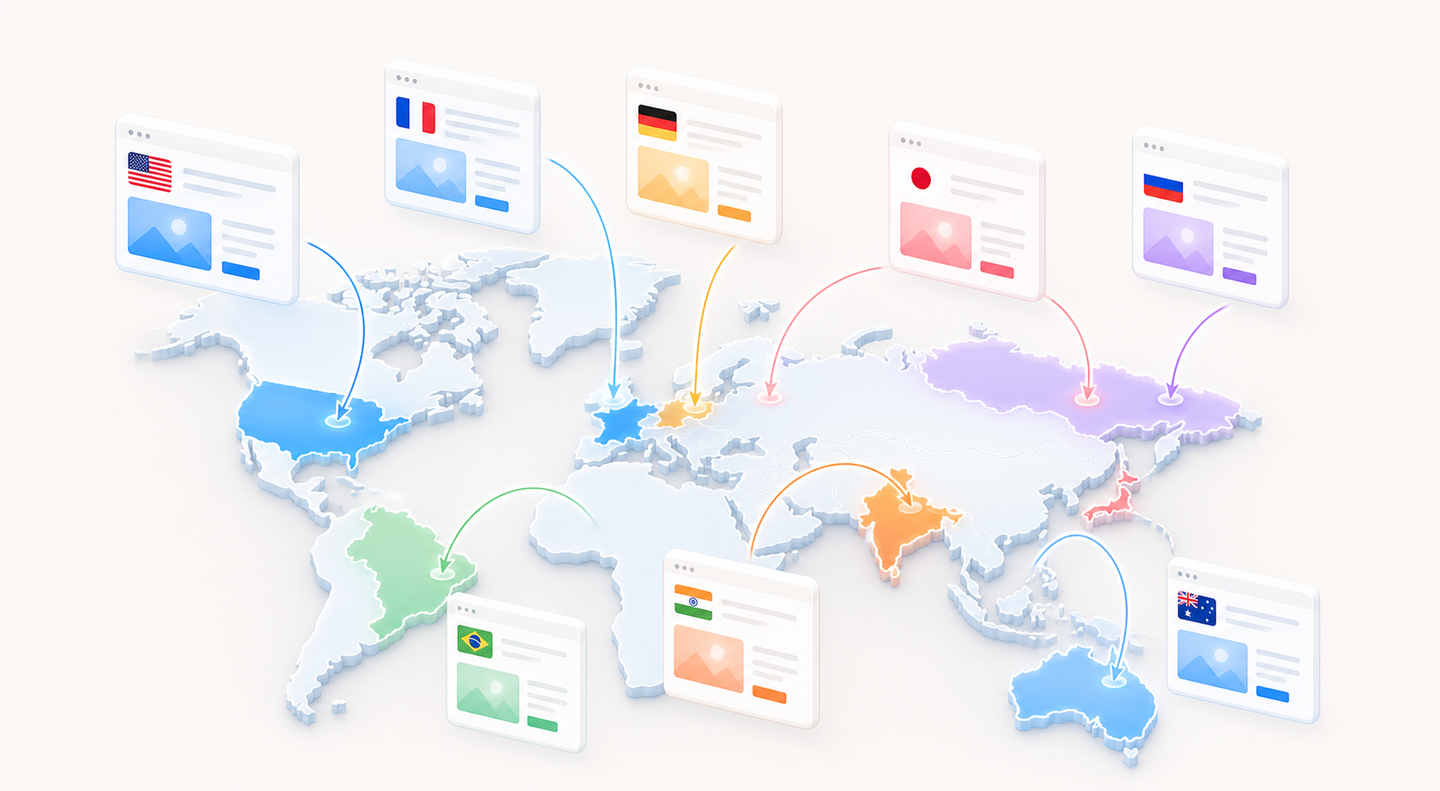
The implementation logic is straightforward. Each page carries a set of <link rel="alternate" hreflang="..."> tags pointing to every language or regional variant. Every variant in that cluster must reference every other variant, including itself. One error causes Google to ignore the entire hreflang cluster — every page in it, not one. That failure rate is real: 75% of hreflang implementations contain errors, and most are silent ones.
Two requirements get skipped most often:
- The
x-defaulttag specifies the fallback page for users in markets you haven't explicitly targeted. Skip it and Google may serve the wrong language version to those users. - Correct ISO 639-1 language codes paired with ISO 3166-1 country codes where regional targeting is needed.
en-gbfor British English,pt-brfor Brazilian Portuguese. Imprecise codes get ignored.
Hreflang doesn't prevent duplicate content on its own. It tells Google the duplication is intentional and directs it to the right version per market.
Localization vs. Translation: Why the Distinction Matters for Rankings
Translation gives you words in another language. Localization gives you a page that feels like it was written for that market.
The distinction matters because Google reads content quality through engagement signals, and culturally off content produces weak ones. A German reader who lands on a page using American idioms, US dollar pricing, and MM/DD/YYYY date formatting bounces fast. That bounce tells Google the page didn't serve the query well, regardless of how technically correct the translation is.
Machine-translated content fails on a more structural level. Google's quality systems detect it with high accuracy, and unedited machine translation generates content quality penalties that suppress rankings across all language versions — the translated page and every other locale you operate in. You're not failing to rank in the new market; you're damaging what you already have.
A real localization workflow looks different from a translation one:
- Currency, date format, and units of measurement get adapted to local conventions
- Examples and case studies reference companies or events the local audience actually recognizes
- Trust signals shift by market, covering certifications, regulatory references, and accepted payment methods
- Idioms and cultural references get replaced outright, not translated literally
Every element that shapes reader trust and content relevance needs market-specific adaptation, not a language swap.
On-Page Optimization for Localized Content
On-page localization isn't a single fix. It's a stack of signals that either reinforce each other or work against each other.
Title tags and meta descriptions should reflect local search intent, going beyond local geography to match how searchers actually phrase queries. Rewriting the title to match how searchers in that city phrase the query is what moves rankings. "Accountants in Lyon" ranks differently than "Lyon comptable PME" because they're answering different queries for different intent states.
Schema markup is where the signal gets explicit. LocalBusiness structured data for AI search lets you declare your location, phone number, hours, and service area in structured data Google and AI engines read directly. If your schema shows a US phone number on a page targeting Germany, you've already sent a conflicting geographic signal.
A quick checklist for each market-specific page:
- Title tag written around local query phrasing, not translated from the home-market version
- Meta description referencing the specific city or region, not a generic market name
LocalBusinessorOrganizationschema with a local location, local phone number, andareaServedset to the correct region- NAP (name, location, phone) consistent across the page, schema, and any directory listings in that market
- Internal links connecting the localized page to other content in the same language and market
Location-specific landing pages need to be built around distinct local intent. A page targeting Manchester that reads identically to the London page except for one noun isn't localized content. It's duplicate content with a find-and-replace applied.
Building Localized Content Hubs Without Triggering Duplicate Content
The duplicate content trap in multi-market SEO isn't caused by translating pages. It's caused by translating pages and stopping there. When the structure, examples, headings, and argument are identical across locales, Google sees near-duplicate content regardless of language.
The fix is building each market's content hub around locally specific angles: the full topic lens of that market, beyond local keywords alone.
What "locally specific" actually means
A hub for Hamburg might center on GDPR compliance concerns a US audience doesn't focus on — the kind of market-specific angle that separates real localization from translation, and one that applies across B2B SEO strategy and tactics more broadly. A hub for São Paulo might cover payment infrastructure that's irrelevant in London. Local market realities produce distinct content angles that translation alone never delivers.
A few practical rules for scaling without duplication:
- Anchor each hub with a pillar page that covers the topic through that market's specific lens, using local data, local examples, and locally relevant trust signals.
- Build cluster content around queries that only exist in that market, since search behavior genuinely differs across regions.
- Use canonical tags when you have transitional content that isn't fully localized yet, pointing to the most authoritative version while you build out the market-specific variant.
Canonical tags are a safeguard, not a strategy. They tell Google which version to credit when duplication is unavoidable, but they don't fix thin localization. If two pages are substantively identical, a canonical tag manages the damage without eliminating it.
Internal linking inside each hub matters too. Localized pages should link to other pages in the same language and market. A French hub that internally links to English pages sends a mixed geographic signal that undercuts the localization work on the page itself.
Local Citations and Structured Directory Listings
Local citations are mentions of your business's name, location, and phone number (NAP) across directories, review sites, and data aggregators. Google cross-references these mentions to verify your business exists where you say it does. Consistent NAP signals trust. Inconsistent NAP signals noise, and noise suppresses local rankings.
The compounding problem is real. Data aggregators feed dozens of downstream directories automatically. If your NAP enters the ecosystem with an error, that error propagates before you notice it. Cleaning it up means tracking down every derivative listing — the original source and every directory it seeded.
Building citations in a new market means targeting directories that carry authority in that specific market. A strong presence on US platforms like Yelp won't help you rank in Munich. You need listings on directories German searchers and Google's local algorithm actually weight. Gelbe Seiten matters there. Yelp doesn't. Each target market has its own directory stack.
A few rules for citation building across markets:
- Start with the major local data aggregators in each country, since these seed the broadest number of downstream directories automatically.
- Match NAP exactly to how it appears on your site and schema. Phone number format, street abbreviations, and location punctuation all count.
- Audit existing citations before building new ones. Adding accurate listings on top of inaccurate ones doesn't cancel the old signals.
Citation building isn't a launch task. Business information changes, directories update their databases, and new market-specific listings appear over time. Treating it as a one-time setup is how NAP inconsistency creeps back in and quietly erodes rankings you worked months to earn.
Measuring Localized SEO Performance
Tracking localized SEO performance requires market-level segmentation from day one. A single aggregated Search Console property tells you almost nothing useful if you're running in five countries. Set up separate properties per country or subdirectory, use GSC's geotargeting settings to confirm which market each property targets, and run rank tracking from IPs in each target market since SERPs differ by location even for identical queries.
The AI visibility KPIs that matter for localized SEO differ from standard organic metrics:
- Local pack appearance rate: how often your business surfaces in the Map Pack for target queries in each market
- Market-specific click-through rate: organic CTR segmented by locale, since searcher behavior and SERP layouts vary enough to make blended CTR misleading
- Citation consistency score: percentage of directory listings where NAP matches your canonical business data exactly
- GBP action rate: calls, direction requests, and website visits generated through your Google Business Profile per market
The zero-click problem hits localized SEO harder than national campaigns. GBP actions are up 41% year-over-year, meaning more searchers get what they need directly from the SERP. Measuring impressions and GBP interactions alongside organic clicks gives you a clearer picture of local visibility than click data alone.
Attribution is the real challenge. A customer who finds your business in the local pack, calls directly, and converts never appears in your analytics. Phone call tracking with market-specific numbers and GBP call logging are the practical bridges. Without them, your localized SEO work is producing results you can't see.
How Maintouch Handles Localized SEO Execution
Localized SEO execution breaks down at the handoff points: keyword research done, architecture decided, hreflang configured, and then nobody actually pushes the changes. Maintouch closes that gap by running the full loop inside one system.
The multi-segment strategy capability lets you build distinct content strategies per market instead of adapting a single global strategy after the fact. Each market gets its own keyword gaps, content angles, and audience targeting. German buyers get German-first content built around how German searchers phrase queries. Brazilian buyers get a separate strategy, instead of a translation of the US one.
Schema automation handles the drift problem that kills localized rankings quietly. When a localized page updates and the structured data doesn't follow, Google encounters a mismatch and pulls the page from its retrieval set. Maintouch regenerates schema on every publish via CMS webhook, so technical SEO on autopilot keeps hreflang tags, LocalBusiness markup, and language-specific structured data synchronized with live page content without manual intervention.
Zero-volume queries surfaced through Search Console show how buyers in a specific locale actually phrase questions to ChatGPT, Claude, and Perplexity. Those signals feed directly into localized content strategy, so the content you build for a new market answers what local buyers are asking AI engines today, instead of mirroring what they typed into Google two years ago. Maintouch supports Japanese and Korean market localization through this same workflow, extending SEO strategy beyond English without rebuilding the execution pipeline from scratch.
The free AI visibility tier tracks 35 prompts across all five AI engines for one full year, a no-cost way to measure where your localized citation presence actually stands before you scale.
Final Thoughts on Localized SEO as a Real Ranking Strategy
Localized SEO isn't a checklist you run once at launch. NAP drifts, structured data falls out of sync, and new market-specific directories keep coming up. The work is ongoing, and the sites that stay visible treat it that way. I've been doing SEO for over a decade, and Maintouch serves hundreds of marketers running into the same wall. If you want to talk through what localized SEO execution would look like on your stack, shoot me a message at [email protected].
FAQ
What's the difference between hreflang and canonical tags for managing duplicate content across multiple markets?
Hreflang and canonical tags solve different problems. Hreflang tells Google which page version to serve to which audience based on language and region. Canonical tags tell Google which version to credit when near-duplicate content exists across your site. Use hreflang when you have genuinely localized versions of a page for different markets. Use canonical tags as a temporary safeguard when content isn't fully localized yet. Relying on canonicals alone to manage multi-market duplication signals thin localization, not intentional market strategy.
Should I use ccTLDs, subdirectories, or subdomains for multi-market localized SEO?
Subdirectories are the right default for most teams expanding into multiple markets. They consolidate link equity under one root domain, require a single technical infrastructure to maintain, and give you explicit market-level control through Google Search Console's geotargeting settings. ccTLDs send a stronger geotargeting signal but rebuild domain authority from scratch in every market, which makes them worth the overhead only if you have dedicated local teams and long-term in-country presence. Subdomains split authority without delivering the geotargeting clarity of a ccTLD, so they rarely win either argument.
What does localized SEO actually require beyond translating existing pages?
Translation gives you words in another language. Localized SEO requires rebuilding keyword research from scratch per locale, adapting trust signals to local conventions (currency, date formats, certifications, payment methods), building citations on directories that carry authority in that specific market, and creating content around angles that only exist for that market's buyers. German searchers use different query phrasing than French ones, local competitors shift entirely once you cross a border, and purchase intent signals vary by how mature the product category is in each market. A translated page that shares the same structure, examples, and argument as your home-market version reads as near-duplicate content to Google regardless of the language swap.
How do zero-volume queries from Search Console connect to localized content strategy?
Zero-volume queries, meaning queries with one to two Search Console impressions, signal what buyers in a specific locale are asking AI engines like ChatGPT, Claude, and Perplexity before they ever run a Google search. Building localized content around these queries means you're answering what local buyers are actually asking AI tools right now, instead of targeting keywords from two years of aggregate search data. This is the same mechanism that drives AI citation outcomes generally: content that answers the exact question an AI engine is fielding gets cited. In a localized context, ZVQ discovery surfaces those questions at the market level, so your São Paulo content answers what São Paulo buyers ask, not a translated version of what your US buyers once searched.
How does schema drift damage localized rankings, and how do I prevent it?
Schema drift happens when you update a localized page but the structured data doesn't follow. When your LocalBusiness schema still shows an old phone number, a mismatched location, or a service area that contradicts the live page content, Google encounters a conflicting signal and pulls the page from its retrieval set regardless of how well-written the content is. AI-generated local packs in 2026 make this worse: Google's AI layer now synthesizes business information across your Google Business Profile, structured data, and third-party mentions before surfacing recommendations, so a mismatch between any of those sources deprioritizes you in favor of a competitor with cleaner signals. The fix is automating schema regeneration on every publish so hreflang tags, LocalBusiness markup, and language-specific structured data stay synchronized with live page content without requiring a manual audit every time something changes.
How important is Google Business Profile for localized SEO, and do I need one for every market?
Google Business Profile (GBP) is a prerequisite for appearing in the Map Pack, which runs on its own ranking logic separate from organic results. For every market where you have a physical address or service area, you need a verified GBP with complete, consistent business information. If you're operating as a service-area business without a storefront, you can still claim a GBP and define your service radius. The key is keeping your GBP information identical to what appears in your schema and directory listings, since mismatches between any of these sources weaken your local ranking signals.
What's the fastest way to find out if my hreflang tags are set up correctly?
The fastest check is Google Search Console: if hreflang errors appear in the International Targeting report, Google is already ignoring some or all of your cluster. You can also use dedicated crawl tools to audit the bidirectional linking requirement, where every page in the cluster references every other variant including itself. The most common silent failures are missing x-default tags, incorrect ISO language or country codes, and self-referential tags that point to a different URL than the canonical. Fix any one of these and Google starts reading the cluster correctly again.
Does localized content help with AI Overviews and AI-generated local packs, or just traditional search?
It helps with both, and increasingly the AI layer is where local search decisions get made. Google's AI Overviews for local queries synthesize your GBP data, LocalBusiness schema, and third-party mention sources before surfacing a recommendation. If those signals are inconsistent or incomplete, the AI layer skips you in favor of a competitor with cleaner structured data, regardless of your organic ranking. Content that is properly localized, structured, and schema-backed is the same signal stack that earns traditional rankings and AI citations. The underlying mechanism is the same: structured data quality and geographic signal consistency.
How many location-specific landing pages do I actually need, and when does it become thin content?
The threshold is whether each page is built around genuinely distinct local intent. A page for Manchester that exists solely because you swapped a city name from the London page is thin content regardless of how many words it contains. The practical test: does this page answer something a Manchester buyer would search that a London buyer wouldn't? If the answer is no, consolidate and use a single well-optimized regional page rather than manufacturing location variants that Google will treat as near-duplicates. Build location pages only where local search behavior, competitive dynamics, or buyer needs genuinely differ.
Can I run a localized SEO strategy for a market where I don't have a physical office?
Yes, though the strategy shifts depending on whether you're targeting local search queries or simply localizing content for a national or regional audience. Without a physical address, you can't claim a standard GBP listing or compete in the Map Pack for that location. You can still rank in organic results by building locally relevant content around queries that carry local intent, building citations on directories that carry authority in that market, and using areaServed in your schema to declare your service geography explicitly. The Map Pack requires proximity signals you can't manufacture, but localized organic rankings are fully achievable without a local address.
How does mobile search behavior affect localized SEO, and should I optimize differently for mobile?
Local intent on mobile skews heavily toward immediate action queries, meaning searches like "near me" or "open now" that carry higher purchase intent than the same query typed on desktop. Google's local ranking algorithm weights proximity more heavily on mobile because the searcher's physical location is a live signal, not an inferred one. The practical implication is that your GBP, NAP consistency, and schema accuracy matter even more for mobile local search than for desktop. Page speed is also a harder constraint on mobile: a slow localized page costs you conversions even when it ranks, because local mobile searchers make decisions in seconds.
Turn search into your best growth channel.
Maintouch tracks your visibility across AI and Google, creates and refreshes content, and gets your brand mentioned on the sites that shape discovery.
Book a demoRelated reading
All posts