
Maintouch vs HubSpot AEO: Which is best for you? (Nov 2026)

By Bennett Cohen
Get Maintouch
Turn search and AI visibility work into a repeatable growth system.
Your brand shows up in a ChatGPT answer. Great. But did an AI agent ever visit your site? A mention can't tell you. HubSpot AEO samples answers to test prompts, while Maintouch also captures live agent traffic. And once you see the gaps, someone still has to fix them. We'll separate what each tool measures from what it helps you get done, and we'll be fair to HubSpot where it's genuinely strong.
TLDR:
- Tracking won't fix your pages. Choose based on who does the work after the report.
- HubSpot AEO includes 25 prompts for $50/month; your team handles the recommended fixes.
- Separate AI mentions from crawler visits: a sampled answer doesn't prove your site was crawled.
- Maintouch offers SEO/AEO/Google Ads agents; analytics starts at $149/month. Agent usage costs extra.
Quick Verdict: Which Tool Fits Your Situation?
- Choose HubSpot AEO if your team already uses HubSpot and needs an inexpensive AI visibility read. It fits focused tracking, provided you have people ready to act on the findings.
- Choose Maintouch if you need agents to act on data across SEO, AEO, and Google Ads. We fit teams that want more search marketing work handled in one workflow.
The deciding factor isn't the data. It's who does the work after you see it.
What Is HubSpot AEO?
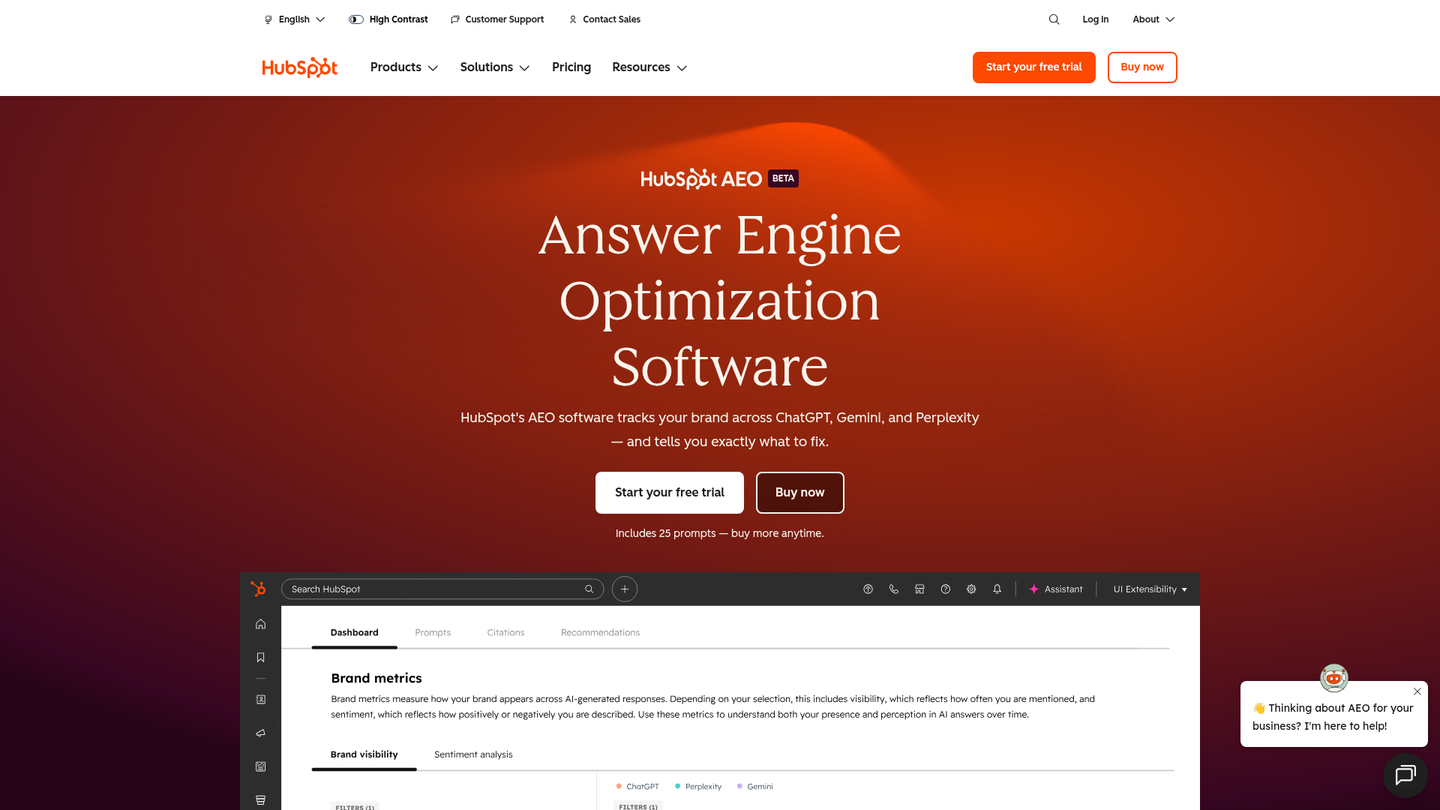
HubSpot AEO gives you a starting point, not a sprawling toolset. It tracks your brand across ChatGPT, Gemini, and Perplexity and recommends fixes. Its entry plan includes 25 prompts for $50 per month, with more available to buy.
Within the HubSpot ecosystem, it works as a lightweight monitoring add-on, one of several AI visibility trackers worth comparing for your team. HubSpot’s AI visibility setup documentation walks you through setup and analysis.
What Is Maintouch?
Your search data should drive action, not sit in reports. At Maintouch, we combine search marketing data with AI agents built for SEO, AEO, and Google Ads, and we're often weighed against other AEO tools in this category. We aggregate data from multiple providers and add your first-party signals through 180+ connectors, including Google Search Console, GA4, and Google Ads.
Your agents use that combined context to draft content and update pages. You decide how far they take each task and where human review belongs.
AEO Tracking Depth
A visibility score tells you that you showed up. It doesn't tell you to whom, in what conversation, or why. That's where tracking depth starts to matter.
What HubSpot AEO Tracks
HubSpot’s AEO product page describes brand visibility scores, citations, tracking, and fix recommendations. Two of those signals are easy to confuse. Brand visibility tells you whether you appear in sampled AI answers. Citations show which sources those answers reference. Read them together and you can tell a plain brand mention from an answer that links to your content. Treat the recommended fixes as a list of places to investigate first, not as a task list the score hands you. And keep the scope in view: these prompt-based results describe the answers tested, not every buyer’s conversation, and they don't prove an AI agent visited your site.
What Maintouch Tracks
Maintouch tracks more models: ChatGPT, Gemini, and Perplexity, plus Google AI Overviews and Claude. It also goes deeper on how it tests:
- Buyer personas inject memory; multi-turn simulations test follow-ups.
- Control sentiment tracking: edit the criteria we score each response against, so you weigh the factors you care about instead of getting a generic sentiment score.
- Search a citation-source database.
- View live SERPs for fan-out queries.
- Catch false claims: we check each response against your knowledge base and context documents, trace inaccuracies to the sources the answer cited, and propose fixes when the source is a page on your site. We also break down this depth of tracking in our Maintouch vs Profound comparison.
Live Agent Traffic vs. Synthetic Prompt Data
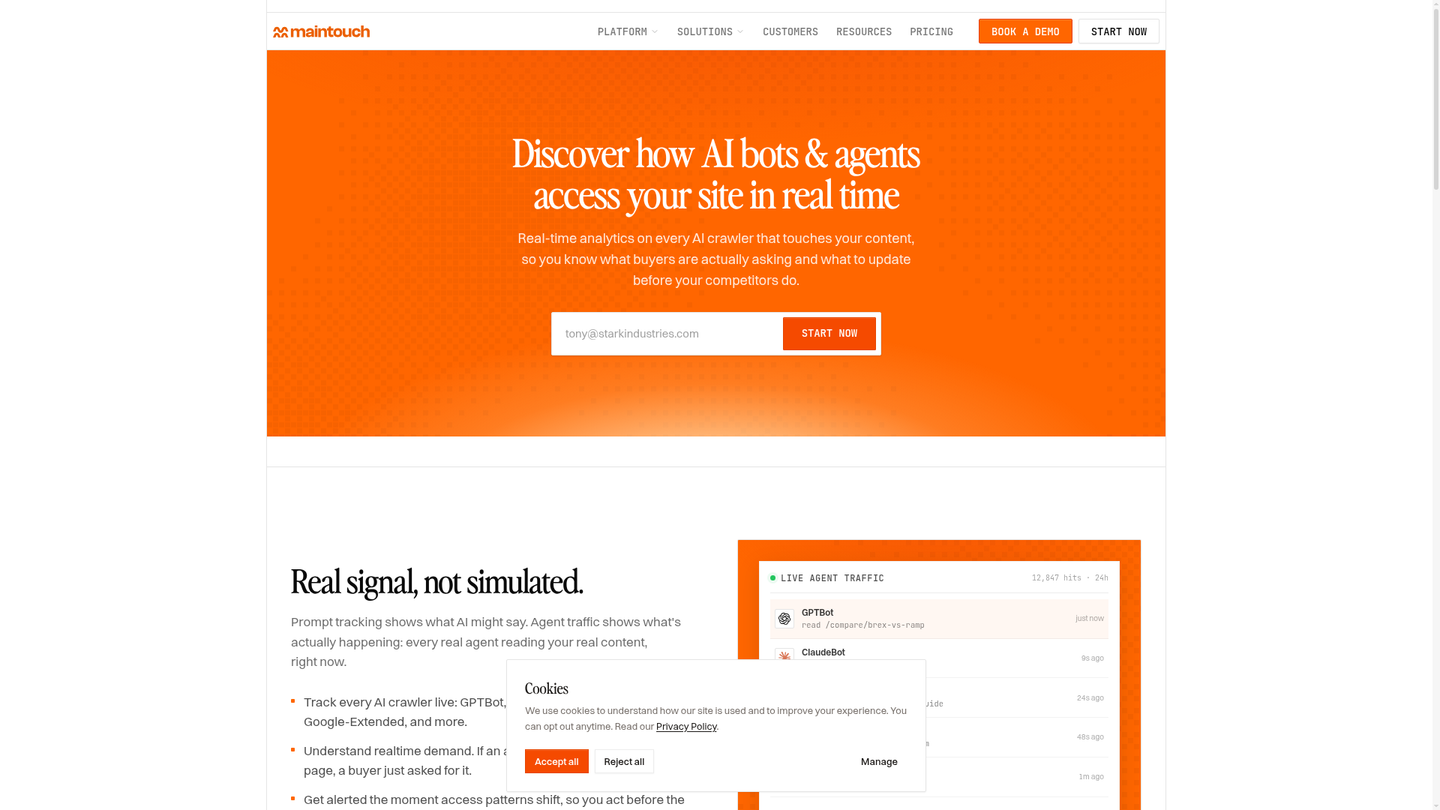
An AI answer mentioning your brand doesn't prove an agent visited your site. HubSpot AEO tracks synthetic prompts: simulated questions sent to AI services that return sampled answers.
At Maintouch, we also capture live agent traffic through Cloudflare, Vercel, Kinsta, AWS CloudFront, or direct server connections. You can see when real AI agents crawl your pages. Keep the measurements separate: a crawl records a visit; a simulated answer records whether your brand appeared in that test. If you're also comparing other monitoring options, see our Maintouch vs Peec AI comparison.
From Insight to Action: Content Execution
Say your report flags five pages that AI keeps skipping. With HubSpot AEO, your team takes it from there. With Maintouch, agents pick up the work.
Content Agents in Maintouch
Maintouch ships with five preloaded content agents: Smart Format, Head-to-Head, Listicle, Competitor Alternatives, and Competitor Head-to-Head. Smart Format is the one most teams use. It builds your outline from live Google or Brave SERP data, so nobody has to analyze search results by hand to plan the structure. The other four give you starting points for bottom-of-funnel comparisons and recommendation articles. When drafting, each agent reads your brand voice, writing rules, knowledge base, and supporting context, then handles internal links, metadata, and JSON-LD. If you'd rather check the outline before a full draft exists, you can configure the workflow to pause there. Tracking feeds this work, too: our prompt tracking flags when AI surfaces false claims about your brand, traces them to cited sources, and proposes page updates when the source is on your site.
Content Updates, Review Agents, and Parallel Agents
Maintouch flags pages with falling impressions or clicks, optimization gaps, or outdated facts and positioning, then gives you scores and a proposed fix plan. Queue those pages, or run an update agent in the background to prepare suggested changes you review before republishing. Review Agents apply your custom editorial checks to each piece: fact checks, positioning checks, or swapping out words your team avoids. Parallel Agents run analysis and updates across many pages at once in a spreadsheet-style grid, where each column defines an action or custom AI prompt. Picture a pricing change. Instead of opening every page, you update the old price across your site in one pass, or check whether your comparison pages still match your current positioning.
The Editor and Publishing
Your draft doesn't have to leave Maintouch for review: our editor lets teammates work in the same document and leave comments as part of the content agent workflow. SEO and AEO optimization checks run with every edit, while Deep Review flags writing issues such as uncited statistics and redundant sections. You can fix issues manually or ask the Editor Agent to suggest changes using your brand voice and writing rules, then inspect version history in a diff view. Metadata and JSON-LD are editable in the same workspace, so your review can cover more than the article body. Before publishing, you can configure approval workflows to match your team's process. When the content is ready, publish through CMS connections such as WordPress, Webflow, or Sanity, or use API, CLI, and MCP options with webhooks for a custom site.
SEO and Google Ads Coverage
AEO coverage isn't SEO coverage, and it isn't Google Ads coverage. The HubSpot pages we cite describe AI visibility tracking and don't confirm traditional SEO rank tracking or Google Ads support. Maintouch offers keyword rank tracking and keyword data aggregated across major providers, supplementing one provider’s results with another’s. You can also connect Google Ads directly to bring first-party performance data into Maintouch alongside Search Console and GA4.
With all of that in one place, you can build custom reports in a Looker/Data Studio-style builder using charts, tables, and metric cards, including ones fed by your Ads data. Then set alerts on any tracked metric or combination of signals, so a performance swing reaches you before it reaches your boss.
Context and Connectors
Monitoring results aren't enough to guide your agents. Maintouch keeps one organizational knowledge base, supports multiple brand voices, and applies writing rules such as excluding your team's banned words and phrases. Your CTA settings supply approved offer text and destinations.
Our connector network lets agents pull CRM signals, learn from sales call recordings, and use project management updates to keep product context current, alongside agent analytics that show how AI bots access your site in real time. You can configure an agent to use buyer questions from calls when revising a comparison page. Our MCP client capability gives agents access to custom integrations.
Pricing and Value
HubSpot AEO is cheaper. If you only need AI monitoring, its entry plan is a reasonable choice.
Maintouch’s analytics and visibility suite starts at $149/month with a 5-day free trial. Our full agent offering uses credit-based usage pricing, so check our plans and pricing to budget separately for execution.
That extra spend buys agent workflows that carry out marketing tasks. You can start with your CRM’s built-in tracker and expand when execution becomes the bottleneck. Compare costs against the work you need completed, including your team’s time.
Side-by-Side Comparison
“Unconfirmed” means the HubSpot sources cited here do not provide enough detail to confirm the capability.
| Capability | HubSpot AEO | Maintouch |
|---|---|---|
| Engines | ChatGPT, Gemini, Perplexity | Also Claude, AI Overviews |
| Personas/multi-turn | Unconfirmed | Both |
| Sentiment | Unconfirmed | Customizable |
| Citations | Analysis | Searchable |
| Fan-out | Unconfirmed | Live SERPs |
| False claims | Unconfirmed | Checks/tracing |
| Traffic | Unconfirmed | Server-connected |
| Agents | Unconfirmed | Five templates |
| Updates | Recommendations | Review-to-publishing |
| SEO/Ads | Unconfirmed | Tools/agents |
| Publishing | Unconfirmed | CMS/custom |
| Connectors | Unconfirmed | 180+ |
| Entry | $50/month | $149/month, analytics |
| Trial | Available | Five days |
HubSpot: AEO pricing and trial. Maintouch’s full agents: separate usage-based pricing.
Why Maintouch Is the Better Choice
HubSpot AEO can be the right starting point. If you already use HubSpot and want basic AI visibility at low cost, it’s a reasonable choice.
Maintouch is the better fit when you need broader AI engine tracking and live agent traffic tied to business context through connectors. Our agents turn findings into drafts, fixes, and published updates across SEO, AEO, and Google Ads.
Willow shows what that looks like in practice. The team used Maintouch to rewrite pages and refresh content so AI tools could quote from it, and its customer story reports Willow is now cited in 47% of tracked prompts. Allan Guo, Co-Founder & CEO at Willow, said: "Since working with them, we've seen a massive increase in our AI visibility, and it's quickly becoming a core growth channel for us."
Start your Maintouch analytics trial to test the tracking against your priorities.
Frequently Asked Questions
Your existing tools still matter when choosing between Maintouch and HubSpot AEO.
Does Maintouch replace my SEO stack?
Maintouch can consolidate tasks. Whether it replaces your stack depends on your current tools and workflows.
Can I buy HubSpot AEO separately?
Yes. HubSpot offers a direct AEO purchase option.
Final thoughts on Picking HubSpot AEO or Maintouch
Your team's time belongs in the price comparison. HubSpot AEO costs less for monitoring, while Maintouch charges separately for agent execution. You can book a Maintouch demo with one real task in mind to judge the fit.
FAQ
When should your team choose Maintouch over HubSpot AEO?
Buy for the work you cannot finish, not the dashboards you can collect. HubSpot AEO fits teams already using HubSpot that have people ready to act on visibility findings; Maintouch fits teams that need agents to draft content, update pages, and handle search marketing tasks. Use your backlog of unfinished fixes as the deciding test.
How can you keep human review in Maintouch when moving beyond HubSpot AEO recommendations?
Start with proposed updates queued for review, then check drafts, run editorial checks, and compare versions before publishing. HubSpot AEO leaves execution to your team; Maintouch lets agents perform the work while you control where approval belongs.
Can you treat Maintouch agent traffic and HubSpot AEO prompt results as the same proof of visibility?
No. HubSpot AEO prompt results show whether your brand appeared in sampled AI answers, while Maintouch’s server-connected traffic shows actual agent visits to your pages. Track these separately: a crawl does not prove a citation, and a sampled mention does not prove a visit.
How should you budget for Maintouch versus HubSpot AEO before committing?
Start with your required prompt volume and the work you want completed: HubSpot AEO starts at $50/month for 25 prompts, while Maintouch analytics starts at $149/month. Maintouch’s full agent offering has separate credit-based usage pricing, so request an estimate for your planned content and update workload. Use the five-day Maintouch analytics trial to test tracking fit, not to assume execution costs are included.
Which AI assistants does Maintouch track?
Maintouch tracks prompts on ChatGPT, Google AI Overviews, Gemini, Claude, and Perplexity. For each response, you see whether your brand is mentioned, cited, both, or neither, along with which competitors show up. HubSpot AEO's own product page lists ChatGPT, Gemini, and Perplexity.
How does Maintouch detect AI agent traffic on my site?
You connect Cloudflare, Vercel, Kinsta, or AWS CloudFront, or you connect your server to Maintouch directly. From there, we identify when AI agents and assistants visit your pages. It's live traffic, so it complements simulated prompt results instead of replacing them.
What is a false claim in an AI answer, and what can you do about it?
A false claim is a statement an AI assistant makes about your brand that contradicts your own documentation. Maintouch checks each tracked response against your knowledge base and context documents, then traces the claim back to the sources the answer cited. If the source is a page on your site, we propose an update. If it's a third-party page, you decide what action to take.
Does Maintouch connect to Google Search Console, GA4, and Google Ads?
Yes. Maintouch integrates directly with Google Search Console, Google Analytics, and Google Ads, so first-party ranking, traffic, and ad performance data sits alongside the keyword data we aggregate from multiple providers. Agents and custom reports draw on all of it.
Can Maintouch publish to my CMS?
Yes. Maintouch connects to CMS options including WordPress, Webflow, Framer, Ghost, Sanity, Contentful, and HubSpot CMS. For a custom site, you can publish through our API, CLI, or MCP, and webhooks keep your own systems updated on events like post published or approval complete.
Can I start with HubSpot AEO and move to Maintouch later?
Yes. Many teams start with their CRM's built-in tracker for a basic read on AI visibility. They move to an agent-based tool like Maintouch when the bottleneck shifts from seeing the gaps to fixing them.
How many connectors does Maintouch support?
Maintouch connects with 180+ integrations, and you can browse them on our connectors page. It also works as an MCP client, so you can connect a custom MCP and give agents access to it. Agents use those signals as context when they draft or update content.
Does Maintouch offer hands-on support?
Yes. Customers on Custom (contracted) plans get a Forward Deployed Marketer from our team, who helps turn priorities into strategy and agent configuration. You also get recurring meetings with us to keep results moving. Some customers choose this setup instead of an agency.
Turn search into your best growth channel.
Maintouch tracks your visibility across AI and Google, creates and refreshes content, and gets your brand mentioned on the sites that shape discovery.
Book a demoRelated reading
All posts