
How Long Does SEO Take to See Results? September 2026 Timeline

By Bennett Cohen
Get Maintouch
Turn search and AI visibility work into a repeatable growth system.
Your site's been live for two months. Search Console is mostly empty. You're refreshing it every few days, wondering if SEO is broken or if you are.
Neither. It just takes time.
The real answer: 3 to 6 months for early movement, 6 to 12 months for real traffic that converts. Local SEO moves faster. New domains move slower. I'll walk you through what's actually happening between now and then, what to watch for, and where most people quit too early.
TLDR:
- Most sites see organic movement within 3-6 months, but real traction takes 6-12 months for new domains.
- Local SEO moves faster (1-3 months) because you're competing against dozens of businesses instead of thousands.
- Technical issues like slow page speed and broken links can stall rankings for months before you ever publish content.
- Track impressions in Search Console before rankings. They climb 4-6 weeks before clicks move.
- Maintouch automates content briefs, on-page optimization, and technical audits to remove lag between SEO execution steps.
What to Expect from SEO: The Realistic Timeline
In my experience, most sites see measurable organic movement within 3 to 6 months. Real traction, the kind where leads and revenue follow, takes 6 to 12 months. New domains with no authority and no backlinks live at the longer end of that range.
That's not a cop-out. It's how Google's index works. Pages get crawled, indexed, and tested against existing competitors before they move anywhere worth moving.
What the timeline actually looks like
| Phase | Timeframe | What's Happening |
|---|---|---|
| Crawl and index | Weeks 1-4 | Google finds and catalogs your pages |
| Early signals | Months 2-3 | Impressions appear in Search Console; rankings are unstable |
| Movement | Months 3-6 | Pages start climbing for lower-competition keywords |
| Real traction | Months 6-12 | Traffic compounds; conversions follow |
| Authority | 12+ months | Competitive terms become winnable |
Local SEO moves faster. A well-optimized Google Business Profile with consistent citations can show results in 1 to 3 months because you're competing in a geographically bounded pool, not against the whole internet.
Why SEO Takes Time: How Search Engines Judge Websites
Google treats new content like a stranger at the door. It crawls your pages, indexes them, then watches how users interact before committing to a ranking position.
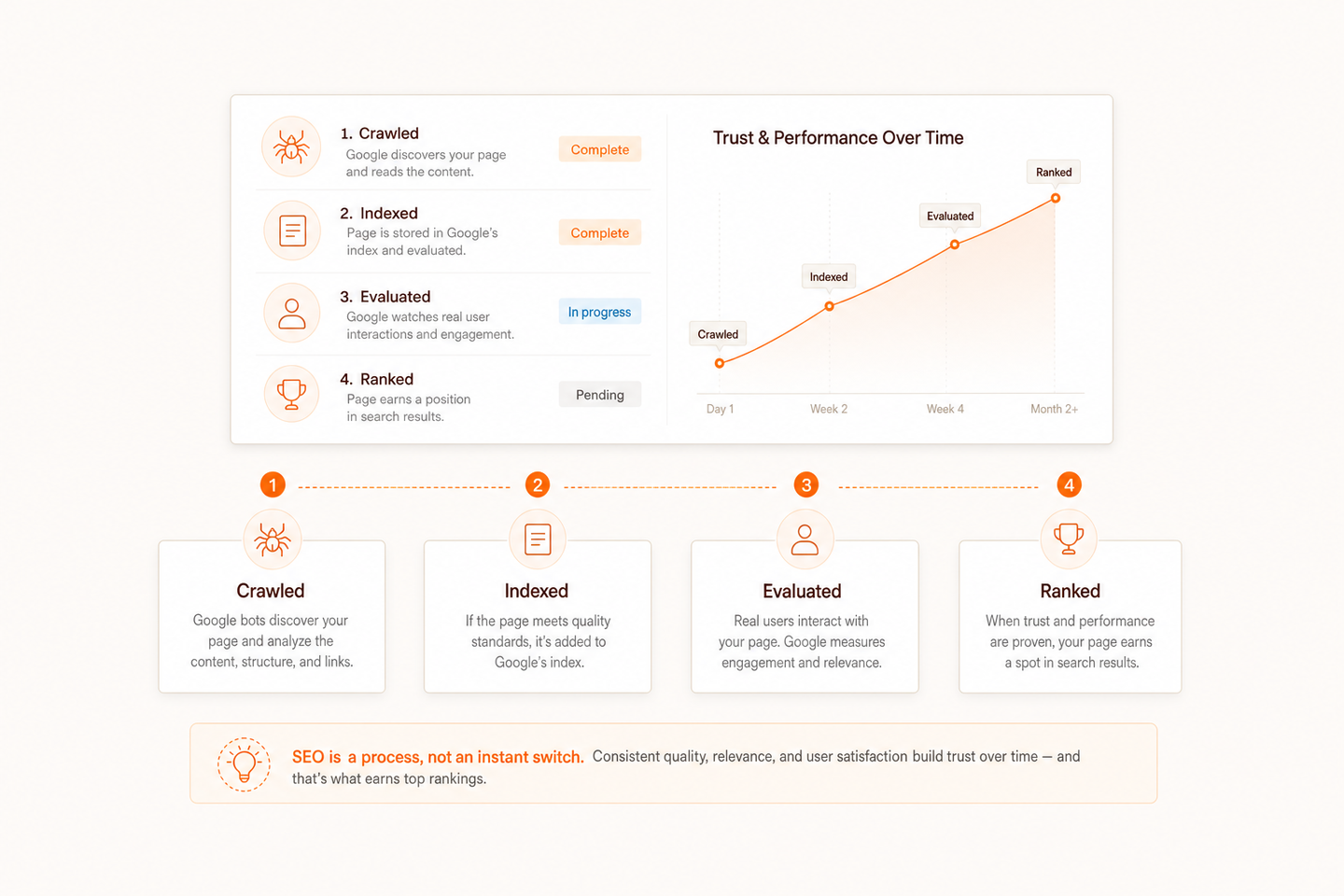
There are a few things happening in parallel:
- Crawling and indexing can take days to weeks depending on your site's authority and how often Google visits it.
- Once indexed, your page enters a testing phase where Google slots it into various positions and watches engagement signals like click-through rate and dwell time.
- Backlinks, which act as third-party votes of confidence, accumulate slowly and carry more weight as they age.
It compounds. A brand new site has no crawl history, no backlinks, and no user data for Google to work with, and Ahrefs research shows only 1.74% of pages make it to the top 10 within a year. Patience beats urgency in the first six months.
Month by Month: Your SEO Timeline Breakdown
The first six months follow a predictable arc:
- Month 1: Site audit, crawl error fixes, Google Search Console setup, keyword targeting finalized.
- Month 2: Technical fixes go live, indexing gaps get resolved, content publishing begins.
- Months 3-4: Google starts crawling new content consistently. You'll see impressions tick up in Search Console before clicks follow.
- Months 5-6: Rankings begin to stabilize. Pages with decent backlinks and strong content start landing in the top 20.
Don't expect revenue in month one. Expect data. The revenue conversation starts around month six, and only if you didn't stop publishing in month four.
The 7 Factors That Determine Your SEO Timeline
Seven things move SEO timelines, but three of them set your ceiling. Get these right and the other four become solvable. Get them wrong and the other four can't save you.
The three that matter most:
- Domain age and authority. New domains with no backlink history typically need 6-12 months before ranking for anything competitive. Sites with existing authority can see movement within weeks of publishing.
- Niche competition. The multiplier nobody talks about. Ranking for "best CRM for solo consultants" is a fundamentally different lift than ranking for "CRM software."
- Content quality and publishing cadence. Determines how fast Google indexes and judges your pages, and whether they hold position once they get there.
The other four still matter:
- Technical health, including crawlability, page speed, and proper indexing, can stall rankings entirely if it's broken.
- Backlink profile strength signals domain authority and affects how quickly new pages gain traction.
- Search intent alignment. If your page doesn't match what users actually want, rankings won't stick regardless of other factors.
- Local vs. national targeting. Local SEO moves faster because the competition pool is smaller and Google Business Profile signals carry real weight.
Local SEO Works Faster: Timeline for Local Businesses
The geographic boundary is the whole advantage. "Plumber in Austin" puts you up against dozens of businesses. "Plumber" puts you up against the entire trade.
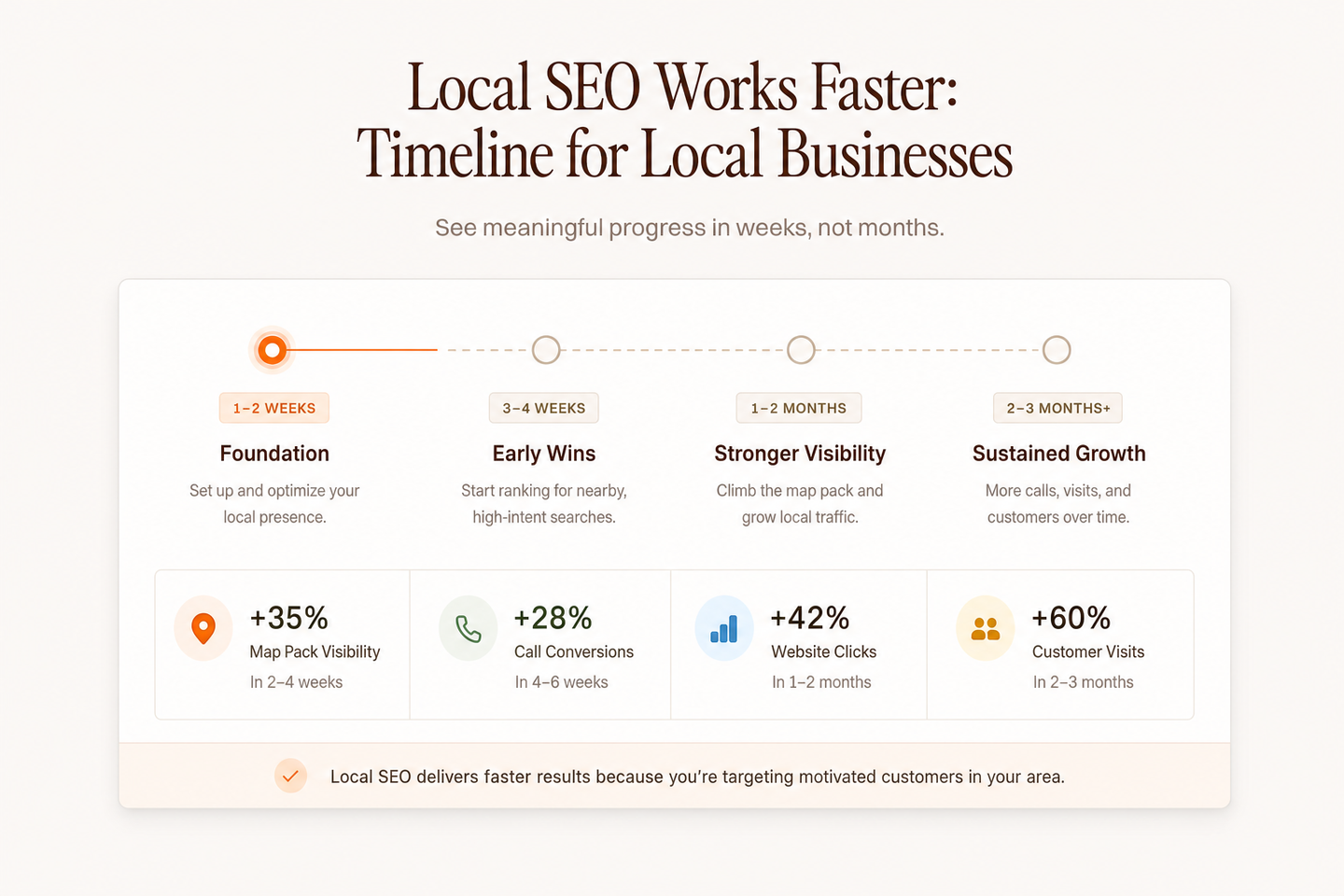
According to local SEO timeline research, most businesses see noticeable movement within 3 to 6 months. Businesses with existing reviews and citations often get there in 2 to 3.
The work is more scoped too. Google Business Profile completeness and NAP citation consistency across directories carry most of the weight. Add steady review volume and you're in solid shape.
How Technical SEO Impacts Your Timeline
Crawl errors, slow load times, and broken internal links don't just hurt user experience. They stall rankings for months. Google can't rank what it can't crawl.
A few things that consistently delay timelines:
- Slow page speed pushes crawl budgets thin, meaning Google visits fewer of your pages per cycle and delays indexing new content.
- Duplicate content issues confuse Google about which page to rank, splitting authority and suppressing both versions.
- Missing or misconfigured sitemaps leave Google guessing at your site structure, which slows discovery on larger sites.
- Broken internal links create dead ends in your crawl path, orphaning pages that may never get indexed.
The good news: technical issues are fixable, and fixing them produces faster ranking movement than almost anything else you can do. Run a crawl audit in Ahrefs or Semrush before touching content or links. If the foundation has problems, everything else is slower.
Content Freshness and the 90 Day Ranking Boost
Google's freshness signals are real. Most people just misread how they work.
Publish a new page and Google usually crawls it within a few days. Soon after, you'll see a short-lived ranking spike, what some people call the "Google Dance." The Google Dance is the volatility you see while Google tests your page in different ranking positions before settling on one. Don't get attached to that initial spike. It isn't your real position.
The more durable freshness signal comes from consistent updates. Pages that get revisited, expanded, or refreshed tend to hold rankings better than pages left untouched for 12+ months.
The 90-day window isn't a formal Google rule. It's a pattern I've seen repeatedly: sites that publish and update consistently in their first 90 days build indexing momentum faster. Google crawls them more often. Ranking changes show up sooner.
A few things worth doing in that window:
- Fix thin pages before they get indexed with weak signals. A 300-word stub that gets crawled and ignored is harder to rescue than a page you catch before Google forms an opinion.
- Update your sitemap in Google Search Console every time you publish. Don't wait for passive discovery.
- Revisit any page sitting below position 10 after 60 days. A targeted content expansion often moves it faster than publishing something new.
The freshness advantage is real. It isn't magic, and it won't save thin content, but on top of pages worth ranking it stacks fast.
How to Speed Up Your SEO Results Without Shortcuts
You can't skip the timeline, but you can stop adding to it. Four things move the needle, and they compound in order.
- Fix your technical foundation first. Crawl errors, slow load times, broken internal links: clean those up before anything else, because they delay indexing on every page you publish after.
- Publish consistently. Google rewards sites that show up on a schedule, not sites that drop 20 posts in a weekend and go quiet for months.
- Target low-competition keywords early. New sites don't rank for broad terms. Find long-tail queries with real intent and build from there.
- Build links the right way. One link from a relevant, authoritative site beats fifty directory submissions.
Common Mistakes That Stall Your SEO Timeline
The most common way to stall a timeline is stopping at month 3 or 4, right when rankings are about to stabilize. Consistent effort compounds. Stopping resets the clock.
A few other reliable ways to see zero results:
- Targeting head terms your domain has no business competing for yet. Start with long-tail, win those, then climb.
- Publishing content misaligned with search intent. Google checks whether your page actually satisfies what the searcher wanted. If it doesn't, the ranking won't hold regardless of how well-optimized the page is.
- Tracking rankings before tracking impressions. In months 1 through 3, impressions in Search Console are the leading indicator. Rankings are the lagging one.
Measuring Progress Before Rankings Improve: Early SEO Indicators
Rankings are a lagging signal. Watch them exclusively and you're flying blind for months while the actual work is happening underneath.
Google Search Console is where you start. Watch for crawl coverage improvements, index rate increases, and clicks on queries where you're sitting at positions 8-15. Movement in that range means you're close.
A few other things worth tracking early:
- Crawl frequency tends to pick up within a few weeks of publishing new content or earning backlinks, which tells you Google is paying attention to the site.
- In the client data I've tracked, impressions in Search Console typically climb 4-6 weeks before any click movement. If impressions are up, rankings are quietly shifting.
- Pages getting indexed faster than before signals your site's authority is building, even when the rankings dashboard looks flat.
Don't ignore these signals just because they're not conversions. They tell you whether the work is actually moving.
How Maintouch Accelerates SEO Timelines Through Automation
Most SEO timelines are slow because the work is slow, and most teams are bottlenecked at every step of it.
Maintouch automates the parts that create the most drag. Content briefs, on-page optimization, internal linking, and technical audits run on a schedule instead of waiting on a human queue. Your site keeps producing and publishing consistently, which is what Google actually rewards.
In my experience, sites that publish consistently outpace competitors who publish in bursts. Automation doesn't skip the work. It removes the lag between each step.
Final Thoughts on Setting Realistic SEO Expectations
The timeline isn't negotiable. Your execution speed is. Sites that publish on a schedule and fix technical issues early move faster than sites that publish in bursts and ignore crawl errors. Track impressions before rankings. Don't stop at month 3 because nothing looks different yet; that's the month right before everything starts to.
If you want help removing the lag between deciding what to do and actually doing it, that's what I built Maintouch for. Bang my line if you want to talk through your timeline.
FAQ
How long does it take to see SEO results for a new website?
Most new sites start seeing measurable movement in 3 to 6 months, with real traction in 6 to 12 months. Brand-new domains with no authority need the longer end of that range because Google has no crawl history, backlinks, or user data to work with.
Why does SEO take so long to start showing results?
Google treats new content with skepticism and needs time to crawl pages, index them, and watch how users interact before committing to ranking positions. Backlinks accumulate slowly, user engagement data takes time to build, and the whole process compounds over months instead of weeks.
How long does local SEO take to work compared to national SEO?
Local SEO typically moves faster, showing results in 3 to 6 months instead of 6 to 12. The geographic boundary shrinks your competition pool from thousands of sites to dozens, and Google Business Profile signals carry real weight in local rankings.
Can I speed up SEO results without using shortcuts or black hat tactics?
Fix technical crawl errors and slow load times first, publish content consistently instead of in bursts, target low-competition long-tail keywords early, and build links from relevant authoritative sites. Clean technical foundation plus consistent publishing beats any shortcut.
How long does it take to rank on the first page of Google?
For new domains, plan on 6 to 12 months for page one on anything competitive. Long-tail terms with low competition can land on page one in 3 to 6 months if the page matches search intent and the site has no major technical drag. Head terms with high commercial intent often need 12+ months and a real backlink profile.
How long does it take Google to index a new page?
Anywhere from a few hours to a few weeks. Sites with existing authority and a clean sitemap usually get indexed within a few days. New domains with no crawl history can wait 2 to 4 weeks before pages show up in Search Console, and submitting the URL manually in GSC speeds things up.
Can SEO work in 30 days?
For a brand new site, no. You can fix technical issues, publish foundational content, and get pages indexed in 30 days, but rankings that drive traffic take longer. The one exception is a site with existing authority adding well-targeted long-tail pages, which can move within weeks.
How long should I wait before changing my SEO strategy?
Give a strategy at least 6 months before deciding it's broken. Impressions, crawl frequency, and rankings between positions 8 and 15 are the signals worth tracking in that window. If impressions are flat after 4 to 6 months and your technical foundation is clean, that's when to revisit keyword targeting or content depth.
Why did my rankings drop after a few weeks?
That's the Google Dance, the volatility while Google tests your page in different positions before settling on one. It's normal in the first 2 to 8 weeks after a page gets indexed. Don't react to the dips. Wait for the position to stabilize before judging the page.
How often should I publish content to speed up SEO?
Consistent cadence beats volume. One to two well-targeted pages a week works better than 20 posts in a weekend followed by silence. Google rewards sites that show up on a predictable schedule because it builds crawl frequency and signals an active site worth revisiting.
Does SEO traffic last, or do rankings drop off over time?
Rankings hold as long as the page stays relevant and Google sees signs of freshness. Pages left untouched for 12+ months tend to slip as competitors update theirs. A quarterly refresh on top-performing pages is usually enough to keep positions stable.
Turn search into your best growth channel.
Maintouch tracks your visibility across AI and Google, creates and refreshes content, and gets your brand mentioned on the sites that shape discovery.
Book a demoRelated reading
All posts