
Top 5 Peec AI Alternatives & Competitors [October 2026 Update]

By Bennett Cohen
Get Maintouch
Turn search and AI visibility work into a repeatable growth system.
If what you need is execution, Peec AI is the wrong tool. It watches how often your brand shows up when ChatGPT, Perplexity, or Gemini responds to buyer prompts, and it reports that frequency cleanly. Citation rates, competitor share, sentiment across engines, all trackable now. The scoreboard tells you a competitor is cited twice as often as you are. What it doesn't do is write the content, earn the links, fix the technical issues, or coordinate the cycle that turns visibility data into actual mentions. That work still lives on your team. This roundup covers the five alternatives worth considering, ranked by how much of that gap each one actually closes.
TLDR:
- Peec AI is a monitoring dashboard. It tracks brand citations across AI engines, shows competitor share, and stops there. No content, no technical fixes, no execution.
- Base plans cover three engines. Adding Claude, Gemini, or others costs €20 to €30 per engine per month, which can double your bill once you want full coverage.
- Semrush and Ahrefs bolt AI monitoring onto existing SEO data suites. OtterlyAI and PromptWatch track visibility across multiple engines. None of them execute the work.
- Maintouch tracks all five engines and runs the content strategy, technical SEO, and backlink procurement inside one system, with a dedicated strategist on every paid plan. The free tier covers 35 prompts across all five engines for a year.
What Is Peec AI and How Does It Work?
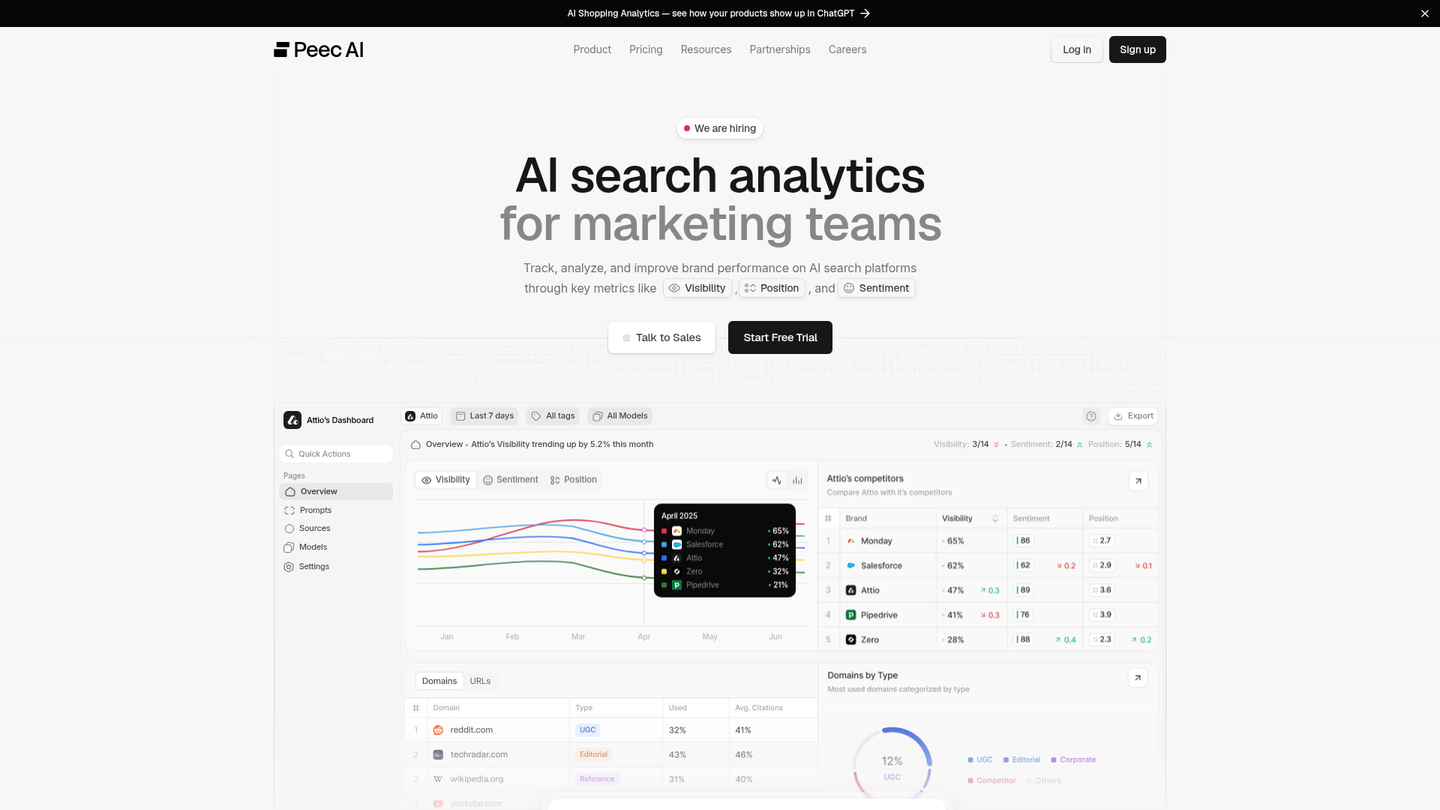
Peec AI tracks how brands show up in answers generated by AI engines. Instead of reporting on blue-link rankings, it watches whether your brand gets mentioned when someone asks ChatGPT, Perplexity, or Gemini a question in your category. You feed it prompts that matter to your business; it runs them across the engines it covers and logs where your brand appears, where competitors show up instead, and how often each surfaces over time. The core function is measurement, and that's where it stays. A Peec AI review from Found Labs lands on the same conclusion: this is an LLM visibility tracking product, and tracking is where it stops.
Who it targets:
- Marketing teams that want to see their share of AI-generated answers
- Agencies managing visibility for multiple clients
- Brands benchmarking against competitors across AI engines
Under the hood, it's a dashboard. You log in, read the numbers, and decide what to do next. A breakdown of Peec AI pricing and features puts it plainly: monitoring product first, execution left to you. Peec AI reports what needs doing. It doesn't do the work. Every tool in this roundup either closes that gap or opens a new one.
Why Consider Peec AI Alternatives?
Peec AI does a few things genuinely well. The interface is clean, the citation data goes down to the source level, and the competitor benchmarking gives you a clear read on who's getting cited instead of you. Sentiment analysis shows how your brand gets framed in answers, beyond whether it appears.
Where it gets thin is everything after the dashboard.
Base plans cover three AI engines. Add Claude, Gemini, or anything beyond the default three and you're paying €20 to €30 per engine per month, which can quietly double your bill once you want real coverage. Entry tiers also cap prompt volume, so a serious prompt set pushes you up the pricing ladder fast.
What it doesn't touch at all, per a rundown of Peec AI alternatives:
- No content creation
- No Google rank tracking or traditional SEO features
- No traffic attribution
- No technical SEO execution or CMS integration
- No human support: you interpret the numbers and figure out next steps on your own
API access and SSO are Enterprise-only. Pipe the data into your own stack and you're on the top plan; otherwise you're copying figures by hand.
If all you need is a scoreboard, Peec AI is a fine one. If you need something that acts on what the scoreboard shows, keep reading.
Best Peec AI Alternatives in July 2026
1. Maintouch - Best Overall Peec AI Alternative
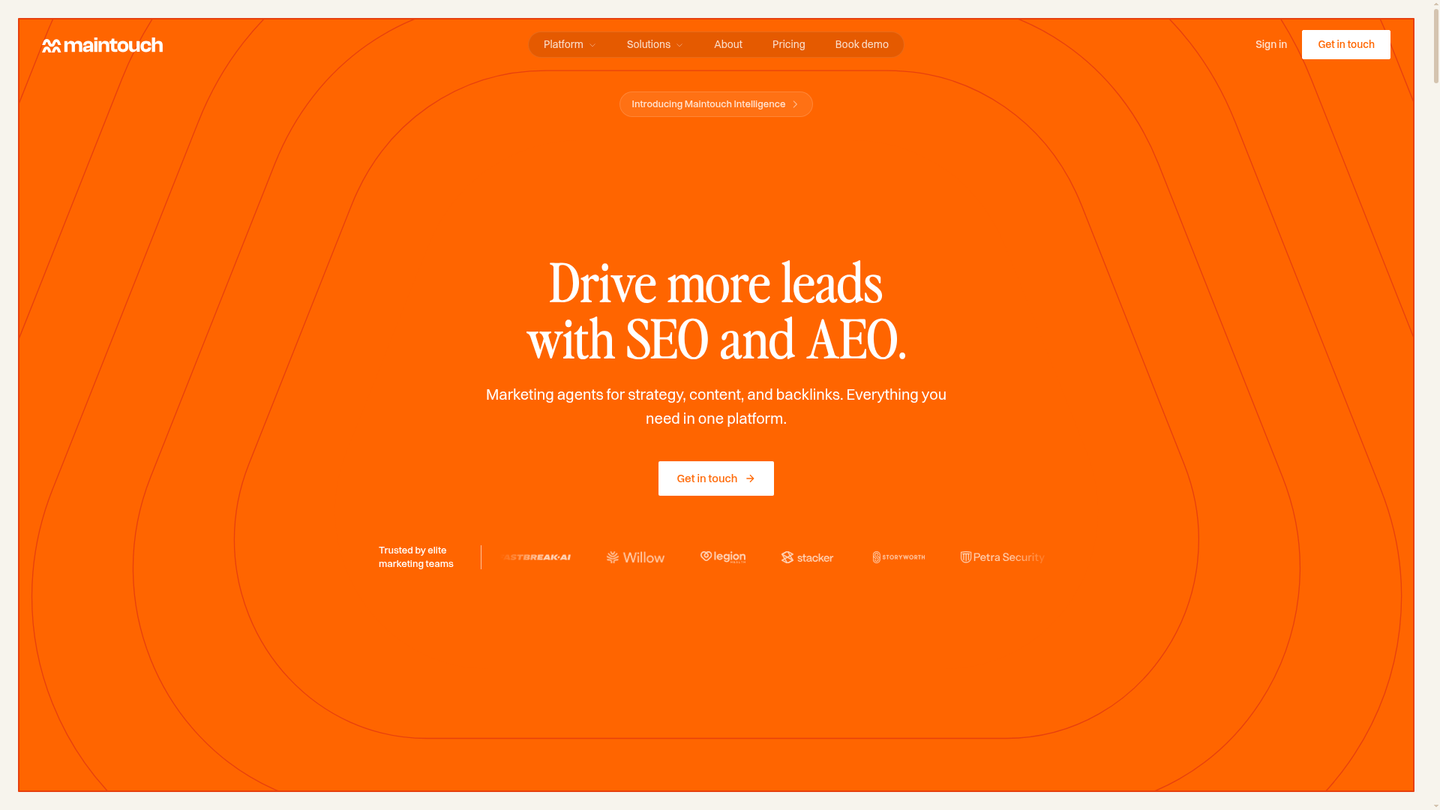
I built Maintouch because I kept watching teams get the monitoring right and the execution wrong. It tracks AI visibility across all five engines (ChatGPT, Claude, Gemini, Perplexity, and AI Overviews), then runs the work to improve it: content strategy, creation, technical SEO, backlink procurement, schema automation.
The Maintouch free tier tracks 35 prompts across all five engines for a full year, no credit card. That's more free coverage than Peec AI's $95/month Starter plan, which caps at three engines and 50 prompts.
Every paying account gets a dedicated forward-deployed strategist (weekly standing sync, dedicated Slack channel) while agents run execution. Technical fixes push live to your CMS without a developer queue. The longer it runs on your content, the sharper the output gets, because it learns your positioning and voice from every cycle.
Best for: B2B SaaS, venture-backed brands, and founder-led teams that want the whole operation run for them.
Bottom line: Peec AI shows you the problem. Maintouch fixes it. See the full Maintouch vs Peec AI breakdown for a closer look.
2. Semrush
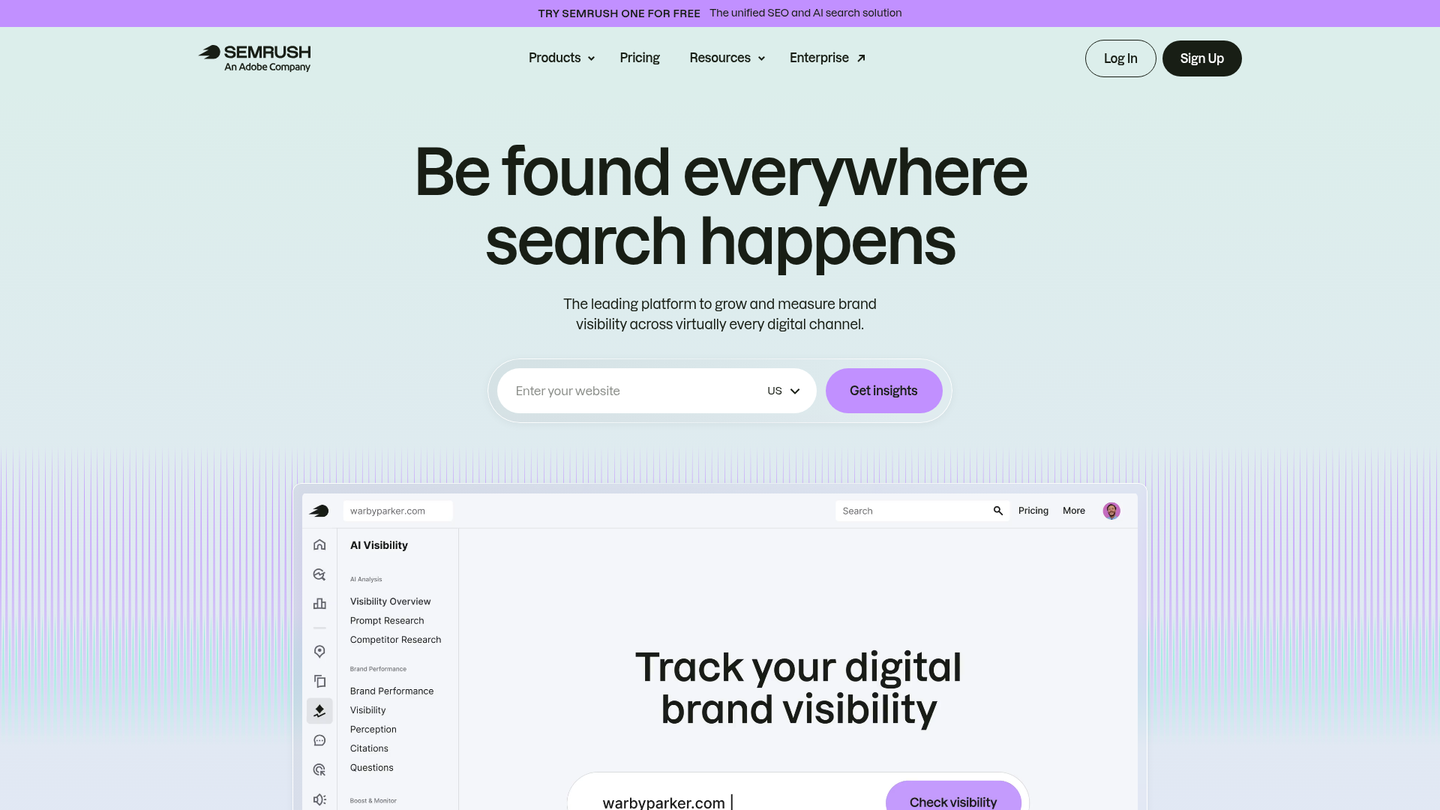
Semrush solves the SEO data problem. It's a mature data suite that bolted AI Overviews monitoring onto its existing stack. If you're already paying for it, the keyword research, rank tracking, and competitive intelligence are genuinely useful, and basic AI visibility comes along for the ride.
Good for: teams already running Semrush who want AI visibility without adding another tool.
Limitation: AI coverage stops at Google AI Overviews, so you're missing four other engines. It won't push CMS fixes, build backlinks, or ship content on your behalf, and there's no free AI tier to test against.
Bottom line: strong data, reporting only.
3. Ahrefs
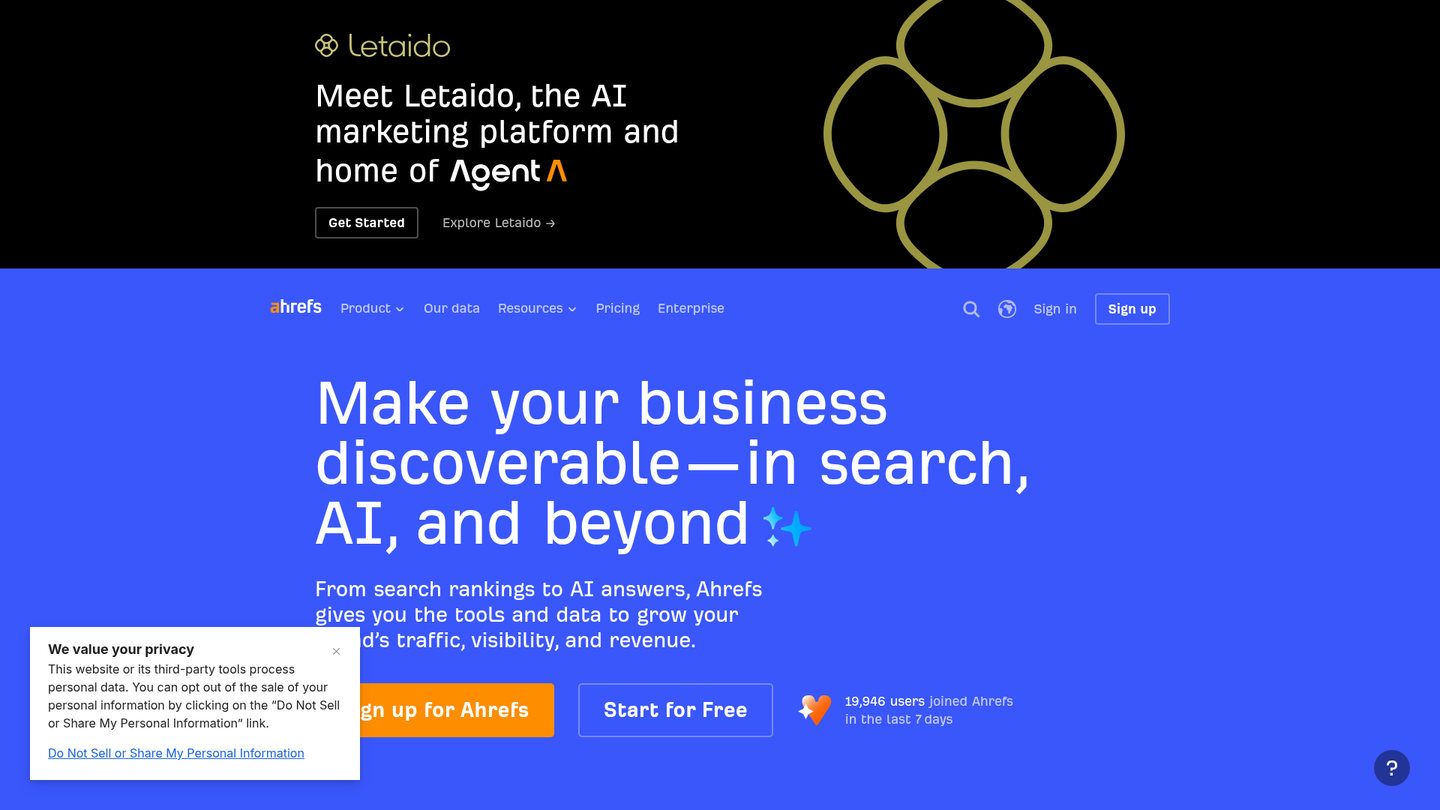
Ahrefs solves the backlink intelligence problem. The link index is one of the deepest available, and the keyword research and site audit tools hold up well alongside it. AI visibility comes through the Brand Radar add-on. See the Maintouch vs Ahrefs comparison for a closer look.
Good for: teams with deep SEO data needs who want backlink intelligence alongside basic AI brand monitoring.
Limitation: full AI coverage requires Brand Radar on top of the base subscription, which adds cost, and the tool won't execute content, CMS fixes, or backlinks on its own. No free AI tier.
Bottom line: a strong data resource. It reports where Maintouch acts.
4. OtterlyAI
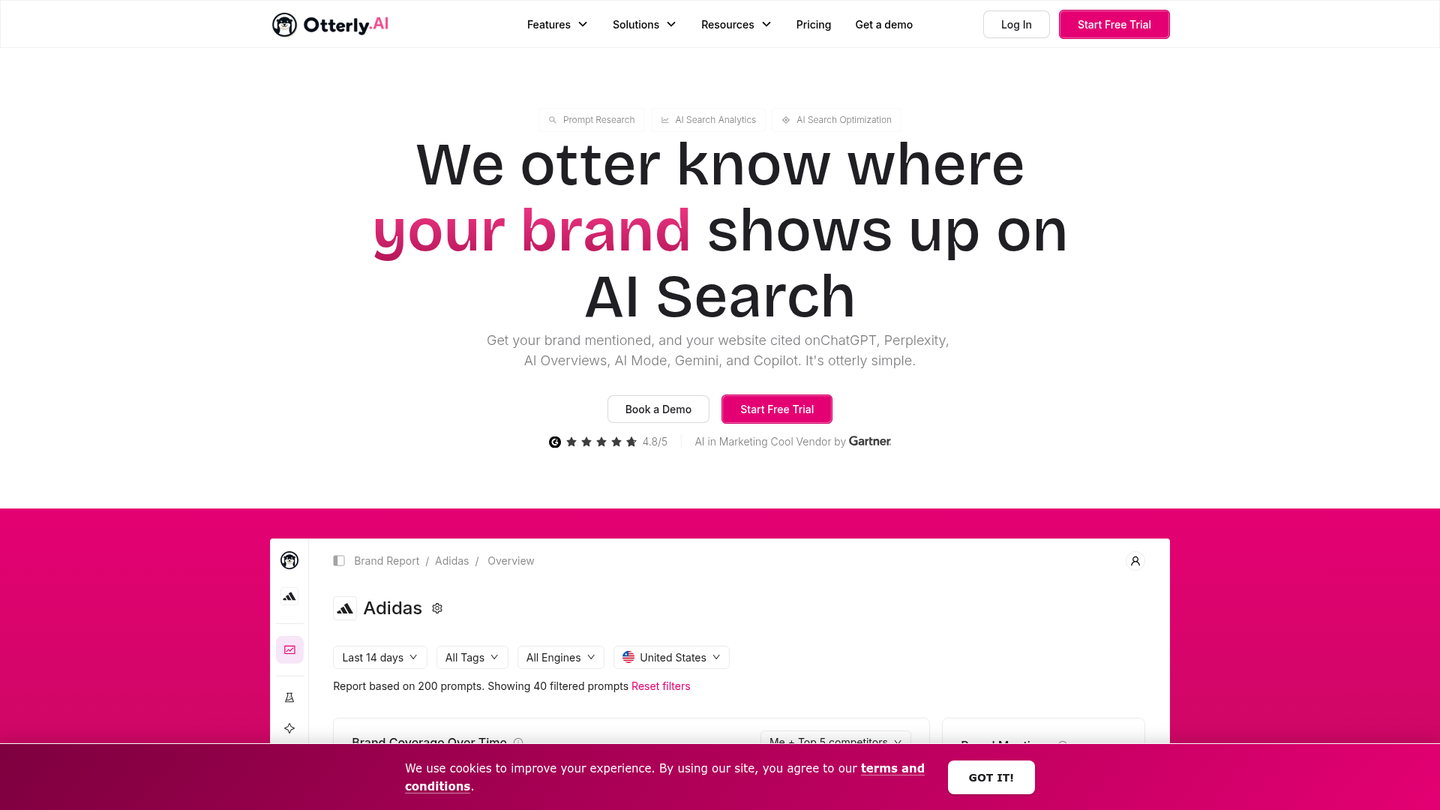
OtterlyAI solves the baselining problem. If you're early-stage and need to know where you stand before committing to higher-tier spend, it's a clean, low-cost entry point. You get prompt tracking, a Brand Visibility Index, domain citation tracking, and a competitor module.
Good for: early-stage startups baselining visibility before higher-tier spend.
Limitation: it audits content but won't create or rewrite it, skips technical AEO factors like schema and robots.txt, and doesn't tie mentions to traffic without manual work.
Bottom line: fine for a first read, thin once you need to act on what you see.
5. PromptWatch
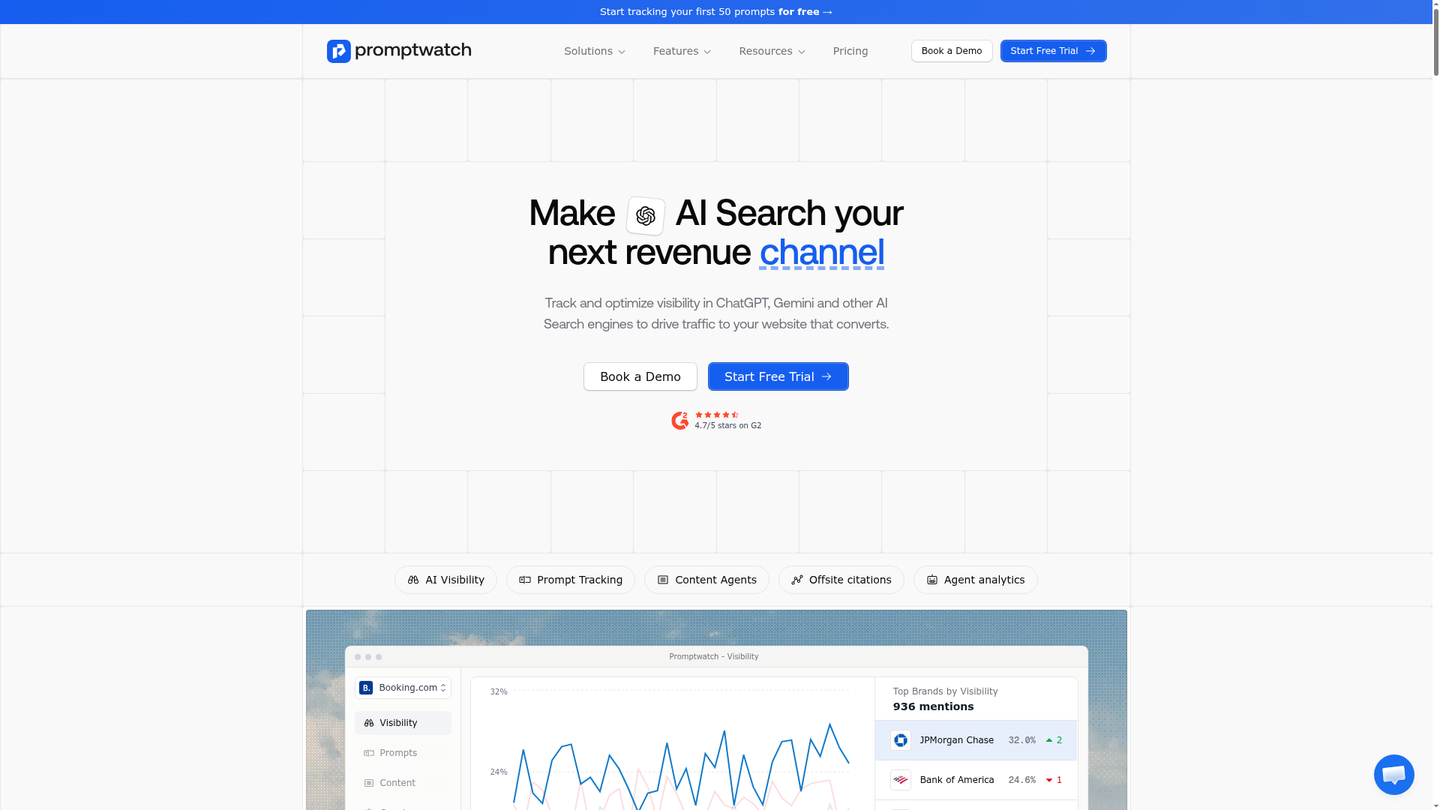
PromptWatch solves the visibility depth problem. It tracks citations across ChatGPT, Gemini, Claude, Perplexity, and Copilot, and goes further than most monitoring tools by adding AI crawler logs (showing when bots read your pages), page-level visibility tracking, and a content agent that generates pages designed to get cited. Trusted by 7,000+ brands including Yelp, Duolingo, and Typeform. For a broader view of how the category breaks down, the best AEO tools ranking covers the full field.
Good for: teams that want deeper visibility analytics (crawler logs, page-level tracking, Reddit insights) beyond basic prompt monitoring.
Limitation: content agents generate pages but don't handle technical SEO, backlinks, or CMS integration. No human strategist. The execution gap between seeing the data and shipping the fix still falls on your team.
Bottom line: the deepest pure-monitoring tool in this list. Still a scoreboard, not a system that ships work.
Feature Comparison: Peec AI vs Top Alternatives
Here's where the split becomes clear. The features below are the ones that decide whether you walk away with a scoreboard or a system that ships work.
| Feature | Maintouch | Peec AI | Semrush | Ahrefs | OtterlyAI | PromptWatch |
|---|---|---|---|---|---|---|
| AI Visibility Tracking | Yes | Yes | Yes (AI Overviews) | Yes (Brand Radar) | Yes | Yes |
| AI Engines Tracked | 5 | 3 (add-ons for more) | AI Overviews | Via add-on | Multi | 5 (incl. Copilot) |
| Content Creation | Yes | No | No | No | No | Limited (Content Agents) |
| Technical SEO Execution | Yes | No | No | No | No | No |
| Backlink Procurement | Yes | No | No | No | No | No |
| CMS Integration | Yes | No | No | No | No | No |
| Human Strategist Included | Yes (every plan) | No | No | No | No | No |
| Free Tier Available | Yes | No | No | No | Yes | Yes (50 prompts) |
The pattern in the execution rows is hard to miss. Peec AI, OtterlyAI, and PromptWatch all track. PromptWatch adds content agents, but none of them run technical fixes, build links, or push to your CMS. Semrush and Ahrefs bolt AI visibility onto their existing data suites. Useful? Yes. But the report still hands off to a separate workflow you coordinate yourself.
Maintouch closes that loop. Content, technical execution, and backlinks run inside one system, with a dedicated strategist on every plan aligning priorities while agents handle the work. The others open a new tab in your stack. Maintouch replaces the stack.
Why Maintouch Is the Best Peec AI Alternative
Peec AI reads the room well. Clean dashboard, granular citation data, clear read on who's winning the answers you want. For a side-by-side breakdown, see the Maintouch vs Peec AI feature comparison. Monitoring is where it stops, though, and monitoring alone leaves you holding a report with no one to run it.
Where Peec AI hands you a report, Maintouch ships the work. Same five engines tracked, plus the content, technical fixes, and backlinks that actually move citation numbers forward.
The difference shows up in the labor math. Peec AI's subscription still needs an Ahrefs seat, a writer, an outreach tool, and someone to act on every report you pull. If you're also considering Profound, the Peec AI vs Profound comparison breaks that down. Realistically you're stacking a few thousand a month before a single page ships. Maintouch is one flat number, and the work happens inside the same system.
Every paid plan includes a strategist who owns the interpretation layer: what to prioritize, what to ignore, what to ship next. That's the thinking Peec AI leaves entirely to you.
I've watched enough teams buy a monitoring tool, stare at the numbers for three months, and then ask who's going to do the actual work. If you're weighing full-service options, the Maintouch vs Profound breakdown covers another key alternative.
Final Thoughts on Picking a Peec AI Alternative
Tracking your AI visibility is worth doing. The harder question is what happens after you see the numbers, and that's where most teams stall. Four of the five tools in this roundup give you a clear read on where you stand, then hand the work back to you. One of them runs it. If you want to talk through what execution actually looks like for your stack, shoot me a message at [email protected]. No pressure.
FAQ
Why do teams switch away from Peec AI to a tool like Maintouch?
Peec AI stops at the dashboard. It shows you which prompts cite competitors instead of you, and then hands the problem back. Most teams switch when they realize that monitoring data is only useful if someone is running content, technical fixes, and backlinks on the back of it. Peec AI doesn't do any of that.
What should you look for in a Peec AI replacement if you need more than monitoring?
Cover all five major AI engines (ChatGPT, Claude, Gemini, Perplexity, and AI Overviews), execute content and technical fixes inside the same system, and don't require stacking Ahrefs, a writer, and an outreach tool on top just to get anything done. The question worth asking every alternative is simple: does it close the loop, or does it just open a new one?
When does switching from Peec AI to Maintouch make sense?
If your team is pulling Peec AI reports, interpreting the citation gaps, and then asking who's going to write the content, fix the schema, or build the links, that's the signal. Maintouch is built for teams that want the work executed, not merely surfaced.
How does Maintouch track AI visibility differently than Peec AI?
Maintouch tracks citations across all five AI engines on every plan (including Claude) with no add-on fees. Peec AI's base plans cover three engines and charge €20 to €30 per month for each one you add. The free tier at maintouch.com/free tracks 35 prompts across all five engines for a full year, no credit card required.
Can Maintouch replace the full stack you'd need alongside Peec AI?
Yes. Peec AI's subscription still requires separate tools for SEO data, content creation, technical execution, and backlink building. You're realistically at several thousand dollars a month before a single page ships. Maintouch runs content strategy, creation, technical SEO, backlink procurement, schema automation, and citation tracking inside one system at a flat rate, with a dedicated strategist on every paid plan.
Is there a free way to track AI visibility without committing to a paid plan?
Yes. Maintouch's free tier at maintouch.com/free tracks 35 prompts across all five AI engines (ChatGPT, Claude, Gemini, Perplexity, and AI Overviews) for a full year with no credit card required. That's more free coverage than Peec AI offers at any tier, and it includes Claude, which many competitors gate behind enterprise pricing.
Does Peec AI track Google AI Overviews?
Peec AI's base coverage focuses on AI chat engines. Google AI Overviews, which appears directly in Google search results, is a distinct surface that requires separate tracking infrastructure. If AI Overviews coverage matters for your visibility strategy, verify whether your tool of choice includes it. Maintouch tracks all five engines, including AI Overviews, on every plan.
What's the difference between AI visibility monitoring and AEO?
AI visibility monitoring is the measurement layer. It tells you whether your brand appears in AI-generated answers and how often. AEO (Answer Engine Optimization) is the execution layer: the content, technical SEO, schema, and backlink work that moves those numbers. Peec AI handles monitoring. Maintouch does both: tracks citations across all five engines and runs the execution that improves them.
How long does it take to see improvement in AI citation rates after switching tools?
In my experience, most sites see meaningful movement in citation share within 8 to 12 weeks of running structured execution: consistent content optimization, schema coverage, and backlink work. The monitoring data is immediate, but citation rate improvement is a compounding process. Don't expect a jump from a dashboard change alone; the lever is the execution behind it.
Can a small team or solo founder actually use these AI visibility tools effectively?
Monitoring-only tools like Peec AI are easy to set up. The real cost shows up when you have to act on the data yourself. That handoff from report to execution is exactly where small teams stall. Maintouch is built for founder-led teams and venture-backed brands that want the full operation run for them, not handed back as homework.
What happens to Peec AI's pricing if I want to track more than three AI engines?
Each additional engine beyond Peec AI's base three (Claude, Gemini, or others) costs an extra €20 to €30 per month. If you want full five-engine coverage, you can quietly end up paying far more than the headline price. Maintouch includes all five engines on every plan, including the free tier, with no add-on fees.
Turn search into your best growth channel.
Maintouch tracks your visibility across AI and Google, creates and refreshes content, and gets your brand mentioned on the sites that shape discovery.
Book a demoRelated reading
All posts