
How to Get Cited in AI Overviews: 9 Proven Strategies for September

By Bennett Cohen
Get Maintouch
Turn search and AI visibility work into a repeatable growth system.
Rankings used to be the whole game. Now they're table stakes.
Google's AI Overview pulls from multiple sources before anyone scrolls, and getting cited in that box matters more than sitting at position one below it. Cited brands tend to earn meaningfully more organic clicks per impression than sites ranking below the box, but the logic that decides who gets quoted runs separately from traditional ranking factors.
I've been doing SEO for over a decade, and Maintouch serves hundreds of marketers. I've watched citation strategies replace traditional ranking tactics across our entire customer base. The shift happened fast, and within eighteen months the playbook changed.
My goal: you walk away with nine citation strategies you can execute this week, plus the measurement framework to track what's working.
TLDR:
- Cited brands earn 120% more clicks per impression than those just ranking high.
- Brand mentions link 3x stronger to AI visibility than backlinks (0.66 vs 0.22).
- Pages with schema markup have a 2.5x higher chance of appearing in AI answers.
- Content updated in the last 90 days gets cited 4.3x more often than stale pages.
- Maintouch tracks citation frequency across ChatGPT, Perplexity, and AI Overviews with API access for 1,000+ concurrent prompts, all from one system.
What Are AI Overviews and Why Citations Matter More Than Rankings
AI Overviews are the AI-generated summaries Google drops at the top of the results page, pulling from multiple sources before anyone scrolls. The blue links still exist, but they sit below an answer most people read first.
That placement shift changes everything. Ranking number one matters less when the box above you controls what gets seen. What matters now is getting pulled in as a cited source.
88% of AI Overviews cite multiple sources, and cited brands earn roughly 120% more organic clicks per impression. Getting referenced beats ranking. That's not theory; it's what the data shows across thousands of queries.
How AI Engines Decide What to Cite
AI engines don't read your page the way Google's old crawler did.
A question gets broken into related sub-queries, run in parallel, then assembled from whatever fits each piece. That's query fan-out.
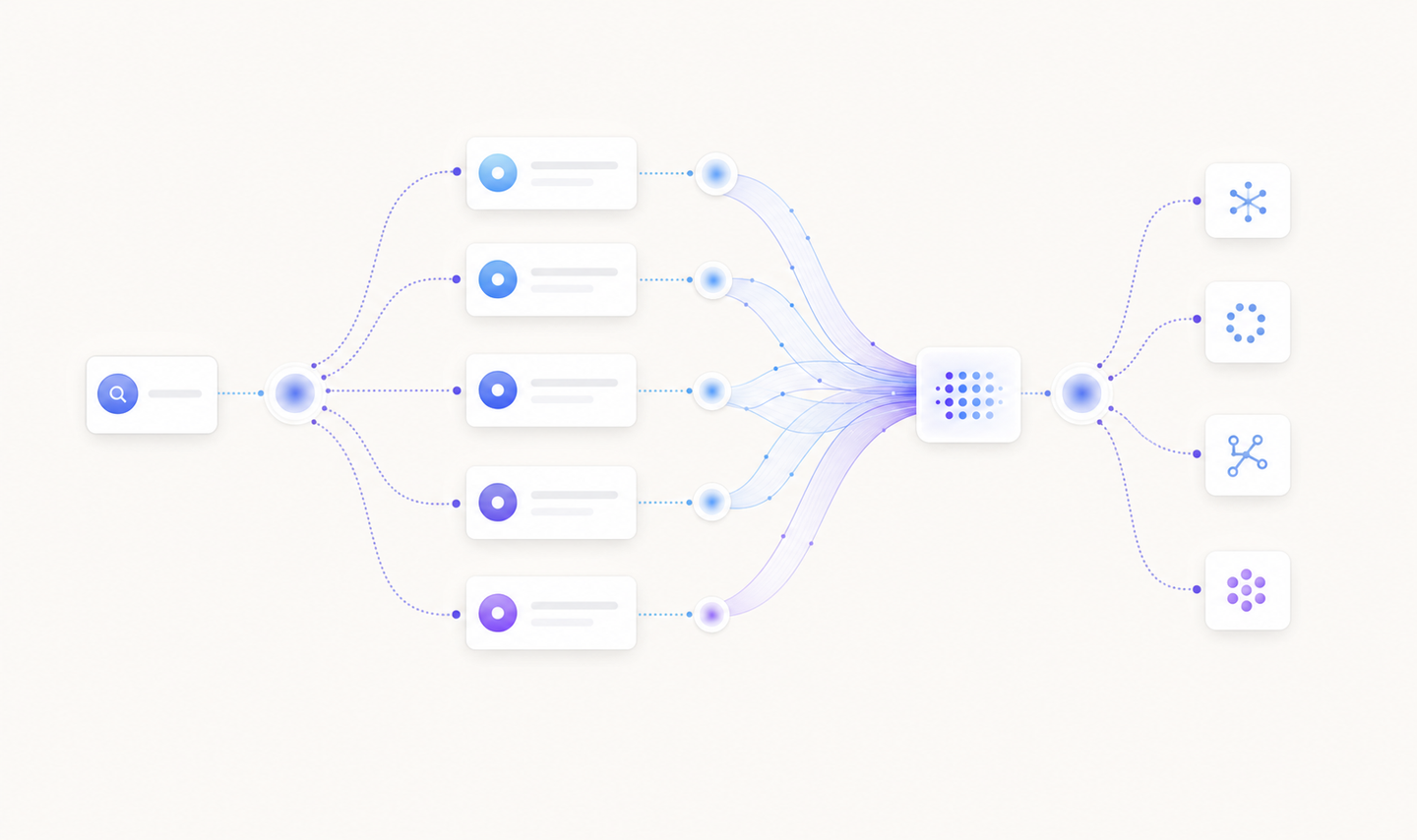
The engine looks for passages that answer one sub-question cleanly, with the entities it expects. Your overall ranking matters less than whether one chunk nails one piece.
The data shows this decoupling in real time. Through H2 2025, most cited pages also ranked in the top 10. Through the first half of 2026, that overlap has dropped sharply. Optimize for the answer, not the rank.
Strategy 1: Build Brand Mentions Across the Web
Backlinks used to be the whole game. Now unlinked brand mentions matter more.
Brand mentions tie 3x stronger to AI visibility than backlinks: 0.66 versus 0.22. Chase mentions, not links. YouTube mentions show the strongest link, ahead of every other signal across ChatGPT, AI Mode, and AI Overviews. For a deeper breakdown, see our guide on the differences between GEO and SEO.
What to go after:
- Earned media and digital PR placements that name you directly
- Product mentions on relevant YouTube channels
- Coverage in industry roundups, comparison posts, and review sites
- Distribution across forums where buyers ask questions
The mention itself carries weight. The link is optional.
Strategy 2: Add Original Statistics and First-Party Data
Generic claims get skipped. Numbers get cited.
Academic research on generative search has found that adding statistics measurably boosts visibility in AI answers. AI engines want figures they can lift and attribute, so a page with a hard number and a clear source is safer to quote than one that hedges.
What pulls citations:
- Proprietary data from your product, surveys, or customer base
- Original research nobody else has published
- Specific figures with context, not vague ranges
Run your own numbers. A stat only you can report is one the engine has to credit to you. That's the whole advantage.
Strategy 3: Implement High-Impact Schema Markup
Schema doesn't write your content, but it tells the engine what each piece is.
Pages with proper structured data have a 2.5x higher chance of appearing in AI answers. Complete markup drives up to 40% more AI Overview appearances. If you're still picking targets, our keyword research tools roundup covers what to plug into.
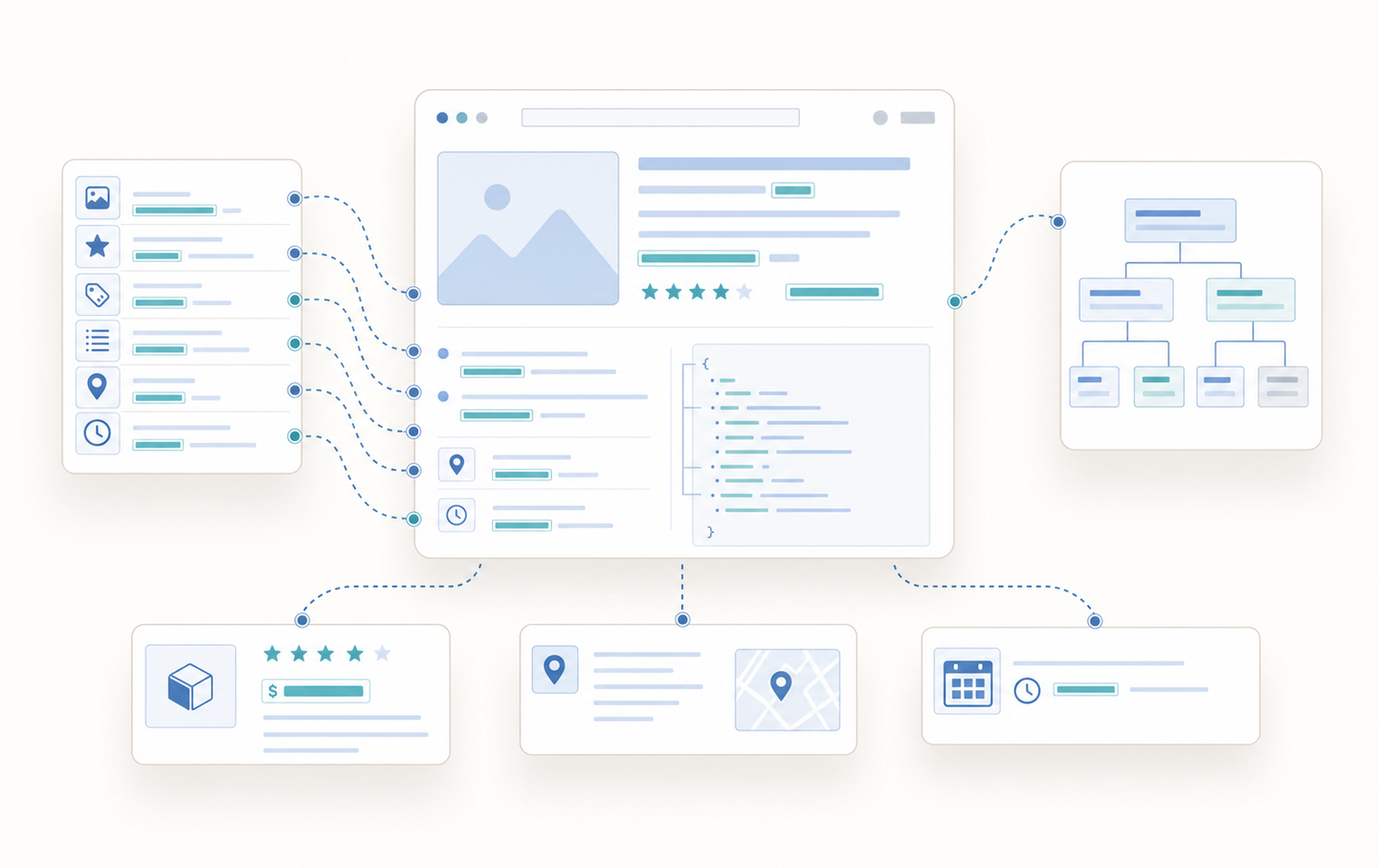
The schema types that pull weight:
- FAQPage for question-and-answer blocks the engine can lift whole
- Article for bylines, dates, and publisher signals
- HowTo for step sequences
- Organization to tie your brand to a verified entity
One caveat: Ahrefs found schema alone isn't a shortcut. The content still has to be worth quoting.
Strategy 4: Optimize Content Structure for Extraction
How a passage is shaped decides whether it gets lifted.
Content that scores high on semantic completeness is far more likely to be cited. AI tends to favor self-contained chunks of roughly 130 to 170 words.
Run the extraction test on every section: Could the engine pull this paragraph alone, with no surrounding context, and have it still make sense? If the answer depends on the heading three levels up, rewrite it.
Two rules that move the needle:
- Front-load the answer in the first 30% of the content, before the supporting detail
- Write at the passage level, so each chunk resolves one question on its own with the entity named inside the block
Strategy 5: Strengthen E-E-A-T Signals
E-E-A-T works as a gate, not a dial.
The vast majority of AI Overview citations come from sources with strong E-E-A-T signals. Weak signals don't lower your odds gradually; they tend to keep you out entirely.
What the engine checks for:
- Named authors with real credentials and a bio tied to a verified profile
- First-hand experience signals like original screenshots, test results, and lived detail a generalist couldn't fake
- Expertise it can confirm against other sources, not self-declared
- Third-party validation through citations, reviews, and mentions you didn't write
Pass the filter first. Then the rest of your optimization counts. That's the order of operations.
Strategy 6: Create Self-Contained Answer Blocks
Strategy 4 covered shape. This one's about language.
Cited passages skew heavily toward definitive phrasing. Hedging tends to get you skipped.
Write blocks that stand alone and commit to an answer:
- Open each answer with a direct claim, not a windup. "X takes 90 days" beats "it can sometimes take a while"
- Build a real FAQ section with the question as the heading and a two-sentence answer below it
- Drop a short summary box atop long pieces, phrased so the engine can lift it whole
Say the thing, then back it up. That order matters.
Strategy 7: Keep Content Fresh and Updated
Stale pages fall out of the citation pool.
Content updated in the last 90 days gets cited far more often than stale pages, and most AI Overview citations point to content less than two years old. Recency is a filter the engine applies before it reads your prose.
Treat 90 days as your visibility window. Past that, an unrefreshed page starts losing eligibility.
A refresh cadence that holds up:
- Revisit cornerstone pages every quarter, sooner if the topic moves fast
- Update stats, examples, and dates to the current year
- Add a new section or two so the change is substantive, not cosmetic
Old facts get you dropped. Fresh ones keep you in. It's that simple.
Strategy 8: Cover Topics from Multiple Angles
One question fans out into many sub-queries. A single page targeting one keyword leaves most branches uncovered.
The fix is breadth: build a cluster that answers the whole family of related questions.
What that looks like in practice:
- Map the sub-questions buyers actually ask, then write a dedicated block or page for each
- Link those pieces together so the engine reads them as one authoritative body
- Cover definitions, comparisons, edge cases, and how-to angles on the same subject
The brand that answers ten angles gets pulled more often than the one nailing a single phrase. Volume of angles matters.
Strategy 9: Monitor and Measure Your AI Citation Performance
Citation rate is a separate metric from traffic. Track it on its own.
Run a fixed prompt set across ChatGPT, Perplexity, and AI Overviews, then log how often you show up.
What to measure beyond clicks:
- Citation share of voice against competitors on the same prompts
- Per-engine breakdown, since a brand cited in AI Overviews often goes missing in Perplexity
Tools that pull this data:
| Tool | What it tracks |
|---|---|
| Ahrefs Brand Radar | Mentions and citations across AI answers |
| SE Ranking AI Overview tracker | Queries that trigger AI Overviews and who gets cited |
Set quarterly targets and track progress. If you're at 8% this quarter, aim for 15% next.
How Maintouch Automates AI Citation Strategy at Scale
Nine strategies is a lot to run by hand.
I built Maintouch to run them as one system. The thesis: AI chatbots pull from web search before answering, so strong SEO feeds your citation rate directly.
The self-learning engine diffs your edits against the AI draft and tightens future output. Every account gets a dedicated strategist with regular standing meetings to guide execution while the software handles the work.
Our standalone AI Visibility product tracks citations across ChatGPT, Perplexity, and AI Overviews, with public API access for 1,000+ concurrent prompts. Citation frequency gets measured on its own, separate from your Google Analytics numbers.
Final Thoughts on Building AI Visibility
Citation rate is the new ranking metric, and it responds to a different set of levers than traditional SEO. The change in how AI engines weight signals is what makes citation work its own discipline.
You need brand mentions, fresh stats, schema that tells engines what to lift, and content written at the passage level so each block can stand alone. The good news: most of this stacks on top of what already works for search.
If you'd rather run this as a system than chase it manually, shoot me a message and I'll walk you through how Maintouch automates the whole stack.
FAQ
Can you get cited in AI Overviews without ranking top 10?
Yes. The overlap between cited pages and top-10 rankings has dropped sharply over the past year. AI engines break questions into sub-queries and pull passages that answer each piece cleanly, so optimizing for the answer beats optimizing for the rank.
AI overview citation strategies vs traditional SEO: what's the difference?
Traditional SEO optimizes for ranking position. Citation strategies optimize for extraction by writing self-contained answer blocks, adding schema, and structuring content so AI engines can lift passages without surrounding context. The work overlaps, but the scoreboard is different.
What's the fastest way to boost AI citation rate if I'm starting from zero?
Add original stats and implement FAQPage schema on your strongest content first. Pages with hard numbers get cited 41% more often. Proper schema gives you a 2.5x higher chance of appearing in AI answers. Both changes take hours, not weeks.
How do you measure AI citation performance separately from traffic?
Run a fixed prompt set across ChatGPT, Perplexity, and AI Overviews, then log how often your brand shows up as a cited source. Track citation share of voice against competitors on the same prompts, broken down per engine. Tools like Ahrefs Brand Radar and SE Ranking's AI Overview tracker pull this data automatically.
Should I refresh content every 90 days even if traffic is stable?
Yes. Content updated in the last 90 days gets cited far more often than stale pages, and most AI Overview citations point to content less than two years old. Recency is a filter the engine applies before it reads your content, so stale pages fall out of the citation pool regardless of current traffic.
Which AI overview citation strategy should I start with if I only have time for one?
Add FAQPage schema to your top-performing pages first. It takes hours, not weeks, and gives you a 2.5x higher chance of appearing in AI answers. Then layer in original stats and brand mention campaigns once the schema is live.
Do AI citations actually drive traffic or just steal clicks from organic results?
They drive traffic. Cited brands earn roughly 120% more organic clicks per impression than brands that just rank high. The citation itself builds visibility that carries over to the blue links below the overview.
How long does it take to see results from AI citation optimization?
In our experience, most sites see measurable citation rate changes within 4-6 weeks after implementing schema and content structure updates. Brand mention campaigns take longer, typically 8-12 weeks, since you're building external signals the engines need time to index and weight.
Can small businesses compete for AI citations against big brands?
Yes, especially on long-tail and niche queries where you have first-hand expertise.
AI engines fan out questions into sub-queries. A smaller site that nails one specific angle often beats a generic big-brand page that tries to cover everything. Focus on self-contained answer blocks for the questions only you can answer.
What's the difference between optimizing for AI Overviews vs ChatGPT citations?
AI Overviews pull from Google's existing index and favor pages with strong E-E-A-T and schema. ChatGPT leans heavier on brand mentions and YouTube visibility, with less weight on structured data. The core strategies overlap, but the signal mix changes per engine.
If I already rank well organically, why should I care about AI citation strategies?
Because ranking doesn't guarantee citation.
The overlap between cited pages and top-10 rankings has shrunk sharply over the past year. The AI Overview sits above your blue link, so if a competitor gets cited instead of you, they're capturing attention before anyone scrolls to your listing.
How much should I invest in building brand mentions compared to on-page optimization?
Brand mentions show a 3x stronger correlation with AI visibility than backlinks, so allocate at least as much effort to earned media and digital PR as you do to link building. The exact split depends on your current mention footprint, but start by auditing where your brand already appears and chase more of those placements.
Turn search into your best growth channel.
Maintouch tracks your visibility across AI and Google, creates and refreshes content, and gets your brand mentioned on the sites that shape discovery.
Book a demoRelated reading
All posts