
Why Claude and Devin Can't Replace an AI SEO Tool (Sep 2026)

By Bennett Cohen
Get Maintouch
Turn search and AI visibility work into a repeatable growth system.
If you're running SEO with a mix of Claude, Devin, and a few n8n automations, the individual tasks probably work fine. The part that doesn't work is everything in between them. Someone still has to close the loop between a ranking signal and a shipped fix — and right now, that someone is you. Let's get into why that gap is harder to engineer away than it looks.
TLDR:
- Custom AI tools like Claude and Devin handle discrete tasks well, but can't hold state across workstreams or close the loop automatically.
- Running a real SEO program spans 5 workstreams (content, on-page, backlinks, creation, AI visibility tracking) that feed each other continuously.
- In-house headcount across a specialist, writer, and link builder can clear $200k per year, and a custom workflow moves that cost into engineering hours, not out of the budget.
- Backlink procurement and multi-engine citation tracking can't be solved with prompts alone. They require publisher networks and ongoing infrastructure that general-purpose tools don't have.
- Maintouch runs all five workstreams inside a single data model, pushing technical fixes directly to WordPress, Webflow, Sanity, Strapi, Contentful, Storyblok, Payload, HubSpot, Ghost, and Framer (beta) with no developer queue, and includes a dedicated account strategist on every paid account.
What a Custom AI Workflow Actually Does (and Doesn't Do) for SEO
Tools like Claude, Devin, Cursor, and n8n are genuinely capable. You can prompt Claude to write a blog post, wire up an n8n workflow to publish it to WordPress, and ask Devin to scrape competitor rankings. These are real, working automations. Nobody's disputing that.
The limitation isn't capability on any single task. It's that SEO isn't a single task. It's a continuous program running across content strategy, on-page fixes, automated SEO optimization, citation tracking, and content refresh — all simultaneously, all feeding each other. General-purpose tools handle discrete jobs well. They don't hold state across workstreams, learn from your edits, or close the loop between a ranking signal and a shipped fix.
That gap is what this post is about.
The Core Gap: Execution vs. Orchestration
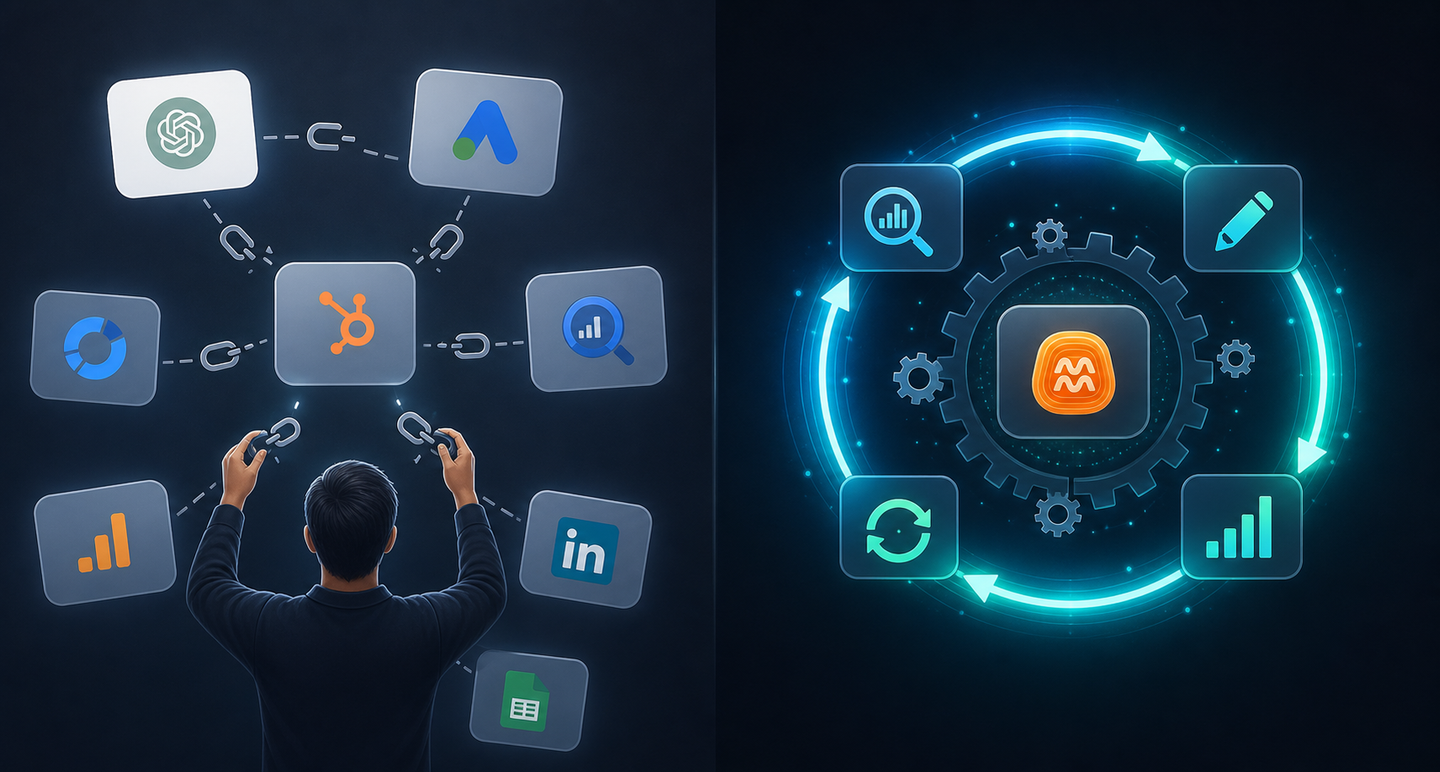
There's a meaningful difference between a tool that responds and a system that operates.
When you prompt Claude to write a post, it writes the post. When you ask Devin to fix a metadata issue, it fixes it. But after each output, the loop opens again. Someone has to notice the next problem, write the next prompt, and coordinate the next action. That coordination cost is real, and it compounds fast.
A closed loop looks different. The system detects a ranking signal, decides what to do about it, executes the fix, publishes it, requests indexing, and monitors the result — with no human stitching those steps together. That's what SEO AI agents are built to deliver. Task-level tools don't do that. They wait.
What It Actually Takes to Run an SEO Program In-House
Running a real SEO program across five workstreams looks like this:
| Workstream | What It Requires | Where Custom AI Workflows Break Down |
|---|---|---|
| Content strategy | Continuous competitor ranking tracking, sales call mining, content gap identification, cannibalization flagging, stale page detection | No persistent state: each analysis starts from scratch with a new prompt |
| On-page optimization | Daily site crawls, metadata audits, canonical tags, 301 fixes, schema handling, direct CMS pushes | CMS integrations break across WordPress, Webflow, Sanity, and Ghost; each has different API surfaces |
| Content creation | ~15 pieces/month with correct keyword density, internal linking, FAQ structure, and consistent brand voice | Generic output without first-party context (call recordings, knowledge base, battle cards) at generation time |
| Backlink building | Publisher network access, placement negotiation, live-link confirmation, ongoing monitoring | Claude and Devin can draft outreach but can't access publisher networks or verify links stayed live |
| AI visibility tracking | Prompts run across ChatGPT, Claude, Gemini, Perplexity, and Google AI Overviews; citation share measurement; schema mismatch detection | Five separate API connections, response parsing, and a storage schema; an ongoing engineering project, not a one-time script |
Each workstream requires its own data inputs, its own integrations, its own feedback loop. None of them are isolated, either. Content strategy feeds content creation. Content creation feeds on-page. On-page feeds citation tracking. When those loops run separately, coordination becomes the job — and suddenly the person running SEO is mostly running handoffs.
The Build Cost and Ongoing Maintenance Problem
The real cost of a custom workflow isn't the build. It's the upkeep.
APIs change. Crawlers update their behavior. New AI engines enter the citation mix and your tracking coverage breaks. Every time something changes, someone has to fix it — and that someone is usually an engineer with other jobs.
The labor math is hard to ignore. SEO agency retainers run $3,000–$10,000/month. In-house headcount across a specialist, writer, and link builder can clear $200k per year before you rank for a single keyword. A custom AI workflow doesn't eliminate that cost — it moves it into engineering hours and prompt maintenance. The build-vs-buy decision almost always comes back to this exact math.
There's also workflow debt, which compounds in ways teams don't anticipate. Prompts written for one version of Claude behave differently when the model updates. n8n integrations break when CMS plugins change. Every piece of custom tooling you ship is a future maintenance ticket nobody budgeted for.
What CMS Integration Actually Requires
Pushing a fix live through a CMS sounds simple until you try to automate it across more than one site.
Devin can write code. It'll spin up a server, clone a repo, and hand you a working UI in twelve minutes — I've seen it. But writing code that pushes metadata, canonical tags, JSON-LD schema, and 301 redirects reliably into Webflow is a completely different problem from doing the same thing in WordPress, Sanity, or Ghost. Each CMS exposes different API surfaces, handles field mapping differently, and has its own quirks around draft states, two-way sync, and collection routing. A custom integration that works on one breaks on another.
The fix-and-forget assumption is where most DIY workflows eventually break down. CMS APIs version. Plugin behavior changes. A schema update that worked last quarter stops firing correctly after a CMS update — and nobody notices until citation share drops.
Why Backlink Procurement Can't Be Automated With a Prompt
Backlink procurement isn't a content task. It's a supply chain.

Finding sites willing to place a link, negotiating the placement, confirming the link went live, and monitoring it over time requires access to publisher networks that don't expose a public API. You can't prompt your way into a backlink marketplace. Claude doesn't have relationships with link sellers. Devin can write an outreach email, but it can't close the deal or verify the link stayed live three months later. Solving this at scale requires structured publisher relationships — the kind built over time, not spun up with a script.
This isn't a clever-prompting problem. The infrastructure simply isn't there.
AI Visibility Tracking Across Multiple Engines
AI visibility tracking isn't like checking Google rankings. You can pull positions from the Search Console API and compare week over week. Citation behavior across AI engines doesn't work that way.
To know whether ChatGPT cites you when someone asks a buying question in your category, you have to run that prompt, capture the response, and parse whether your brand appears. Then repeat across Gemini, Google AI Overviews, Perplexity, and Claude. Each engine pulls from different sources and updates its behavior independently.
A DIY setup requires a prompt list, five separate API connections, response parsing logic, a citation storage schema, and a comparison layer that surfaces competitor mentions alongside yours — and that's before scale enters the picture. Running 50 prompts occasionally tells you almost nothing. Meaningful data requires hundreds of prompts run often enough to catch behavioral changes when they happen.
None of these engines expose citation behavior through a simple API you can automate against. Tracking citations in Claude means querying Claude, reading the output, and extracting structured brand mentions programmatically. Doing that reliably across five engines with different output formats isn't a one-time script — it's an ongoing engineering commitment. I've watched teams start this build and quietly abandon it two months in when the maintenance load hits. Tracking LLM visibility at scale is a different category of problem than most teams expect going in.
The Context Problem: Why Generic AI Produces Generic Content
Claude writes from its training data unless you tell it otherwise. That's the whole problem.
Prompt it to "write a blog post about AI visibility tracking" and you get accurate, well-structured content that reads like every other piece on the topic — because it's drawing from the same corpus every other team is prompting against. Right keywords, expected angles, nothing your competitors can't generate with the same prompt tomorrow.
Search engines catch this through three signals: engagement behavior (dwell time, scroll depth, return visits), content fingerprinting (repeated phrase patterns recombined from training data), and semantic depth (whether claims are specific, evidenced, and logically developed). Generic AI content fails all three. It's penalized because it's thin, not because it's AI-generated.
E-E-A-T in practice is trickier than adding an author bio. Real first-person experience signals look like:
- Customer questions pulled from actual sales calls, not paraphrased from competitor FAQs
- Internal stats that exist nowhere else on the internet
- Specific product behavior described with precision
- Competitive comparisons grounded in real use
These break content fingerprinting because the information isn't in the training data. An AI engine looking for sources to cite picks pages with unique, verifiable claims — not pages that pattern-match to a hundred others.
Injecting this context consistently at scale requires an architecture. You need customer language (call recordings), product detail (knowledge base, changelog), competitive context (battle cards), and brand voice all available at generation time on every single piece. A custom Claude workflow can pull one or two of these if you build it. Getting all of them into every post, keeping them current as the product evolves, and having the system learn from every human edit without manual retraining — that's a different problem entirely.
When a Custom AI Workflow Is Actually the Right Choice
There are real scenarios where a custom workflow is the right call — and I'd rather say that clearly than pretend otherwise.
If you have an in-house SEO lead who owns strategy and just needs to automate one task, a Claude prompt or n8n script is faster and cheaper than vetting SEO automation software. Meta description generation, title tag variants, basic content briefs — isolated tasks with clean inputs and outputs. Build the script once, run it forever.
If you're pre-product-market fit and publishing two posts a month, you don't need a closed-loop SEO system. Write, learn what lands, iterate. A custom workflow is enough for that stage.
If your team is engineering-heavy and already maintaining internal tooling, adding an SEO automation script is low-lift. The maintenance burden is real but manageable when engineers are already on the hook for it.
The honest answer: a custom workflow works when scope is small and your team can own it. Where it breaks down is when you need all five workstreams running simultaneously, staying current, and feeding each other — without a human coordinator in the middle stitching it all together.
How a Purpose-Built AI SEO System Closes the Loop
A collection of automations shares data only when you build the pipe. A closed-loop system shares data by design.
That distinction has real consequences. When keyword discovery, content creation, CMS publishing, technical remediation, backlink procurement, and citation tracking all run inside a single data model, the output of each step becomes the input of the next — automatically. A ranking signal triggers a content update. A content update triggers schema regeneration. Schema regeneration triggers indexing. No handoff. No prompt. No ticket.
Custom workflows invert this. Each tool runs its own data model, and integration is your problem. The GSC data your keyword script reads isn't the same data your content generator sees unless you built that pipe yourself. Every seam is a place where coordination becomes manual work again.
There's a compounding effect too. Every human edit feeds back into the context layer, so the next piece of content is better calibrated than the last — without anyone reconfiguring a prompt.
How Maintouch Approaches the Closed-Loop Problem
I built Maintouch for exactly this problem. Strategy runs from zero-volume query discovery and sales call mining, so content gets built around what buyers actually ask AI engines — not recycled keyword lists. Every piece pulls from the Knowledge Base, Brand Voice, and Blog Rules at generation time, and every human edit updates all three simultaneously. The system gets sharper with each cycle without anyone reconfiguring a prompt.
Technical fixes push directly to WordPress, Webflow, Sanity, Strapi, Contentful, Storyblok, Payload, HubSpot, Ghost, and Framer (beta) — no developer queue. Backlinks are sourced through integrated marketplaces at zero markup. Citation tracking runs across ChatGPT, Claude, Gemini, Perplexity, and Google AI Overviews continuously.
Every paying account includes a dedicated account strategist — a forward-deployed marketer embedded in your growth motion — available via weekly standing syncs and a dedicated Slack channel. You can build the automations yourself. You can't prompt your way into someone who knows your market and keeps the program moving when you're heads-down on everything else.
The free tier tracks 35 prompts across five engines for one full year. No credit card required.
Final Thoughts on Choosing Between a Custom AI Workflow and a Purpose-Built SEO System
A custom workflow is the right call when your scope is small and your team can own it. I mean that. Don't buy a system when a script will do.
But when all five workstreams need to run simultaneously and feed each other without a coordinator in the middle, you're not solving a tool problem anymore. You're solving an architecture problem. I've watched enough teams try to duct-tape the coordination layer together — and eventually hand the job back to a human — to know where that ends up.
If you want to talk through what closing that loop would look like for your stack, shoot me a message at [email protected].
FAQ
What's the real difference between an AI SEO platform vs. a custom AI workflow built on Claude or Devin?
A purpose-built system operates continuously across every workstream simultaneously, while a custom workflow handles discrete tasks and stops. The core gap is orchestration: when keyword discovery, content creation, CMS publishing, technical fixes, backlink procurement, and citation tracking all run inside one data model, each step feeds the next automatically. With Claude or Devin, someone has to notice the next problem, write the next prompt, and stitch the outputs together manually, and that coordination cost compounds across every workstream.
Can I build AI citation tracking across ChatGPT, Gemini, Perplexity, and Claude without a dedicated tool?
You can, but it's an ongoing engineering project, not a one-time script. Each engine requires a separate API connection, response parsing logic, a citation storage schema, and a comparison layer that surfaces competitor mentions alongside yours. Running 50 prompts occasionally tells you almost nothing. Meaningful data requires hundreds of prompts run regularly enough to catch behavioral changes when they happen, and the output formats across five engines are different enough that maintaining reliable extraction across all of them is a real maintenance burden.
How does Maintouch close the loop that DIY AI workflows leave open?
Maintouch runs keyword discovery, content creation, CMS publishing, schema regeneration, Google indexing, backlink procurement, and citation tracking inside a single data model with no handoffs. A ranking signal triggers a content update. A content update triggers schema regeneration. Schema regeneration triggers indexing. No prompt, no ticket, no human coordinator in the middle. Custom workflows invert this: each tool runs its own data model, and every seam between them is a place where coordination becomes manual work again.
What does E-E-A-T actually look like in practice when most content is AI-generated?
E-E-A-T in practice requires content that contains information AI engines can't generate from training data alone: customer questions pulled from actual sales calls, internal stats that exist nowhere else, specific product behavior described with precision, and competitive comparisons grounded in real use. These break content fingerprinting because the information isn't in the training corpus. An AI engine looking for sources to cite picks pages with unique, verifiable claims, and injecting that first-party context consistently at scale requires an architecture that pulls from call recordings, a knowledge base, and battle cards at generation time on every piece.
How is Maintouch different from Semrush or Ahrefs for a B2B SaaS trying to actually move the needle?
Semrush and Ahrefs give you data and stop there. They surface what needs doing and hand the work back to you. Maintouch executes: it pushes technical fixes directly to your CMS, creates and publishes content, sources backlinks through integrated marketplaces, and tracks citation share across all five AI engines. For B2B SaaS, the practical difference is whether insights become shipped work inside the same system or open a new coordination loop every time. Semrush and Ahrefs also limit AI visibility tracking to Google AI Overviews only, with no coverage of ChatGPT, Perplexity, Claude, or Gemini citations.
How much ongoing maintenance does a custom AI SEO workflow actually require?
More than most teams expect. APIs change, CMS plugins version, and every new AI engine that enters the citation mix requires new parsing logic and a new API connection. Each of those changes lands as an unplanned engineering ticket. The maintenance burden is low when scope is small and engineers are already on the hook for internal tooling, but it compounds fast once you're running all five SEO workstreams simultaneously. A purpose-built system absorbs those changes at the infrastructure layer so you don't have to.
Does the content Maintouch generates actually get better over time, or does quality stay flat?
It compounds. Every time a human edits an AI-generated draft inside Maintouch's editor, the system automatically diffs the two versions and updates the Knowledge Base, Brand Voice, and Blog Rules simultaneously. The next piece is better calibrated than the last without anyone reconfiguring a prompt. After six months of normal editing cycles, the system knows your voice, positioning, and product with high fidelity. A custom Claude or n8n workflow stays static unless someone manually rebuilds it — that's the whole difference between a tool and a system.
Is there a free way to try AI visibility tracking before committing to a full SEO platform?
Maintouch offers a free tier at maintouch.com/free that tracks 35 prompts across all five AI engines (ChatGPT, Google Gemini, Google AI Overviews, Perplexity, and Claude) for one full year, no credit card required. That's enough to get a real read on where you're being cited and where competitors are showing up in your place. Full platform capabilities (content strategy, content creation, backlinks, technical SEO) require a paid subscription, but the citation tracking is genuinely free.
Which CMS platforms does Maintouch actually push fixes to without a developer?
Maintouch connects directly to WordPress, Webflow, Sanity, Strapi, Contentful, Storyblok, Payload, HubSpot, and Ghost, plus Framer (beta). Technical fixes (metadata, canonical tags, JSON-LD schema, 301 redirects) push live through those integrations without routing through a developer queue. Custom or headless stacks that aren't on that list are served via API and MCP, which requires minimal engineering setup but keeps the full optimization loop intact.
How do I know if a custom AI workflow is enough or if I actually need a purpose-built SEO system?
The honest answer comes down to scope and coordination cost. If you have one or two isolated tasks (generating meta descriptions, writing briefs) and an in-house SEO lead who owns strategy, a custom Claude or n8n script is probably fine. If you need content strategy, on-page fixes, content creation, backlink procurement, and AI citation tracking all running simultaneously and feeding each other, the coordination cost of stitching together general-purpose tools will exceed the cost of a system built to do all of it. That's the real build-vs-buy question.
Does Maintouch include any human support, or is it fully automated?
Every paying account includes a dedicated account strategist — a forward-deployed marketer embedded in your growth motion. They run a weekly standing sync and are accessible via a dedicated Slack channel. The agents handle execution; the strategist makes sure priorities are aligned and you're getting the most out of the system. It's not tiered support gated to higher plans. Every account gets the same model regardless of plan size.
Turn search into your best growth channel.
Maintouch tracks your visibility across AI and Google, creates and refreshes content, and gets your brand mentioned on the sites that shape discovery.
Book a demoRelated reading
All posts