
LLM Visibility: The Complete Guide to Tracking AI Search Rankings

By Bennett Cohen
Get Maintouch
Turn search and AI visibility work into a repeatable growth system.
You can rank #1 in Google for "best CRM software" and still never show up when someone asks ChatGPT the same question. That gap is what LLM visibility tracks, and most teams don't realize they have a problem until a prospect mentions they found a competitor through Perplexity.
Why listen to me? I run Maintouch. I spend my days looking at how AI systems cite (or skip) the brands we work with, and the same patterns repeat across hundreds of B2B sites.
My goal: you walk away knowing which LLM visibility tools and LLM tracking tools are worth paying for, what content actually gets cited, and how to track your AI search rankings across ChatGPT, Perplexity, Gemini, and Claude. I'll cover the metrics that matter, compare the LLM rank trackers and LLM visibility checkers on the market right now, and show you what an honest LLM visibility audit looks like.
TLDR:
- LLM visibility tracks how often your brand appears in AI responses from ChatGPT, Perplexity, Gemini, and Claude, where citation frequency matters more than traditional search rankings.
- Google's AI Overviews appear in 47% of searches with CTR dropping to 2% vs. 13% for organic listings.
- Press coverage drives AI citations because one mention becomes ten indexed references across aggregators that LLMs weight as consensus.
- Track citation frequency, source attribution rate, query coverage, and competitor share of voice across all four major AI systems.
- Maintouch tracks both traditional keyword rankings and AI citation presence across ChatGPT, Perplexity, and Google AI Overviews in one audit.
What Is LLM Visibility and Why It Matters in 2026
LLM visibility refers to how often and how favorably your brand appears in AI-generated responses across tools like ChatGPT, Perplexity, Gemini, and Claude.
Where traditional SEO tracks keyword rankings in Google's index, LLM visibility tracks whether AI systems mention your brand, recommend your product, or cite your content when users ask relevant questions.
The gap between the two is widening fast. AI search tools now handle a growing share of informational queries, and users who get an answer directly from ChatGPT often never click through to Google results at all.
If your brand isn't showing up in those responses, you're invisible to that segment of your audience.
The Traffic Impact: How AI Overviews Changed Click Economics
Google's AI Overviews now appear in a large share of searches, and the click-through rate drops to around 2% compared to around 13% for standard organic listings, per Ahrefs research.
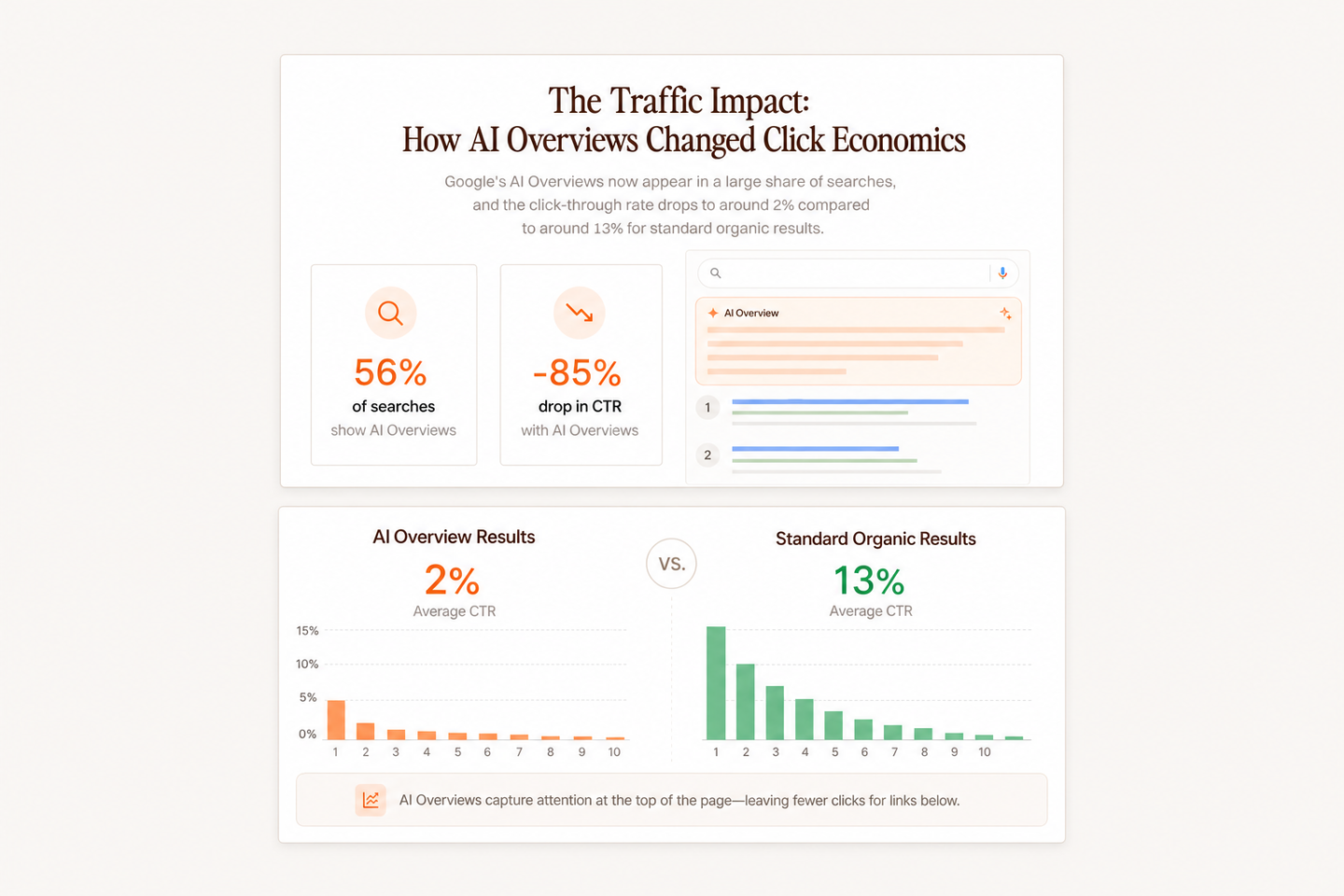
Ranking isn't enough anymore. If the AI summarizes your page and the user gets the answer right there, they never click through. The traffic you used to count on goes invisible.
The sites still pulling traffic from AI-heavy queries share one thing: they get cited. The LLM pulls from their content, names them as a source, and the curious readers click through to verify.
How AI Citations Differ From Traditional Search Rankings
Traditional search rankings give you a number. Position 3 for "project management software." Clean, trackable, something you can screenshot and put in a report.
AI citations don't work that way. When ChatGPT or Perplexity answers a query, your brand either gets mentioned or it doesn't. There's no rank to chase, no SERP position to move up one spot at a time.
That's the core shift LLM visibility tracking has to account for.
- Frequency matters more than position: How often your brand appears across relevant AI responses is the primary signal, not where you land in a list.
- Query coverage tells the real story: You might get cited for "best CRM for startups" but completely absent from "CRM for remote teams." Mapping that coverage gap is where the work lives.
- Source influence is indirect: LLMs pull from training data and live retrieval. Getting cited by high-authority sources that AI models trust is what moves the needle, not on-page optimization alone.
The Four Platforms That Control AI Search Visibility
Four sources account for the majority of AI-generated answers right now: ChatGPT, Google Gemini, Perplexity, and Claude. If your brand isn't surfacing in these four, you're missing the conversation.
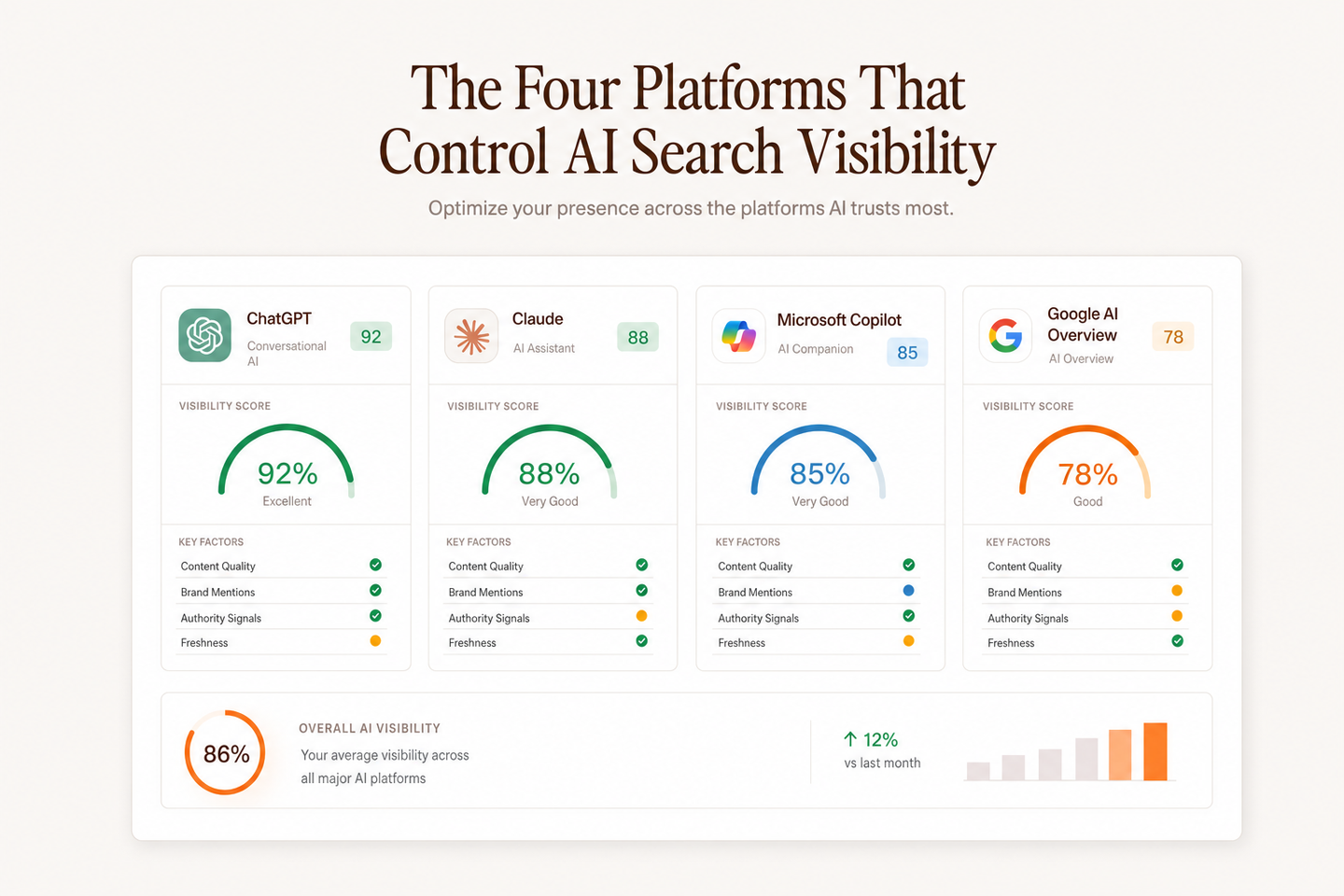
Each one pulls from different sources, weighs authority differently, and rewards different content signals. ChatGPT leans on Bing's index and trained knowledge. Perplexity crawls the live web aggressively. Gemini integrates tightly with Google Search. Claude favors authoritative, well-cited content.
Tracking all four manually is where most teams fall apart.
How LLM Citation Tracking Works: Methodology and Metrics
Most LLM citation tracking tools work by submitting test prompts across multiple AI systems (ChatGPT, Claude, Perplexity, Gemini) and recording whether your brand appears in the responses.
The core metrics worth tracking:
- Mention rate: how often your brand shows up across a defined prompt set
- Citation rate: how often you're linked or attributed as a source
- Sentiment: whether the mention is positive, neutral, or negative
- Competitor share of voice: where you rank relative to named alternatives
The hard part is prompt design. The prompts you test against need to reflect real user queries, not vanity searches for your brand name.
Best LLM Visibility Tools: Feature Comparison
| Tool | Best For | Free Tier | LLM Coverage | Standout Feature |
|---|---|---|---|---|
| Maintouch | B2B SaaS & venture-backed brands | No | ChatGPT, Perplexity, Google AI Overviews | Unified SEO + AI citation tracking in one system |
| Profound | Enterprise | No | ChatGPT, Perplexity, Gemini | Real-time AI answer monitoring |
| Goodie | SMBs | Limited | ChatGPT, Perplexity | Keyword-to-citation mapping |
| Otterly.ai | Freelancers | Yes | ChatGPT, Gemini | Free tier with basic prompt tracking |
| Brandwatch | Enterprise PR | No | Limited | Broad social + AI mention coverage |
A few things worth calling out about this table.
Free tiers exist but they're limited. Otterly.ai gives you a starting point, but free tools typically cap prompt volume and LLM coverage in ways that make them impractical for anything beyond initial exploration.
Coverage across LLMs matters more than it gets credit for. A tool that only tracks ChatGPT is missing Perplexity, Gemini, and Claude, which together account for a real share of AI-assisted search queries. If your audience skews technical, Perplexity coverage is non-negotiable.
The Earned Media Advantage: Why Press Coverage Drives Citations
Earned media (press mentions, journalist citations, industry roundups) is one of the cleaner signals for LLM citation. When a reporter at TechCrunch or a researcher at a known publication quotes your brand, that content gets indexed across dozens of aggregators, news feeds, and third-party sites. LLMs training on web data pick up those references repeatedly, from multiple independent sources. That repetition builds credibility in a way a single well-optimized page can't replicate.
The mechanic is straightforward. One press mention becomes ten indexed references. Ten references from independent domains look like consensus. LLMs weight consensus.
Getting there means treating PR as an input to your LLM visibility strategy, not a vanity metric.
Measuring What Matters: KPIs for AI Search Performance
Tracking AI search performance requires different metrics than traditional SEO. Keyword rankings don't tell the full story here.
The KPIs that actually matter:
- Citation frequency: how often your brand or content gets referenced in AI-generated answers across ChatGPT, Perplexity, Gemini, and Claude
- Source attribution rate: what percentage of your citations include a direct link back to your site versus an unlinked mention
- Query coverage: how many of the target queries in your category return answers that include your brand at all
- Sentiment in citations: whether AI responses frame your brand positively, neutrally, or as a secondary option
- Share of voice vs. competitors: how your citation frequency stacks up against the two or three brands that keep showing up alongside you
None of these show up in Google Search Console. You need an LLM visibility tool to pull them.
Optimizing Content for AI Citations: What Works in 2026
Structured, authoritative content gets cited. Vague, meandering content gets skipped.
The pattern I've seen across AI-cited pages is consistent: direct answers to specific questions, clear source attribution, and content organized so an LLM can extract a clean passage without needing surrounding context to make sense of it.
A few things that work:
- Write answer-first. Put the direct response to a question in the first sentence of a section, not buried in paragraph three after the setup.
- Use named entities. Brand names, product names, and proper nouns give AI systems confidence anchors when deciding whether to cite a source.
- Keep claims tight. A single well-supported claim per paragraph outperforms a paragraph that makes four claims loosely.
- Format for extraction. Short paragraphs, specific headers, and concrete examples all make it easier for an LLM to lift a passage and surface it cleanly.
One thing worth calling out: in our experience auditing AI-cited pages, statistical claims with clear attribution tend to get picked up more often than unsourced assertions. If you have the number, cite where it came from. If you don't have the number, write around it.
Schema markup still matters here. FAQ schema and HowTo schema give AI crawlers structural signals that a piece of content contains extractable answers instead of prose.
The Attribution Challenge: Connecting AI Visibility to Revenue
AI visibility is genuinely hard to attribute. Unlike a Google click where the referral shows up in Analytics, an LLM mention often sends a user who arrives with no traceable source, no UTM, and no referral string.
The honest answer is that most teams track this through brand search lift and direct traffic trends. If your AI visibility score rises and branded queries in Search Console tick up a few weeks later, that's a reasonable signal.
Set up a simple tracking approach: monitor your brand name in ChatGPT, Perplexity, and Gemini weekly, log the responses, and watch whether direct and branded traffic moves in parallel.
Maintouch: Unified SEO and AI Visibility Tracking
Maintouch tracks both traditional search rankings and AI citation presence in one place. You get keyword rank tracking alongside citation monitoring across ChatGPT, Perplexity, and Google AI Overviews, so you're not toggling between separate tools to understand where your brand actually shows up.
The audit runs automatically. Set your brand, your competitors, and your target queries, and Maintouch surfaces which AI systems are citing you, how often, and in what context.
If you want to go deeper, shoot me a message.
Final Thoughts on Getting Cited by AI Systems
AI search isn't theoretical anymore. ChatGPT, Perplexity, Gemini, and Claude are answering real queries your audience is typing, and if your brand doesn't surface in those responses, you're not in the conversation. If you want a look at where you stand, I can run the audit for you.
FAQ
What's the main difference between LLM visibility and traditional SEO rankings?
LLM visibility tracks whether AI systems mention your brand in generated responses, not where you rank in search results. Traditional SEO gives you a position number: you're #3 for "project management software." AI citations don't work that way: your brand either gets mentioned or it doesn't, and frequency across relevant queries matters more than position.
Can I track LLM citations without paying for specialized tools?
Yes, but free tiers are limited in ways that make them impractical beyond initial exploration. Otterly.ai offers a free tier with basic prompt tracking, but free tools typically cap prompt volume and LLM coverage. If you need to track across ChatGPT, Perplexity, Gemini, and Claude simultaneously, you're paying for a tool.
How do I optimize content to get cited by AI systems?
Write answer-first: put the direct response to a question in the first sentence of a section, not buried in paragraph three. Use named entities (brand names, product names, proper nouns), keep claims tight with one well-supported claim per paragraph, and format for extraction with short paragraphs and specific headers. Statistical claims with clear attribution get cited at a noticeably higher rate than unsourced assertions.
LLM visibility tools vs traditional rank trackers: which should I use?
You need both. Traditional rank trackers show you where you land in Google's index. LLM visibility tools track whether ChatGPT, Perplexity, Gemini, and Claude mention your brand when users ask relevant questions. AI search handles a meaningful share of informational queries now, and users who get an answer directly from ChatGPT often never click through to Google results at all.
How do I attribute revenue to AI visibility when there's no referral data?
You can't attribute AI visibility directly because LLM mentions send users who arrive with no traceable source, no UTM, and no referral string. Most teams track this through brand search lift and direct traffic trends. Monitor your brand name in ChatGPT, Perplexity, and Gemini weekly, log the responses, and watch whether direct and branded traffic moves in parallel.
Turn search into your best growth channel.
Maintouch tracks your visibility across AI and Google, creates and refreshes content, and gets your brand mentioned on the sites that shape discovery.
Book a demoRelated reading
All posts