
Best AI SEO Tools That Actually Execute [October 2026 Update]

By Bennett Cohen
Get Maintouch
Turn search and AI visibility work into a repeatable growth system.
I've been doing SEO for over a decade, and Maintouch serves hundreds of marketers. I've tested most of these tools as a buyer and stress-tested the rest as a builder who competes with them, so you're getting the straight read, not a vendor comparison that pretends to be neutral. The market is loud right now. Most options look identical until you ask one question: does this tool execute the work, or does it hand the work back to you the moment output lands? That distinction separates tools that save you time from tools that generate a new to-do list. By the end of this piece, you'll know exactly which tool fits your situation, your team size, and the way you actually work day to day.
TLDR:
- Most AI SEO tools report what needs doing and stop. The key split is execution vs. reporting.
- Semrush and Ahrefs have massive backlink indexes (42-43+ trillion links) but hand the work back the moment output lands.
- Search Atlas ships some fixes autonomously via OTTO SEO, but it's built for agencies, not B2B SaaS teams.
- Clearscope grades drafts against top-ranking pages starting at $129/month, but won't touch technical SEO or backlinks.
- Maintouch runs strategy, content, technical SEO, backlinks, and AI visibility tracking across all five engines in one system, without handing off.
What Are AI SEO Tools?
The category spans everything from keyword research and content creation to technical audits, internal linking, and the newer work of tracking AI search rankings to see whether engines like ChatGPT and Perplexity are actually citing your pages. Some tools handle one slice of that stack. Others run the whole operation from strategy through publishing. The distance between those two categories is where teams burn weeks coordinating between dashboards, spreadsheets, and agency Slack channels.
How We Ranked These AI SEO Tools
Every tool here got measured against one question: does it execute the work, or just tell you what to do? A reporting tool hands you a dashboard and reopens the loop. An execution system closes it. Here's what I weighed, in rough order of importance:
- Execution vs. reporting. Does the tool ship changes, or surface a recommendation and leave the work to you? This is the categorical split.
- AI visibility tracking. Does it measure citation share across ChatGPT, Gemini, Perplexity, Claude, and AI Overviews, or stop at Google rankings?
- Content creation quality. First-party data, enforced brand voice, and real E-E-A-T signals, or generic output that trips AI detection?
- CMS integration. Can it push fixes to a live CMS, or dump a list into a developer queue?
- Full-stack coverage. Does one system run strategy, content, technical SEO, and backlinks, or own a single slice?
- Self-learning. Does it sharpen as humans edit its output, or stay static?
All rankings are based on publicly available information and product documentation. No private trials.
Best Overall AI SEO Tool: Maintouch
I built Maintouch to replace an SEO agency with one system, so I'll say plainly why it tops this list. It runs strategy, content, technical SEO, backlinks, and AI visibility tracking in a single loop. No handoffs, no separate tool stack, no developer queue. It's built for B2B SaaS companies, venture-backed brands, and founder-led teams who want search marketing to run without an agency or in-house SEO hire.
Against the criteria above, here's where it lands:
- Tracks citation share across all five AI engines (ChatGPT, Google Gemini, Google AI Overviews, Perplexity, and Claude) with 1,000+ concurrent prompts supported.
- Pushes technical SEO fixes straight to the live CMS across WordPress, Webflow, HubSpot, and seven other integrations. No developer queue.
- Runs a self-learning content engine: every human edit to an AI draft updates the Knowledge Base, Brand Voice, and Blog Rules automatically, so output gets sharper over time instead of resetting.
- Acquires backlinks across multiple backlink procurement platforms at zero-markup pass-through pricing. No manual outreach.
- Offers a free AI visibility tier: 35 prompts tracked across all five engines for a full year, no credit card required. Claude coverage included, where competitors gate it behind enterprise pricing.
- Every paid account gets a dedicated strategist through weekly syncs and a Slack channel.
Every other tool on this list leaves the loop open somewhere. Maintouch closes it.
Semrush
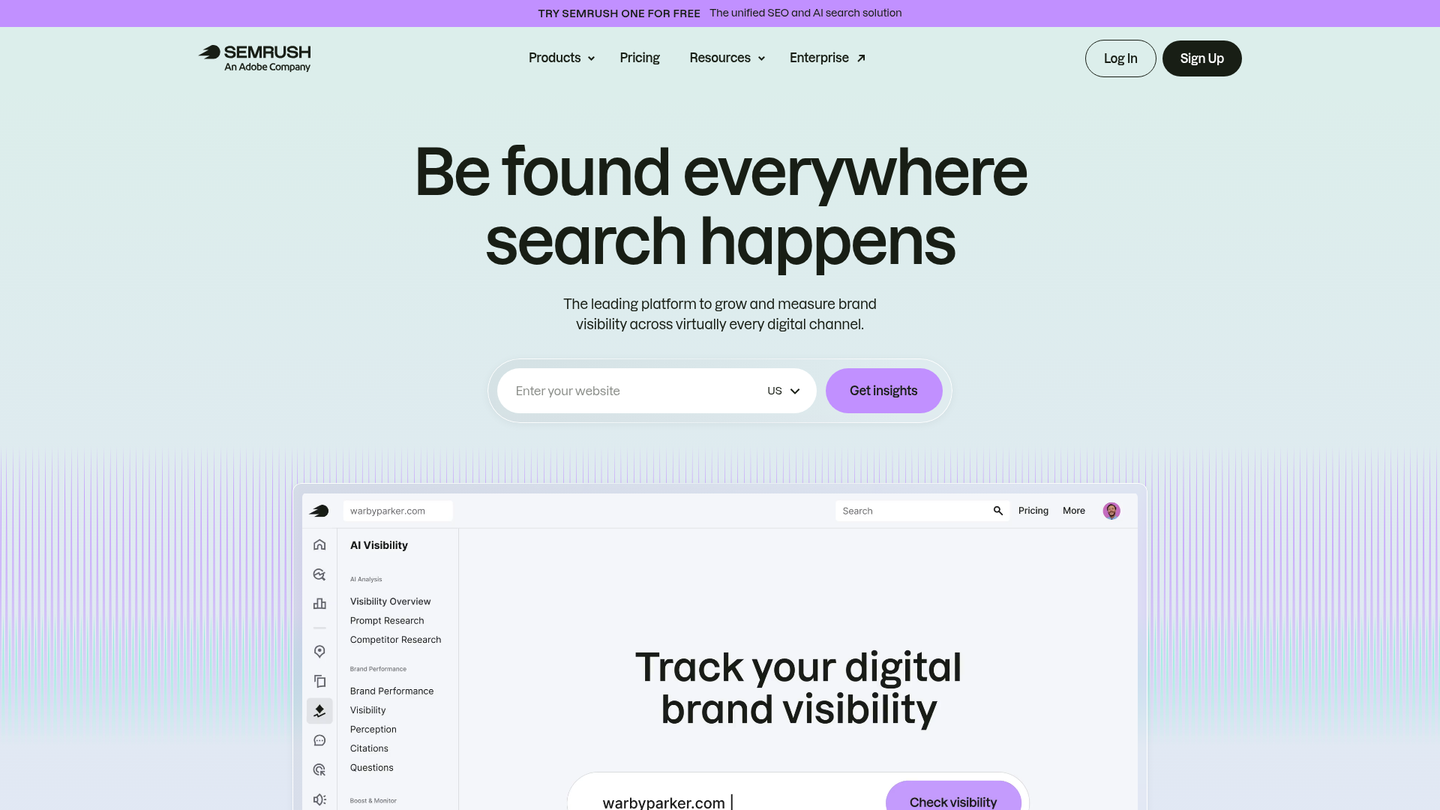
Semrush is the data suite most SEO teams already know. It's been the default research layer for years, and it earns that spot. If you've ever opened a keyword gap report or run a site audit, there's a good chance you were in Semrush.
What They Offer
- Keyword research, rank tracking, site auditing, and backlink analysis across a database of 43+ trillion backlinks
- AI visibility tracking through Semrush One or the AI Visibility Toolkit add-on, covering ChatGPT, Perplexity, and Gemini
- Content optimization via the SEO Writing Assistant (a separate paid add-on)
Good for: teams with a dedicated internal SEO hire or agency relationship who need solid research infrastructure to inform strategy.
Limitation: Semrush surfaces data and recommendations, then stops. Someone still has to act on every output, stacking hidden headcount or agency cost on top of the subscription fee. Full AI visibility tracking requires the add-on or Semrush One, starting at $199/month.
Bottom line: strong data tool if you already have the people to execute against it. The loop stays open.
Ahrefs
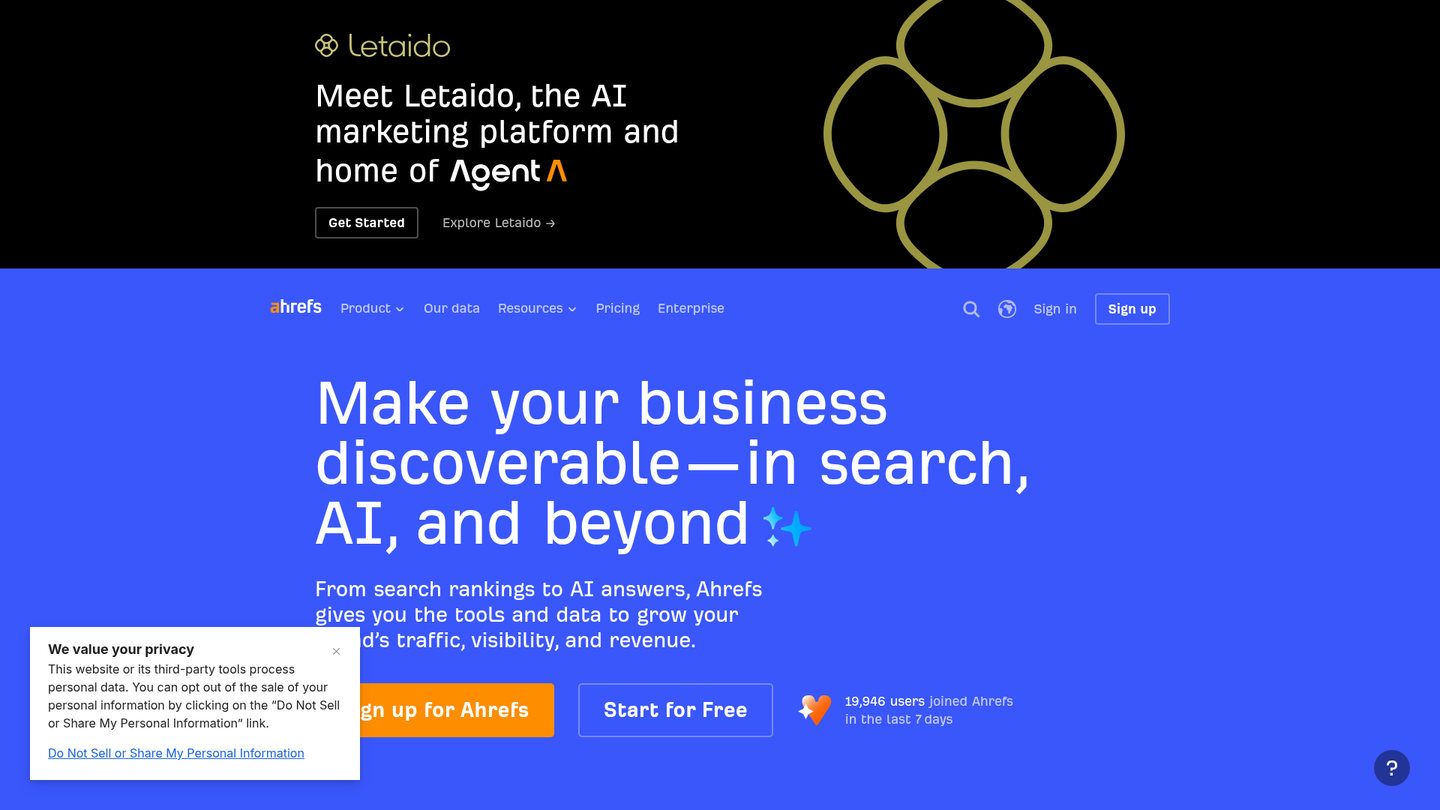
Ahrefs built its reputation on link data, and that reputation holds. If your work revolves around who links to whom and why the competitive link profile in your space looks the way it does, this is the reference set.
What They Offer
- One of the largest backlink indexes available: 42+ trillion links, with a crawler processing roughly 8 billion pages a day
- Keyword research, content gap analysis, and site auditing
- AI visibility tracking through Brand Radar, a paid add-on starting at $199/month
- Content Explorer for finding top-performing content in any niche
Good for: SEO pros and agencies whose workflow revolves around backlink analysis, competitor research, and link building at scale.
Limitation: Ahrefs reports, it doesn't act. It won't push a fix or publish a page. You still need a team to turn the data into shipped work. Brand Radar sits behind an add-on fee, and independent accuracy tests have flagged heavy undercounting in its AI citation detection across ChatGPT and Perplexity (see our Ahrefs vs. Maintouch comparison and this Ahrefs vs. Semrush breakdown).
Bottom line: a strong research tool for link-focused SEO. The loop reopens the moment it hands you the data.
Search Atlas
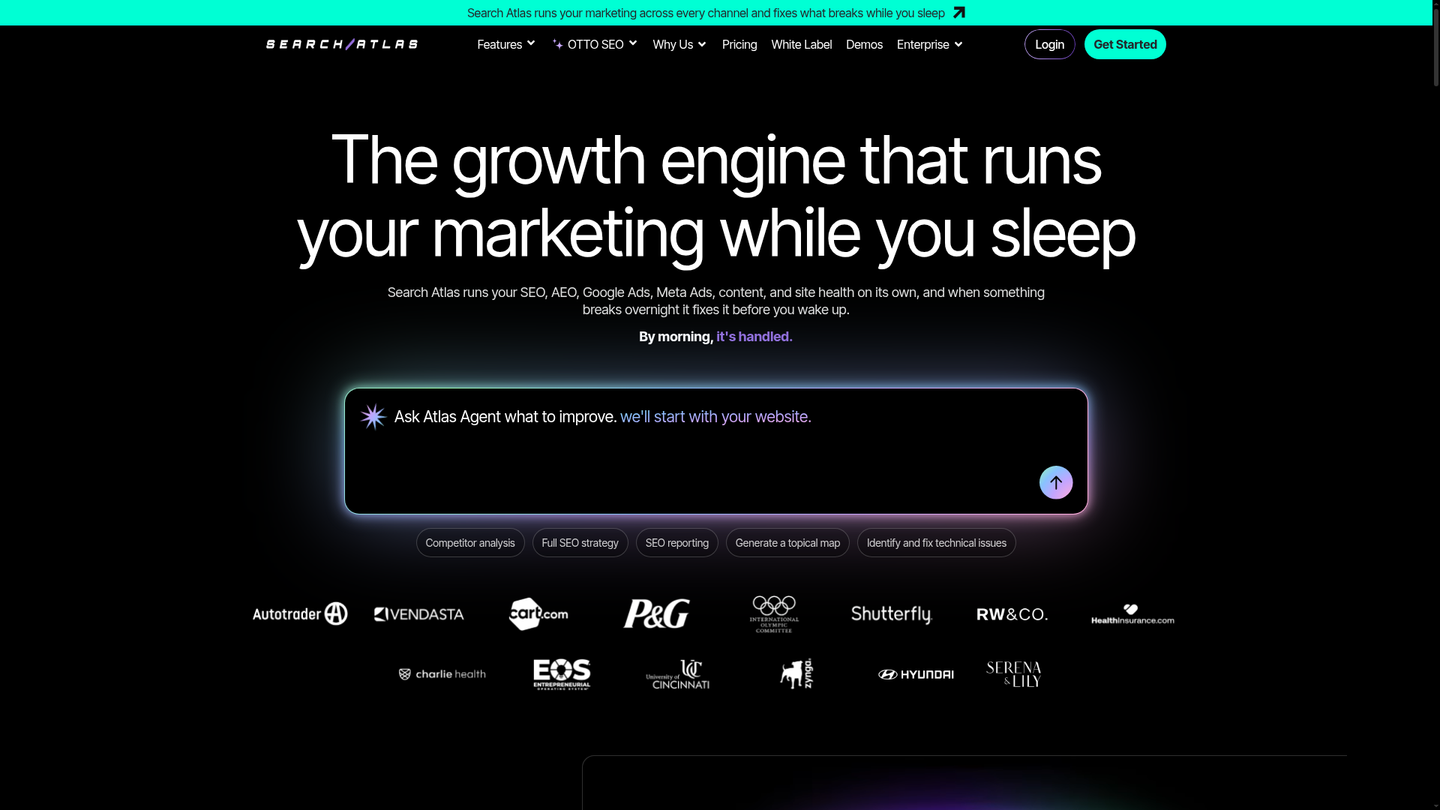
Search Atlas leans into automation harder than the data suites above, and the difference is immediate: it actually ships changes. OTTO SEO, its AI agent, implements schema markup, internal links, and meta tag fixes without manual intervention, which puts it a real step beyond handing you a report and walking away.
What They Offer
- OTTO SEO: an AI agent that implements schema markup, internal links, and meta tag fixes without manual intervention
- Content Genius: AI content creation for generating and optimizing articles
- QUEST: AEO tracking across ChatGPT, Claude, Gemini, and Perplexity
- Local SEO tools, including Google Business Profile automation and local citation building
Good for: agencies running multiple client sites that want a broad automation suite with white-label reporting at a lower price than enterprise alternatives.
Limitation: it's designed for agencies, not B2B SaaS or venture-backed brands. The self-learning layer doesn't adapt to a company's specific brand voice and first-party context the way Maintouch does, and reviews have flagged instability and slow load times under real production workloads.
Bottom line: solid automation for agency-scale work. Teams that need a self-learning content engine grounded in their own voice, customer data, and product positioning will fit better with Maintouch.
Clearscope
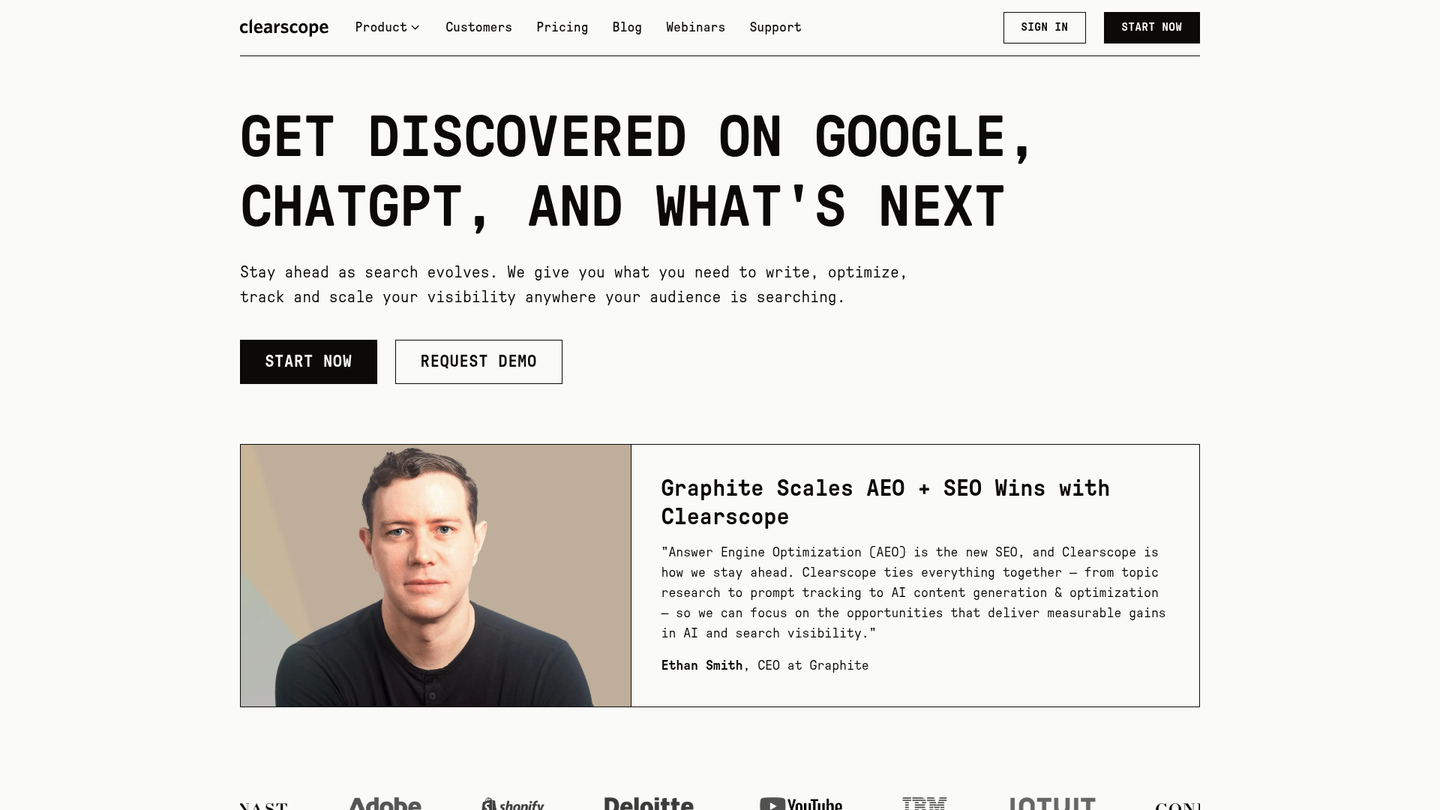
Clearscope stays in its lane, and that lane is content quality. It grades your writing against what's already ranking (letter grade, A through F), which makes it a favorite among teams that live in the draft and need a fast feedback loop on search intent alignment.
What They Offer
- A content grading system (A to F) that scores drafts against top-ranking SERP pages in real time
- Google Docs and WordPress integrations for in-editor optimization without switching tabs
- Topic Explorations for keyword research
- AI Prompt Tracking for LLM visibility across ChatGPT, Perplexity, and Gemini (a newer addition)
Good for: mid-market in-house content teams and agencies with multiple writers who need structured briefs and live draft grading to keep everyone aligned on search intent.
Limitation: Clearscope is a content optimization layer, not a full SEO execution system. It won't touch technical SEO, build backlinks, or publish to your CMS, so you're stacking separate tools for everything else. Pricing starts at $129/month, with per-usage overages on top.
Bottom line: excellent at on-page content quality if your writing workflow is already solid. For teams that want strategy, creation, technical SEO, and backlinks handled inside one system, Maintouch removes the need for the stack.
Surfer SEO
Surfer SEO does one thing and does it well: it scores your drafts against what's already ranking. The Content Editor feeds you live optimization signals as you write (keyword density, heading structure, word count), and for writers who want that feedback loop baked directly into the drafting experience, the setup is clean.
What They Offer
- SERP-based content scoring and keyword density guidance for individual pages
- Content Editor with live optimization scoring against top-ranking competitor pages
- Keyword research and content brief generation
- AI article writing priced per article on a credit model
Good for: writers and small content teams optimizing individual pages who want live on-page scoring while they draft.
Limitation: Surfer doesn't learn from your edits. Every piece starts from scratch with no improvement to brand voice over time, no institutional memory. For high-volume operations, the per-article AI pricing ($19 per article, capped at 30 on the base plan) compounds fast. The Scale plan runs $219/month for 90 content editors, and costs keep stacking once you're past the base tier (DemandSage's Surfer SEO pricing breakdown).
Bottom line: a solid on-page scoring tool at low-to-moderate volume. If you want a system that improves as it runs and doesn't charge more as you scale, Maintouch is the better fit.
Feature Comparison Table of AI SEO Tools
Here's how the six tools stack up across the dimensions that decide whether search marketing actually runs, or just gets reported on:
| Feature | Maintouch | Semrush | Ahrefs | Search Atlas | Clearscope | Surfer SEO |
|---|---|---|---|---|---|---|
| AI visibility tracking (5 engines) | Yes | Partial (add-on) | Partial (add-on) | Yes (4 engines) | Partial (3 engines) | No |
| Executes fixes vs. only reports | Yes | No | No | Partial | No | No |
| Direct CMS publishing | Yes | No | No | Partial | No | No |
| Automated backlink procurement | Yes | No | No | No | No | No |
| Self-learning from human edits | Yes | No | No | No | No | No |
| Full content creation (strategy to draft) | Yes | Partial | No | Yes | Partial | Partial |
| Free AI visibility tier | Yes | No | No | No | No | No |
| Dedicated human strategist | Yes | No | No | No | No | No |
The row that matters most is the second one. Every tool other than Maintouch either reports and stops, or automates a slice and hands the rest back to you. The loop reopens the moment the output lands.
Why Maintouch Is the Best AI SEO Tool
Every other tool here stops somewhere. Some report. Some recommend. A couple automate a slice and hand the rest back to you. That gap (the space between insight and shipped work) is where your headcount, your agency retainer, and your lost weeks go.
Maintouch runs the whole thing: strategy, content, programmatic SEO, backlink procurement, all inside one system. The self-learning engine sharpens with every human edit, so quality compounds instead of resetting with each new piece. A dedicated strategist sits on every account to point the agents at what actually matters. You get the execution and a person who knows your business, not a dashboard and a to-do list.
Final Thoughts on AI SEO Tools That Execute vs. Just Report
The tools that report are good at their job. So are the ones that automate a slice. The gap shows up when you count how many separate systems you're managing to get a single piece of work shipped, and how much of your week goes to coordinating between them. I've watched enough teams spend three months comparing tools, pick the right one for the wrong stage, and lose a quarter of execution time. If you're comfortable with the stack you've got, keep it. If you're not, book a Maintouch demo.
FAQ
How do I choose the right AI SEO tool from this list for my stage and team size?
Start with the execution question: do you have the internal headcount or agency budget to act on what a reporting tool surfaces? If you have a dedicated SEO hire or agency relationship, Semrush or Ahrefs give you strong research infrastructure. If you don't, Maintouch or Search Atlas are better fits because they execute the work instead of handing you a to-do list.
Is Semrush or Ahrefs better for AI visibility tracking in 2026?
Neither is built for it natively. Both gate AI visibility behind paid add-ons starting at $199/month, and independent accuracy tests have flagged Ahrefs Brand Radar for heavy undercounting across ChatGPT and Perplexity. If AI citation tracking is a primary concern, Maintouch tracks all five engines with a free tier at maintouch.com/free, no credit card required.
When should I use Clearscope or Surfer SEO instead of a full-stack system like Maintouch?
If your content team is already producing at solid volume and you just need live on-page scoring while writers draft, Clearscope or Surfer SEO are reasonable single-layer additions. The tradeoff is that neither handles technical SEO, backlinks, or CMS publishing, so you're still coordinating a separate tool stack for everything else.
Which of these AI SEO tools works best for B2B SaaS companies without an in-house SEO team?
Maintouch is built for exactly that situation: B2B SaaS, venture-backed brands, and founder-led teams that want search marketing to run without an agency or internal SEO staff. Search Atlas is an alternative if your needs are more agency-style multi-site management, though its self-learning layer doesn't adapt to company-specific voice and first-party data the way Maintouch does.
What's the difference between how Search Atlas and Maintouch execute SEO work?
Search Atlas automates specific tasks like schema markup and meta tag fixes through its OTTO agent, which is a meaningful step beyond pure reporting. Maintouch closes the full loop: keyword discovery, content strategy, CMS publishing, backlink procurement, and citation tracking all run inside one system without any handoff, and the content engine sharpens over time as humans edit drafts.
Do any of these AI SEO tools actually publish content to my CMS, or do they all require me to copy-paste?
Most of them stop at the draft or recommendation layer. Maintouch pushes changes directly to WordPress, Webflow, HubSpot, Contentful, Sanity, Strapi, Storyblok, Ghost, Payload, and Framer (beta). No developer queue and no copy-paste. Search Atlas offers partial CMS integration, but the other tools on this list (Semrush, Ahrefs, Clearscope, Surfer SEO) don't publish to your CMS at all.
What's the difference between an AI SEO tool and just using ChatGPT to write content?
ChatGPT produces generic content with no awareness of your keyword gaps, competitor rankings, brand voice, or technical SEO state. The AI SEO tools on this list layer in structured data from Search Console, competitor analysis, schema generation, and CMS publishing on top of content generation. The ones that self-learn (like Maintouch) also incorporate your first-party context, sales call recordings, and past human edits so output gets sharper over time instead of staying generic.
How much time per week do I actually need to spend managing an AI SEO tool?
It depends heavily on how much the tool executes versus how much it reports. With a reporting tool like Semrush or Ahrefs, you're still doing all the work, so the time commitment scales with your team's capacity. With a full-execution system like Maintouch, the human time commitment is roughly 1-2 hours per week: agents handle content creation, technical fixes, backlink procurement, and schema updates continuously, while a dedicated strategist aligns priorities on a weekly sync.
Are AI SEO tools good for tracking whether AI engines like ChatGPT are citing my content?
Most aren't built for it natively. Semrush and Ahrefs surface some AI Overviews data but gate full visibility behind paid add-ons, and independent tests have flagged accuracy issues with Ahrefs Brand Radar specifically. Maintouch tracks citation share across all five engines (ChatGPT, Google Gemini, Google AI Overviews, Perplexity, and Claude) and offers a free tier at maintouch.com/free that covers 35 prompts across all five engines for a year, no credit card required.
Can these tools help with technical SEO, or are they mainly for content?
Clearscope and Surfer SEO are content-only: they don't touch technical SEO at all. Semrush and Ahrefs surface technical audit findings but leave remediation to you. Search Atlas's OTTO agent implements some technical fixes autonomously. Maintouch runs automated site audits covering metadata, JSON-LD, canonical tags, redirects, schema, and page speed signals, then pushes fixes directly to your CMS the moment issues are detected, no manual step required.
How do I know if an AI SEO tool is producing content that won't get flagged as AI-generated?
AI detection works across three layers: engagement signals, content fingerprinting, and semantic depth. Generic AI tools fail on all three because they recombine training data without introducing anything novel. The strongest countermeasure is first-party data infusion: content built from your actual sales calls, customer language, product details, and proprietary context contains information that exists nowhere else, which breaks fingerprint signatures and shows real depth. Maintouch ingests that first-party context directly and enforces brand voice and blog rules across every draft, which is why its output is structurally harder to flag than content from generic AI writers.
Do I still need an SEO agency if I'm using one of these AI SEO tools?
For reporting tools like Semrush and Ahrefs, yes, you still need someone (internal or agency) to act on what the data surfaces. That's the hidden cost those tools don't advertise. Maintouch is built explicitly to replace the agency, not sit alongside one: it executes the full content and link-building operation autonomously, and every paid account gets a dedicated strategist via weekly syncs and a Slack channel for the 5% of strategic decisions that benefit from a human judgment call.
Turn search into your best growth channel.
Maintouch tracks your visibility across AI and Google, creates and refreshes content, and gets your brand mentioned on the sites that shape discovery.
Book a demoRelated reading
All posts