
Profound AI for SEO in October 2026: What It Does and Its Gaps

By Bennett Cohen
Get Maintouch
Turn search and AI visibility work into a repeatable growth system.
The conversation about Profound online splits pretty cleanly between two camps: teams that love it, and teams that outgrew the self-serve tiers faster than expected. The tool is real, the category is real, and the customer list is impressive. But there are structural gaps that matter — a lot — depending on what you're actually trying to do. Here's what it does, where it falls short, and how to tell which side of that line you're on.
TLDR:
- Google searches ended without a click 68% of the time in early 2026, so brands tracking only rankings are missing where buyers now find them
- Profound tracks AI citations across up to 11 engines, but Claude coverage is Enterprise-only, and meaningful functionality starts around $2,000/month
- Ranking on page one doesn't get you cited in AI responses. Self-contained passages, FAQPage schema, and direct answers do
- Profound surfaces citation gaps but can't push schema fixes, update canonicals, or deploy content to your CMS. The loop reopens every time
- Maintouch tracks citations across ChatGPT, Gemini, Google AI Overviews, Perplexity, and Claude, then closes gaps inside the same system — the free tier at maintouch.com/free tracks 35 prompts across all five engines for one full year, no credit card required
What Profound Is and Why It Exists
Profound is built around one question: when someone asks ChatGPT or Perplexity about your category, does your brand show up in the answer? It launched into a market that barely existed and helped define what's now called Answer Engine Optimization (AEO).
The urgency is real. Google searches ended without a click 68% of the time in early 2026. AI answers are eating the clicks that used to flow to your site, and brands tracking only rankings are flying blind on a growing share of how buyers actually find them.
Profound's founding bet: AI search needed its own measurement layer, and brands would pay to understand and improve their position inside it. So far, that bet is paying off.
How Profound Works: The Core Mechanics
The mechanics are simple. Profound sends prompts across AI engines, checks whether your brand gets cited in the response, and records the result. Do that across enough prompts and you get a clear picture: where you show up, where competitors show up instead, and where nobody shows up at all.

What makes the data layer different
Prompt Volumes is what separates Profound from most competing AEO tools. Instead of synthetic queries the tool invents, it pulls from real user conversations to show actual AI search demand by topic. Nothing in the category matches it directly.
On the content side, the Agents feature takes citation data and converts it into briefs and drafts. It's credit-based, so you're paying per output. The workflow resembles a Zapier-style builder: configure steps, the agent executes them. Powerful if you have a dedicated person to own it. Friction-heavy if you don't.
The core loop: track prompts, identify gaps, generate content to close them. Clean in theory. The execution layer is where buyers run into limits — and that's what the rest of this review is really about.
Profound's Key Features
Profound's features break down by tier — and that distinction matters because the headline price doesn't reflect where useful functionality actually starts.
- Citation tracking across AI engines (ChatGPT-only on Starter, three engines on Growth, ten on Enterprise)
- Prompt Volumes: real AI search demand data pulled from actual user conversations, not synthetic queries
- Agent Analytics: tracks AI crawler behavior on your site
- Content Agents: turns citation gaps into briefs and drafts, credit-based
- Shopping visibility: tracks product appearance in AI-generated shopping responses
- Brand sentiment monitoring: flags whether AI engines describe you positively or negatively
Meaningful functionality starts around $2,000/month. Starter gets you ChatGPT tracking and not much else. Growth adds more engines and a thin content output. Enterprise unlocks everything — crawler analytics, shopping data, the works.
Profound AI Pricing
Three tiers. Starter is $99/month: ChatGPT tracking only, one region, one seat, limited prompts. Growth is $399/month and adds more engines plus six optimized articles per month. Enterprise is custom pricing with full engine coverage across ten AI surfaces.
| Tier | Price | AI Engines | Content Output | Notable Limits |
|---|---|---|---|---|
| Starter | $99/month | ChatGPT only | None | 1 region, 1 seat, limited prompts |
| Growth | $399/month | 3 engines | 6 optimized articles/month | No Claude; no crawler analytics |
| Enterprise | Custom | 10 engines (full coverage) | Custom | Includes Claude, shopping data, crawler analytics |
The gap between tiers is wide enough to matter. Claude is Enterprise-only — the engine many buyers came specifically for is locked behind a custom-quote conversation. Growth is the minimum if you want more than one AI engine on a self-serve plan.
Extra costs stack fast once you add workspaces, users, regions, or higher prompt volume. Most buyers upgrade sooner than expected.
Which AI Engines Profound Tracks
Engine coverage is the thing buyers get wrong most often before they sign up. It's worth comparing AI visibility trackers side by side on this point alone before committing to anything.
At Enterprise, Profound tracks 11 surfaces: ChatGPT, Claude, Gemini, Perplexity, Google AI Overviews, Google AI Mode, Copilot, Grok, Meta AI, DeepSeek, and Amazon Rufus. That's the broadest coverage in the category.
Below Enterprise, the list shrinks fast. Starter is ChatGPT only. Growth adds two more. If Claude or Perplexity is why you're looking at Profound, you're looking at Enterprise pricing — not the $99 or $399 plans.
Who Profound Is Built For
Profound is built for large enterprise marketing teams: companies with a dedicated AEO owner, formal procurement requirements, and a budget that comfortably clears $2,000/month for AI visibility tooling alone.
The customer list backs that up. Ramp, DocuSign, MongoDB, Indeed. These aren't lean teams running one-person content operations — they're organizations that can staff a dedicated analyst to own the dashboard, interpret the data, and coordinate execution separately.
Who it's not built for: solo operators, early-stage startups, agencies managing multiple clients on tight margins. The onboarding overhead is real, and the self-serve tiers are thin enough that you'll hit the ceiling fast if you're doing anything beyond basic ChatGPT monitoring.
Where Profound Falls Short
Pricing is the most documented frustration. Starter at $99/month is genuinely thin: one AI engine, limited prompts, one seat. You can see ChatGPT mentions, but that's about it. The jump to Growth at $399/month is steep when Claude still isn't included — that's an Enterprise conversation. Buyers expecting broad coverage at the entry price get a monitoring sliver instead.
Traffic attribution is where smaller sites feel the pain most. Profound's website-level analytics rely on CDN integrations, which work well for enterprise domains but leave SaaS companies and agencies with limited visibility into how AI traffic is actually converting. One detailed SaaS-specific review rated AI traffic attribution and lead tracking at 2–3 out of 5 for this exact reason.
The workflow builder rewards teams with a dedicated AEO owner. Without someone whose actual job is configuring and maintaining the pipelines, you end up where Reddit threads on Profound consistently land: hiring a contractor on top of the subscription just to get output working.
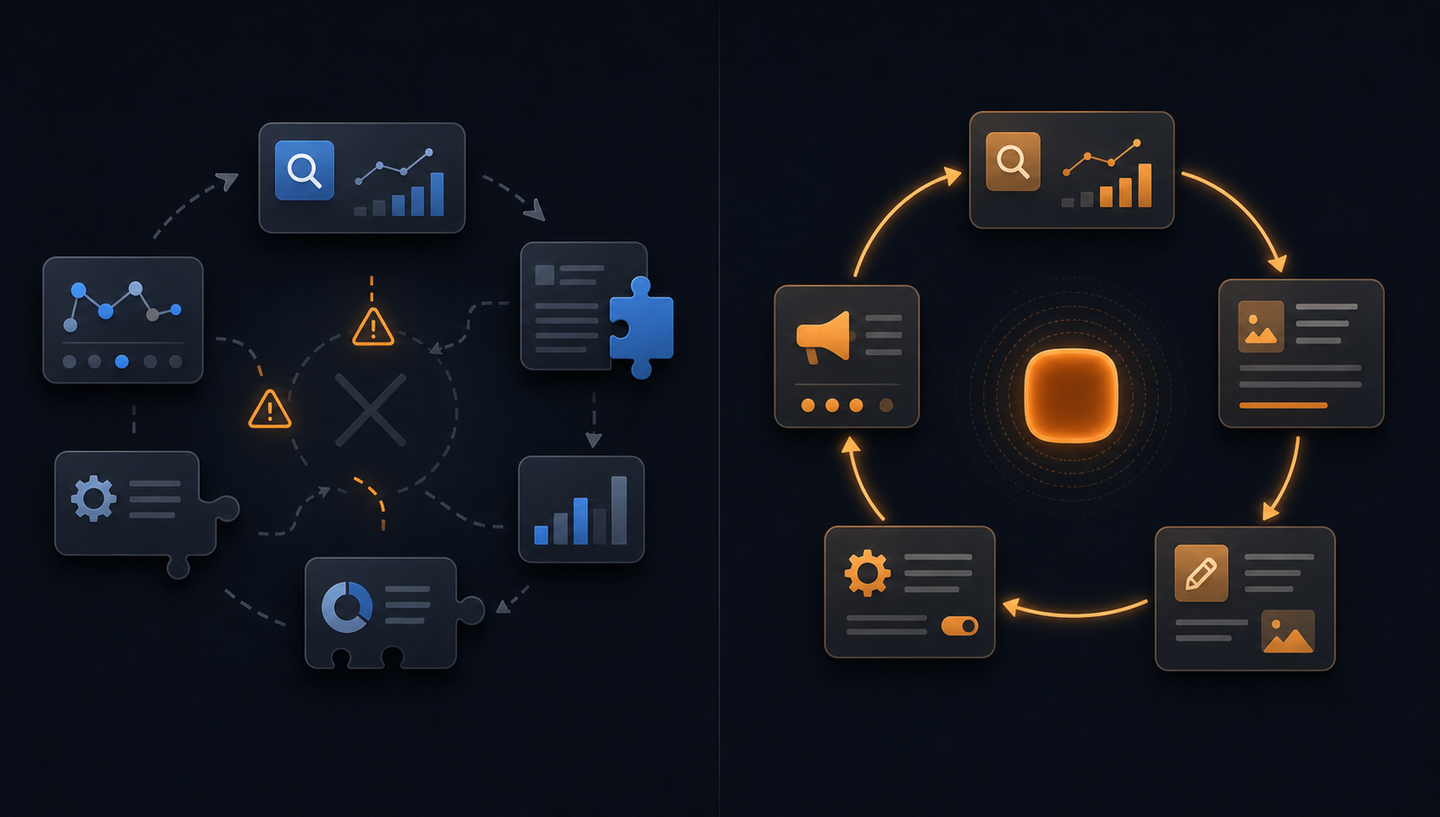
But the bigger gap is what Profound doesn't do at all. There's no native execution layer. It surfaces citation data and content gaps, but it can't push a schema fix, update a canonical tag, or deploy a redirect to your live CMS. Every insight hands a new task to someone else. The loop never closes.
Profound's Funding and Market Position
Profound has raised serious money fast. In August 2025, the company closed a $35M Series B led by Sequoia, with participation from Kleiner Perkins, Khosla Ventures, Saga VC, and South Park Commons, bringing total funding to $58.5M. Six months later, Fortune reported a $96M round as AI search visibility moved from niche concern to active line item for enterprise marketing budgets.
The signal is simple: institutional investors believe this is a real, durable category, and Profound is currently its leader. Sequoia's involvement alone tends to accelerate enterprise sales cycles. The customer list reflects it.
AEO vs. SEO: The Relationship Profound Is Working Through
Profound's core premise assumes AEO is a distinct discipline from SEO, worth tracking separately. That's directionally right, but the underlying mechanics are more intertwined than the tool's framing suggests.
AI chatbots don't generate answers from nothing. They run a web retrieval step first, pulling candidate pages through search before assembling a response. Your Google rankings are the front door to AI search visibility — not a separate track. Strong SEO authority gets you into the retrieval pool. Passage-level structure and schema determine whether you get cited from it.
A brand can rank on page one and still be invisible in ChatGPT responses. The reason is almost always structural: no FAQPage schema, hedged language instead of direct answers, content that needs surrounding context to make sense. AI engines need extractable, self-contained passages that resolve a question in one block. A strong ranking doesn't save you if your content isn't built that way.
SEO and AEO aren't parallel tracks that need separate strategies. They share the same foundation — schema and passage optimization are an additional layer, not a replacement.
What "AI Visibility Tracking" Actually Measures
When a tool reports your "AI visibility score," the number is simpler than it sounds. Prompts get submitted to each AI engine, the response is checked for brand citations, and the frequency is recorded. The score reflects your citation share relative to competitors — not a raw mention count.
That distinction matters. A brand cited in 8 out of 10 responses means nothing if a competitor appears in all 10. Relative share is the only signal worth tracking.
Fan-out queries are the part most buyers miss. AI engines break a prompt into related sub-questions, run those in parallel, and assemble an answer from whichever sources resolve each piece cleanly. Ask ChatGPT "best CRM for early-stage startups" and it's fielding four or five sub-queries under the hood: pricing flexibility, integration depth, onboarding speed, support quality.
Your citation depends on whether your content resolves any of those sub-queries directly. A page that talks generally about your CRM won't get cited. A page with a self-contained passage answering "how long does onboarding take" might.
Tracking fan-out queries surfaces the actual content gaps — which is central to AI citation visibility optimization. A competitor getting cited on the pricing sub-question while you're not is a concrete brief, not a vague visibility problem.
How Maintouch Approaches What Profound Does Differently
Profound reports. Maintouch executes.
Maintouch vs. Profound comes down to architecture. Citation tracking runs across the same five engines: ChatGPT, Google Gemini, Google AI Overviews, Perplexity, and Claude. But when a gap shows up, Maintouch closes it inside the same system — generating the content, pushing schema fixes directly to your CMS, sourcing backlinks through integrated marketplaces at zero markup. No separate workflow. No contractor to hire. No loop that reopens.
The free tier at maintouch.com/free tracks 35 prompts across all five engines for one full year, no credit card required. Claude is included from day one — Profound gates it behind Enterprise pricing. If you want to see where you stand before committing budget, that's where to start.
For enterprise teams with a dedicated AEO analyst and formal procurement requirements, Profound is a serious tool. For B2B SaaS and venture-backed teams that need monitoring and execution in one place, the architectural difference is the whole decision. Every paying Maintouch account also gets a dedicated forward-deployed strategist — embedded in your growth motion, with a weekly standing sync and a dedicated Slack channel — so the execution loop doesn't hand off to a contractor you have to source separately.
Final Thoughts on AI Visibility Tracking and Where Profound Fits
Profound built the category. For enterprise teams with a dedicated AEO owner and the budget to match, it's the right tool. For everyone else, the gap between what the Starter tier shows you and what you'd need to actually act on it is wide enough to matter.
The real question isn't whether to track AI visibility — it's whether your tooling closes the loop or just reports what's broken. I've watched enough teams buy a monitoring tool, stare at the numbers for three months, and then ask who's going to do the work. Don't be that team.
If you want to see how the closed-loop approach works in practice, shoot me a message at [email protected].
FAQ
What is the relationship between SEO and AEO, and how much do they actually overlap?
SEO and AEO share the same foundation: AI chatbots run a web retrieval step before generating answers, so your Google rankings are the front door to AI citations. The additional layer is passage-level structure and schema, which determine whether you get cited once you're in the retrieval pool. Running two separate strategies for Google and AI search is structurally broken because the authority and content work compounds across both.
How are AI visibility scores calculated and what's actually happening behind the scenes when Profound or Maintouch checks whether your brand gets cited?
Tools like Profound and Maintouch submit prompts to each AI engine, check the response for brand citations, and record the frequency. The score reflects your citation share relative to competitors, not a raw mention count. AI engines also break prompts into fan-out sub-queries and pull candidate pages through search before assembling answers, which means your citation depends on whether specific self-contained passages in your content resolve one of those sub-questions directly.
What are the best AI SEO platforms for a small team compared to traditional tools like Semrush and Ahrefs?
Semrush and Ahrefs surface AI visibility data — limited to Google AI Overviews only, with no coverage of ChatGPT, Perplexity, Claude, or Gemini citations — but are monitoring-only: they report what needs doing and hand the work back to you. Profound tracks citation share across AI engines but has the same architectural gap, with meaningful functionality starting around $2,000/month and no native technical SEO execution layer. Maintouch is built for B2B SaaS and venture-backed teams that need monitoring and execution in one place: citation tracking across ChatGPT, Gemini, AI Overviews, Perplexity, and Claude, plus schema fixes pushed directly to your CMS and backlinks sourced through integrated marketplaces without a separate workflow or contractor.
Should I use Profound or Maintouch if I need AI visibility tracking without hiring a separate contractor to act on the data?
If you have a dedicated AEO analyst and a budget that clears $2,000/month for tracking alone, Profound is a serious tool with the broadest engine coverage in the category. If your team needs insights and execution in one system, Profound's gap is structural: it can't push a schema fix, update a canonical tag, or deploy a redirect to your live CMS, and Reddit threads on Profound consistently note that teams end up hiring a contractor on top of the subscription just to get output working. Maintouch closes that loop inside the same system, and the free tier at maintouch.com/free tracks 35 prompts across all five engines for one full year with no credit card required.
How do I find out what people are asking about my product in AI search, including questions I haven't thought to track?
Zero-volume queries in Google Search Console, which show 1-2 impressions, are a proxy for what buyers are actually typing into ChatGPT, Perplexity, and Claude. Maintouch's agents surface these automatically without requiring manual prompt input, and fan-out query tracking shows the sub-questions AI engines break your target prompts into, which is where the concrete content gaps live. A competitor getting cited on a pricing sub-query while you're not is a specific brief, not a vague visibility problem.
Does Profound track Google AI Overviews, or is it only conversational AI engines like ChatGPT?
Profound tracks Google AI Overviews at the Enterprise tier alongside ChatGPT, Claude, Gemini, Perplexity, and several others. Below Enterprise, coverage is limited to ChatGPT on Starter and three engines on Growth. If Google AI Overviews visibility is a priority, that's an Enterprise conversation, not a self-serve one.
Why would a brand rank on page one in Google but still not show up in ChatGPT or Perplexity answers?
Google rankings get you into the retrieval pool, but they don't guarantee a citation. AI engines pull candidate pages through search and then check whether any passage directly resolves the question in a self-contained block. If your content hedges, requires surrounding context to make sense, or lacks FAQPage schema, you'll be skipped even from a strong ranking position. The fix is structural: direct phrasing, extractable passages, and schema markup.
What does it actually cost to run a full AI visibility and AEO program, including the tools and execution work on top of a Profound subscription?
Profound at $399/month (Growth) or Enterprise pricing still leaves you without a native execution layer, which means you need to budget for an Ahrefs or Semrush seat for supporting SEO data, a technical resource or contractor to act on schema and canonical recommendations, and a content workflow to produce the briefs the tool generates. Teams on Reddit consistently report spending $2,000 or more per month on contractor time alone just to extract value from the platform. Maintouch rolls tracking, content creation, technical SEO execution, and backlink procurement into one subscription — with a dedicated forward-deployed strategist included on every paying account — so the stack cost is one number, not several.
How important is FAQPage schema for getting cited in AI answers, and how do I add it?
FAQPage schema is a binary qualifier for most AI engines: without it, your Q&A content is deprioritized before content quality is even evaluated. Adding it tells AI systems exactly which question-answer pairs on your page are structured and citable. The fastest path is to mark up any FAQ section you already have using FAQPage JSON-LD, make sure each answer is self-contained and 130-170 words or fewer, and keep the phrasing direct rather than hedged.
Is AI visibility tracking worth it for a small team, or is it only useful at enterprise scale?
Tracking is worth it at any scale because citation gaps are a content brief, not a monitoring vanity metric. The question is whether your tooling turns those gaps into shipped work or leaves you holding a report. Enterprise teams can staff an analyst to close the loop manually. Smaller teams can't, which is why the architectural difference between a monitoring-only tool and an execution system matters more, not less, as headcount shrinks.
What's the difference between AI visibility tracking and traditional rank tracking, and do I need both?
Traditional rank tracking measures where your pages appear in Google's blue-link results. AI visibility tracking measures whether your brand gets cited in AI-generated answers across engines like ChatGPT, Gemini, Perplexity, and Claude. You need both because they measure different outcomes: a page can rank first on Google and be invisible in AI answers if its structure isn't built for citation. The two signals are complementary, not redundant.
How often should I update content to stay cited in AI answers?
Content updated in the last 90 days gets cited far more often than stale pages. AI engines weight recency as a trust signal, so pages that haven't been touched in six months are at a structural disadvantage even if their underlying information is still accurate. A practical cadence is quarterly refreshes on your highest-visibility pages, with schema regenerated on every update so the structured signal stays in sync with the content.
What is Profound's Prompt Volumes feature and how is it different from regular prompt tracking?
Prompt Volumes pulls from real user conversations to surface actual AI search demand by topic, rather than synthetic queries the tool constructs itself. That's a meaningful distinction: you're seeing what people are genuinely typing into AI engines, not what the platform guesses they might ask. Nothing in the AEO tool category matches it directly, which is one of the things that separates Profound's data layer from lighter citation trackers.
Does Profound track e-commerce and shopping visibility in AI responses?
Yes, at the Enterprise tier. Profound's shopping visibility feature tracks how your products appear in AI-generated shopping responses, alongside Amazon Rufus coverage. It's Enterprise-only, so if retail or product visibility in AI answers is the primary use case, that's a custom-quote conversation, not a self-serve one. Starter and Growth plans don't include shopping data.
How do I decide which prompts to track in an AI visibility tool?
Start with the questions your buyers actually ask during the sales process, then layer in the head-terms that define your category. Zero-volume queries in Google Search Console, queries showing 1-2 impressions, are a reliable proxy for what people are typing into ChatGPT and Perplexity. Fan-out sub-queries matter just as much as the top-level prompt: the AI engine is fielding several related questions under the hood, and your citation depends on whether your content resolves any of them directly.
How does Profound's Content Agents feature work in practice?
Content Agents takes citation gap data and converts it into briefs and drafts using a Zapier-style workflow builder: you configure the steps and the agent executes them. It's credit-based, so you pay per output. The workflow is powerful if you have a dedicated AEO owner to configure and maintain the pipelines, but the setup overhead is real. Teams without someone whose actual job is running the agent frequently end up hiring a contractor on top of the subscription to get consistent output.
Is Profound SOC 2 compliant?
Profound's compliance posture isn't publicly equivalent to SOC 2 Type II certification. If security compliance is a hard procurement requirement, that's worth surfacing early in any enterprise evaluation. Maintouch is SOC 2 Type II certified, which tends to accelerate security reviews at larger organizations with formal vendor assessment processes.
What's the practical difference between Profound's Starter and Growth tiers?
Starter at $99/month gets you ChatGPT tracking only, one region, one seat, and limited prompts. Growth at $399/month adds two more AI engines and six optimized articles per month, but Claude still isn't included at that tier. The operational gap is wider than the price gap suggests: if you're doing anything beyond basic ChatGPT monitoring, you'll hit the Starter ceiling fast, and Growth still leaves you without coverage on the engine many buyers specifically came for.
Turn search into your best growth channel.
Maintouch tracks your visibility across AI and Google, creates and refreshes content, and gets your brand mentioned on the sites that shape discovery.
Book a demoRelated reading
All posts