
Content Marketing as a Service in September 2026

By Bennett Cohen
Get Maintouch
Turn search and AI visibility work into a repeatable growth system.
Stop treating content marketing as a resourcing problem you can solve by hiring one more person. The real question isn't headcount — it's whether you need a hire or a program. Those aren't the same thing, and which one fits depends entirely on where your business actually is.
TLDR:
- Content marketing as a service means the provider owns the program: the deliverables, yes, but also the strategy, SEO, and reporting.
- Content generates 3x more leads than outbound at 62% lower cost, because owned assets compound where ad spend stops the moment budgets do.
- Full-service B2B engagements run $5,000 to $15,000 per month, but two providers at the same price can be selling completely different scopes.
- Don't outsource if you're pre-product-market-fit, in a highly technical niche, or in a compliance-heavy industry with tight review cycles.
- Maintouch runs strategy, content creation, technical SEO, backlink procurement, and AI visibility tracking across five engines inside one system.
What Is Content Marketing as a Service?
Content marketing as a service is an arrangement where an external provider takes ownership of your content program end-to-end — strategy, creation, distribution, and performance tracking — bundled into an ongoing engagement, not a one-off transaction.
That's the key distinction. Buying content piecemeal means you're managing a contractor who writes what you specify. Building in-house means you're hiring and managing the team yourself. A content marketing service means the provider owns the program: the deliverables and everything behind them. They decide what to write, why, and whether it's working.
Think of it as the difference between hiring a painter and hiring an interior designer. One executes a task. The other owns the outcome.
How Content Marketing as a Service Differs from Traditional Advertising
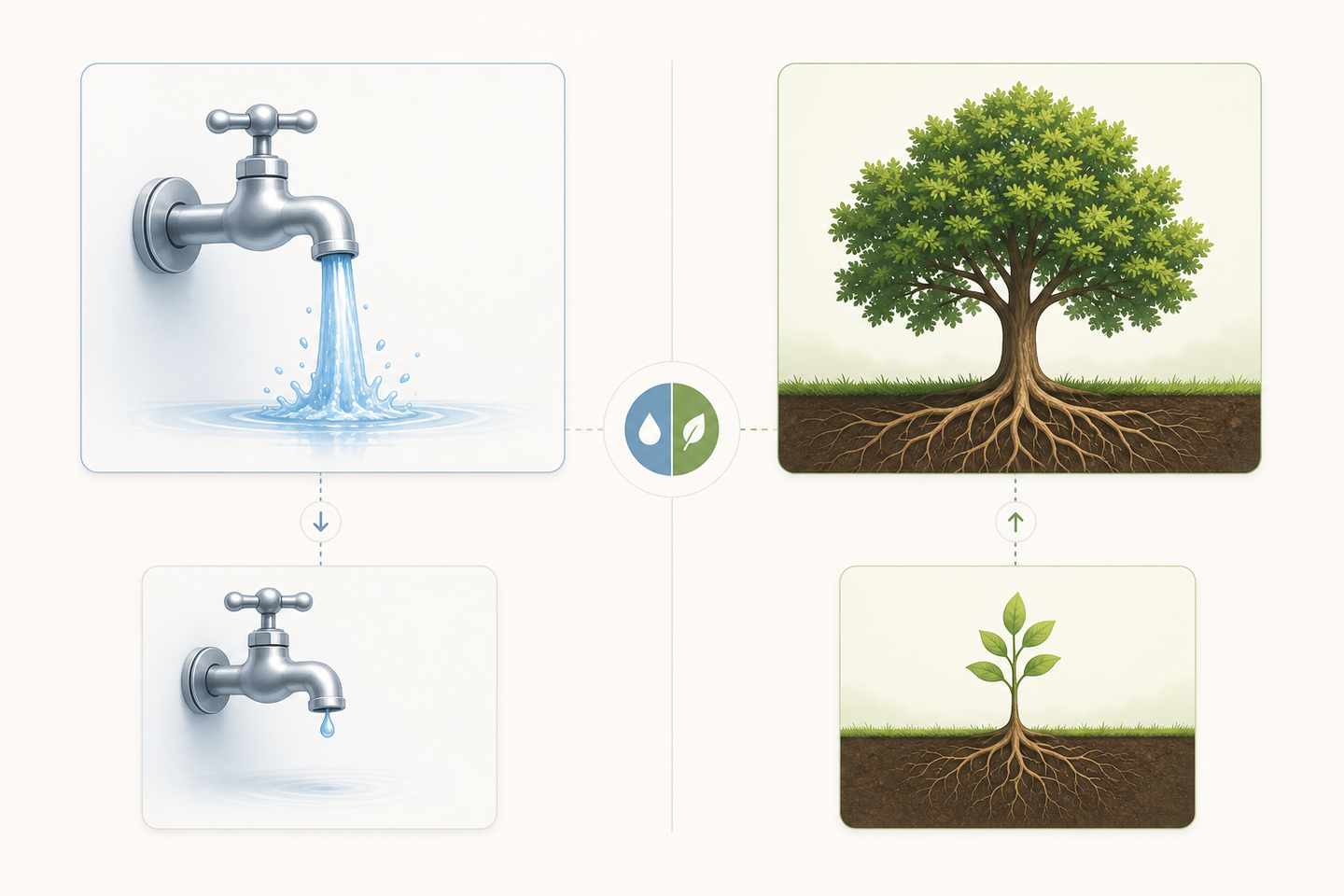
Paid advertising rents your audience. The moment you stop paying, the traffic stops. Content builds something you own — and that distinction matters more than most marketing teams give it credit for.
With ads, you're interrupting someone mid-scroll and hoping they convert before the impression expires. With content, you're answering a question they already had. One is intrusion; the other is utility. Buyers remember the difference.
The compounding economics are the real argument. A well-ranked article drives traffic for years after publication. A paid campaign drives traffic for exactly as long as the budget runs. According to DigitalApplied, content marketing generates 3x more leads than outbound at 62% lower cost — because owned content assets don't decay the way ad spend does. Understanding where AEO fits alongside SEO sharpens how you think about both sides of that equation.
That's the strategic logic for shifting budget toward content: you're building an asset, not renting an impression.
The Core Deliverables of a Content Marketing Service Engagement
What you're actually buying varies a lot by provider. Before you start comparing quotes, it's worth knowing what a full-engagement scope should look like — so you can tell the difference between a real program and a glorified writing subscription.
Six deliverables should appear in any serious engagement:
- Strategy and editorial calendar: a documented content plan tied to keyword targets, audience segments, and business goals, updated on a recurring cadence
- SEO briefs and keyword maps: per-piece briefs that define target keywords, search intent, competitor gaps, and structural requirements before a word gets written
- Written assets: blog posts, pillar pages, landing pages, case studies, and comparison content, depending on where buyers are in your funnel
- Technical on-page fixes: metadata, schema markup, internal linking, canonical tags, and redirect handling, actually resolved instead of flagged in a report
- Distribution guidance: where to publish, how to structure for AI citation eligibility, and which formats perform by channel
- Performance reporting: rankings, traffic, impressions, and citation share across both Google and AI engines, delivered monthly or quarterly with clear attribution
The gap that separates providers is whether those last two items ship at all. Plenty of content services hand over polished drafts and stop there — technical SEO and AI search optimization treated as add-ons, if they appear at all. Ask directly whether technical fixes get executed or just flagged in a report, and whether reporting covers AI engine visibility alongside traditional rankings.
Content Marketing as a Service vs. Hiring In-House
The decision comes down to four things: cost, speed, breadth, and flexibility. Here's how those actually stack up.
Most B2B content marketing agencies charge between $5,000 and $15,000 per month for ongoing work. A single in-house content hire runs $80,000 to $120,000 annually in salary and benefits alone — before tools or production budget.
| Dimension | In-House | Outsourced Service |
|---|---|---|
| Cost | $80K-$120K+ per hire | $5K-$15K/month |
| Speed to output | Slow (hiring, onboarding) | Fast (day one) |
| Expertise breadth | One or two specialties | SEO, writing, tech, strategy |
| Flexibility | Fixed headcount | Scale up or down |
In-house makes sense once you have enough volume to support a dedicated team and need deep institutional knowledge baked into every piece. Outsourcing wins when you need broad expertise fast, or when building a full content team would take quarters you don't have. Either way, a solid B2B SEO strategy should be the first thing locked in — whether an external provider does it on day one or you build it yourself.
When Outsourcing Content Marketing Makes Sense
Outsourcing tends to win in four specific situations.
No dedicated marketing team. You're choosing between outsourced and nothing. A founder writing blog posts between product sprints isn't a content program — it's a distraction with a publishing date.
Scaling faster than hiring allows. Recruiting a content strategist, SEO specialist, and editor takes months. A service engagement starts in days. It's worth thinking through SEO platform vs. SEO agency before you commit to either path, but speed is usually the deciding factor at this stage.
Deep domain expertise, no content production skills. You bring the subject matter knowledge; the provider handles keyword strategy, structure, and distribution. That split works cleanly when the roles don't overlap.
Consistency. Most in-house teams can produce great content occasionally. Maintaining a 12–15 piece monthly cadence alongside every other priority is a different challenge entirely. Outsourced services are built to hold that output regardless of what's happening internally.
When It Does Not Make Sense to Outsource Content Marketing
Three situations where outsourcing genuinely underperforms.
Highly technical or proprietary subject matter. If your product requires deep engineering context to explain accurately, an external provider will produce surface-level content your buyers will see through immediately. Compiler infrastructure, novel biomedical protocols, specialized financial instruments — these need internal authors who live inside the problem. A service can edit and optimize that content, but it can't originate it.
Pre-product-market-fit. If you're still figuring out who your buyer is and what they actually care about, producing 12 pieces per month locks in the wrong message at scale. Get the positioning right first. Content marketing amplifies a clear message; it doesn't create one.
Compliance-heavy industries with tight review cycles. If every piece requires legal, compliance, and medical sign-off before it can publish, the speed advantage of outsourcing disappears. You need a workflow built around those gates — and most external providers aren't equipped to operate inside them.
How to Vet a Content Marketing Service Provider
Most provider pitches sound the same until you ask five questions.

- Does their proposal lead with a documented keyword strategy or a content volume commitment? Volume without strategy is just noise.
- Do they understand answer engine optimization well enough to structure content for citation eligibility — beyond rankings alone?
- Is SEO baked into the brief-level process, or offered as an optional review after writing?
- Do they cover AI search visibility — optimization for citation in ChatGPT, Perplexity, and Google AI Overviews — or only traditional rankings?
- What exactly appears in monthly reports, and who owns acting on the findings?
- What's the minimum contract term, and what happens to your content if you leave?
That last one matters more than most buyers realize. Some providers retain licensing rights or lock content inside proprietary CMS environments. Confirm ownership in writing before signing anything.
The AI search question is the sharpest filter of the bunch. Most traditional agencies built their workflows before AI-generated answers existed, and that gap shows. Producing well-written blog posts is a different skill set than structuring passage-level content for citation eligibility, adding FAQPage schema, or tracking citation share across AI engines. Ask directly how they measure AI visibility. If the answer is vague, assume they don't.
How Much Content Marketing as a Service Costs
Pricing ranges widely depending on what you're actually buying — and two providers quoting the same number can be selling completely different things.
Entry-level retainers start around $1,500 to $3,000 per month. At that price, you're typically getting a set number of articles with basic keyword targeting and no meaningful SEO integration. Content production, not a content program.
Full-service B2B retainers run $5,000–$15,000/month, where strategy, technical SEO, editorial planning, and reporting come bundled. Two providers quoting $8,000 can be selling completely different scopes — which is exactly why the vetting questions in the previous section matter.
Project-based work sits outside the retainer model. A single pillar page or content audit might run $3,000 to $10,000 as a standalone engagement.
Four factors drive the cost differences:
- Strategy depth: keyword research, competitor gap analysis, and editorial planning cost more than a content brief template
- Volume: more pieces per month, higher base cost
- SEO integration: technical fixes and schema work add to the scope
- Human expertise: subject matter specialists cost more than generalist writers
Performance-based pricing is worth knowing about — roughly 18% of agencies now offer some version of it, up from 11% in 2024. Aligned incentives sound good in theory. The risk is agencies optimizing for trackable vanity metrics instead of revenue-contributing outcomes.
Human expertise is the biggest hidden cost driver. Generalist writers are priced differently from specialists, and AI-powered content creation is shifting what that expertise mix needs to look like. Know which you're actually buying before you sign.
SEO and AI Search: What a Content Marketing Service Should Cover in 2026
Two ranking systems are running simultaneously right now, and most content services are only optimizing for one of them. That's a problem worth naming before you sign anything.
Traditional Google rankings still matter. But AI-generated answers from ChatGPT, Perplexity, Gemini, and Claude are now fielding a real share of buyer research queries — and the content that gets cited there follows different structural rules than what ranks on page one.
A provider optimizing only for Google in 2026 is leaving an entire visibility channel untouched.
What AI citation eligibility actually requires
AI citation eligibility is structurally different from standard SEO. Passage-level structure matters: self-contained blocks of 130–170 words that answer one question completely, with the entity named inside the block. FAQPage schema, Article schema, and HowTo markup function as binary qualifiers — AI engines deprioritize pages without them before content quality is even checked. Getting cited in AI Overviews depends heavily on getting these structural signals right.
Schema drift is a real problem too. When content updates outpace schema updates, citation eligibility drops regardless of how good the writing is — and most providers don't track it. AI citation visibility optimization covers how to keep both in sync.
Ask any provider you're considering whether they track citation share across AI engines alongside traditional rankings. If they measure success only through impressions and organic clicks, they're reporting on half the picture.
How Maintouch Approaches Content Marketing as a Service
I built Maintouch to replace your SEO and content marketing agency entirely — running strategy, content creation, technical SEO, backlinks and brand mentions, and AI visibility tracking inside one system. Every paying account gets a dedicated account strategist, accessible via weekly standing syncs and a dedicated Slack channel. That's the agency account team, without the agency markup.
The cost comparison is straightforward. Traditional agencies run $3,000 to $10,000 per month for execution scope Maintouch automates. Building that capability in-house runs $200,000 or more annually before you've ranked for a single keyword.
Where most agency engagements leave the loop open, Maintouch closes it. Technical fixes push directly to your connected CMS without routing through a developer queue. Citation performance tracks across all five AI engines: ChatGPT, Google Gemini, Google AI Overviews, Perplexity, and Claude. The system learns from every human edit, compounding in accuracy over time instead of resetting each month. If you want to see how the leading AEO tools compare on that front, that breakdown is worth a look.
If you've reached the point where outsourcing makes sense and want execution that actually compounds, shoot me a message at [email protected].
Final Thoughts on Building a Content Program That Actually Works
Content marketing done well is one of the few marketing investments that keeps paying after the work is done. The catch is that most providers sell deliverables, not outcomes — and the gap between the two shows up in your traffic about six months in.
Know what you're buying before you sign. Confirm you own the content. Make sure whoever you work with is measuring both traditional rankings and AI visibility. Those aren't optional checks — they're the difference between a program that compounds and one that runs out the clock on a retainer.
If you want to talk through what that looks like on your stack, shoot me a message at [email protected].
FAQ
Should a B2B SaaS company invest in backlinks or more content first?
Content comes first if your pages have no authority signals to support them, but neither works alone for long. The practical sequence: build enough content to cover your core keyword targets, then use backlinks to push those pages into ranking positions where they can compound. A page with strong structure and zero inbound links stalls; a link pointing to thin content wastes the authority. Run both in parallel once you have 10-15 pages worth defending.
How do I implement SEO when I don't have an in-house marketing team?
Outsource the strategy and execution layer, not the writing alone. A content marketing service that owns keyword research, technical fixes, and reporting gives you the full program without the hiring timeline. The risk with piecemeal freelancers is that the strategy stays with you, and that's the part most founders don't have time to hold. If you're comparing options, ask directly whether the provider executes technical changes or just flags them in a report.
Content marketing as a service vs. hiring in-house: which makes more sense for an early-stage startup?
Outsourcing wins for most early-stage companies because speed and breadth matter more than institutional depth at that stage. A single in-house content hire runs $80,000 to $120,000 annually in salary and benefits, covers one or two specialties, and takes months to recruit and onboard. A service engagement starts in days and brings SEO, technical, and strategy capabilities together. In-house makes sense once you have enough volume and enough product clarity to support building a dedicated team.
What type of content should you create when your ICP doesn't know your solution category exists yet?
Build content around the problems your buyers are actively searching for, not the category name you've invented. If buyers don't know your category exists, they're searching for symptoms and workarounds, not solutions. Zero-volume queries pulled from Search Console are the most useful signal here: they show the exact questions buyers ask AI tools and search engines before any search volume has accumulated around the answer. That's where you find the real research window.
What should you ask a content marketing service provider about AI search visibility before signing a contract?
Ask them directly how they measure citation share across ChatGPT, Perplexity, Google AI Overviews, Gemini, and Claude. If the answer is vague or they track only traditional rankings, they're optimizing for one of two parallel ranking systems and leaving the other untouched. Also ask whether FAQPage, Article, and HowTo schema are part of their standard workflow or an add-on, and whether schema gets updated automatically when content changes. Schema drift is one of the most common reasons a page loses AI citations without any change to content quality.
How long does it take to see results from a content marketing service?
In most cases, you'll start seeing ranking movement and impression growth within three to six months, with compounding traffic gains in months six through twelve. Don't expect revenue from month one -- expect data. Impressions, crawl activity, and early ranking movement are legitimate wins in the first 90 days. The mistake most teams make is pulling the plug at month four before the compounding has had time to kick in.
Do you own the content a content marketing service produces for you?
You should, but confirm it in the contract before signing anything. Some providers retain licensing rights or lock content inside proprietary CMS environments that make migration painful. Any reputable content marketing service engagement transfers full ownership of all produced content to the client -- including if you leave. Ask the question explicitly, get it in writing, and treat vague answers as a red flag.
What's the difference between a content marketing service and a content agency?
The terms are used interchangeably, but the distinction that actually matters is execution scope. A content agency typically produces deliverables you specify -- articles, copy, creative -- with you owning the strategy layer. A content marketing service takes ownership of the program end-to-end: the strategy, the keyword targeting, the technical SEO, and the reporting. You're buying an outcome, not a deliverable. If a provider can't tell you who owns the strategy, it's a content agency, whatever they call themselves.
How do you measure ROI from content marketing as a service?
Start with the cost comparison: what would it cost to build this capability in-house versus what you're paying for the service. For most B2B companies, converting a single new customer through inbound content covers six to twelve months of service fees. Beyond that, track organic traffic growth, keyword rankings, inbound pipeline, and -- if your provider covers it -- citation share across AI engines. If the only metric in your monthly report is blog traffic, you're missing most of the picture.
Can a content marketing service work for a highly technical or niche B2B product?
It depends on how the provider handles subject matter expertise. For products that require deep engineering context to explain accurately -- compiler infrastructure, novel biomedical protocols, specialized financial instruments -- an external provider will struggle to originate accurate content without significant input from your team. The better model in those cases: you provide the subject matter depth, they handle the keyword strategy, structure, and distribution. A good provider will tell you this upfront; one that promises to handle everything independently in a highly technical niche is overselling.
Is content marketing as a service worth it for a small company or startup with a tight budget?
At entry-level retainer prices ($1,500 to $3,000 per month), you're typically getting content production without the strategy layer -- which means you're still on the hook for figuring out what to write and why. For early-stage companies where the positioning isn't locked in yet, that's a problem. If you're pre-product-market-fit, hold off. If you have a clear message and a defined ICP but no bandwidth to execute, a full-service engagement is almost always cheaper than the internal hire it replaces.
Turn search into your best growth channel.
Maintouch tracks your visibility across AI and Google, creates and refreshes content, and gets your brand mentioned on the sites that shape discovery.
Book a demoRelated reading
All posts