
The Best Profound Alternatives [October 2026]

By Bennett Cohen
Get Maintouch
Turn search and AI visibility work into a repeatable growth system.
If you're considering Profound for AI visibility tracking, you already know the gap: it shows you where your brand is invisible in AI answers, then hands the fix back to you.
Profound is largely a dashboard. It was one of the first companies to ship AI visibility tracking, and the citation data is real. But someone still has to write the content, push the technical changes, and chase the backlinks. The tool reports; it doesn't execute.
This post breaks down the best alternatives in July 2026 so you can find the tool that fits your situation, whether that's cheaper monitoring, custom workflows, or a system that does the work instead of reporting on it.
TLDR:
- Profound no longer offers a Growth plan. It now has a 7-day free trial (ChatGPT, Gemini, and Google AI Overviews only, no ongoing tracking after 7 days) and a custom Enterprise plan. Every other engine (Claude, Perplexity, Grok, Copilot, DeepSeek) requires Enterprise.
- Most alternatives in this category do the same thing Profound does: report on AI visibility without pushing fixes, publishing content, or building backlinks
- Peec AI starts at $95/month for monitoring only; AirOps requires developer involvement every time a workflow changes
- Maintouch tracks all 5 engines starting at Hypergrowth ($799/mo) and offers a 5-day free trial on any self-serve plan; it also runs the full execution loop inside one system. No handoff, no coordination tax.
How Profound Works
Profound launched as one of the first dedicated AI visibility products. For a deep look at how it works, the Profound AI citation review covers the tracking mechanics and limits in detail. It monitors ChatGPT, Perplexity, and Google AI Overviews, tracking which brands get cited in AI-generated answers, how often, and in what sentiment context.
The core mechanics:
- Prompt tracking across the major AI engines
- Competitive share-of-voice reporting
- Sentiment analysis on how your brand gets framed
- A workflow builder called Agents for configuring content and optimization steps
It slots into your existing content workflows without replacing them. The scope is AI search visibility only, not general SEO, not social.
The standout feature is Prompt Volumes: panel data from opted-in consumers showing what people actually ask AI tools, with demographic breakdowns attached. Think of it as keyword research rebuilt for the answer engine optimization era, built into the same product instead of bolted on separately.
The Agents workflow builder is real, but it has a learning curve. User feedback is consistent on this: you need a bit of technical comfort before it pays off.
Why Consider Profound Alternatives?
Profound earns its keep for a specific buyer: enterprise brands with real analytics budgets, a dedicated AI search team, and a genuine need for deep citation intelligence. Independent agency reviews of Profound consistently rate it 4/5 or higher for brand presence and sentiment tracking, while flagging configurability and CDN-dependent traffic attribution as real gaps for smaller teams. If that's you, the tool holds up.
The gaps show up the moment your situation drifts from that profile.
Pricing is the first wall. Profound AI pricing no longer has a self-serve paid tier. Profound now offers a 7-day free trial (ChatGPT, Gemini, and Google AI Overviews only, no ongoing tracking once the trial ends) and a custom Enterprise plan for everything else. Want Perplexity, Claude, or Grok? That requires a custom Enterprise conversation. Independent reviews flag this consistently as the primary friction point.
But the deeper issue is architectural. Profound tells you where the gaps are and leaves the room. Someone on your team still has to write the content, ship the technical changes, and chase the backlinks. The tool was built to inform decisions, not to execute them.
A few more limits worth naming:
- One workspace per account, so agencies, holding companies, and multi-brand teams hit a hard ceiling
- CMS integrations cover WordPress and Sanity, per the knowledge base
- The Zapier-style workflow builder was built for agency setups, not lean in-house startup teams
That's the real reason teams start looking elsewhere: not the price, but the handoff. For a full feature breakdown, see the Maintouch vs Profound head-to-head.
Best Profound Alternatives in July 2026
1. Maintouch, Best Overall Profound Alternative
I built Maintouch to replace what an SEO agency does end to end. Strategy, content creation, technical SEO, backlink procurement, AI citation tracking. All of it running continuously inside one system. Where Profound surfaces data and stops, Maintouch does the work.
In practice: it pushes technical fixes straight to your live CMS, sources backlinks through integrated marketplaces, drafts and publishes content built for both Google and AI engines, and tracks LLM visibility across all five engines. The Agentic Document Editor (think Cursor, but for SEO) sharpens quality with every human edit, automatically updating the Knowledge Base, Brand Voice, and Blog Rules as your content evolves.
Key strengths:
- AI visibility tracking across all five engines on Hypergrowth and above; 5-day free trial on any self-serve plan
- Closed-loop execution from keyword strategy through backlink procurement, no manual handoff
- SOC 2 Type 2 compliance; dedicated forward deployed marketer on Custom
- SEO-first architecture with AEO layered on top
Best for: B2B SaaS startups, developer tools companies, and venture-backed brands that want a full search program running without an agency or a full-time SEO hire.
Bottom line: Maintouch offers a 5-day free trial on any self-serve plan, covers all five engines from Hypergrowth upward, and pairs that coverage with execution Profound's architecture was never designed to do.
2. Peec AI
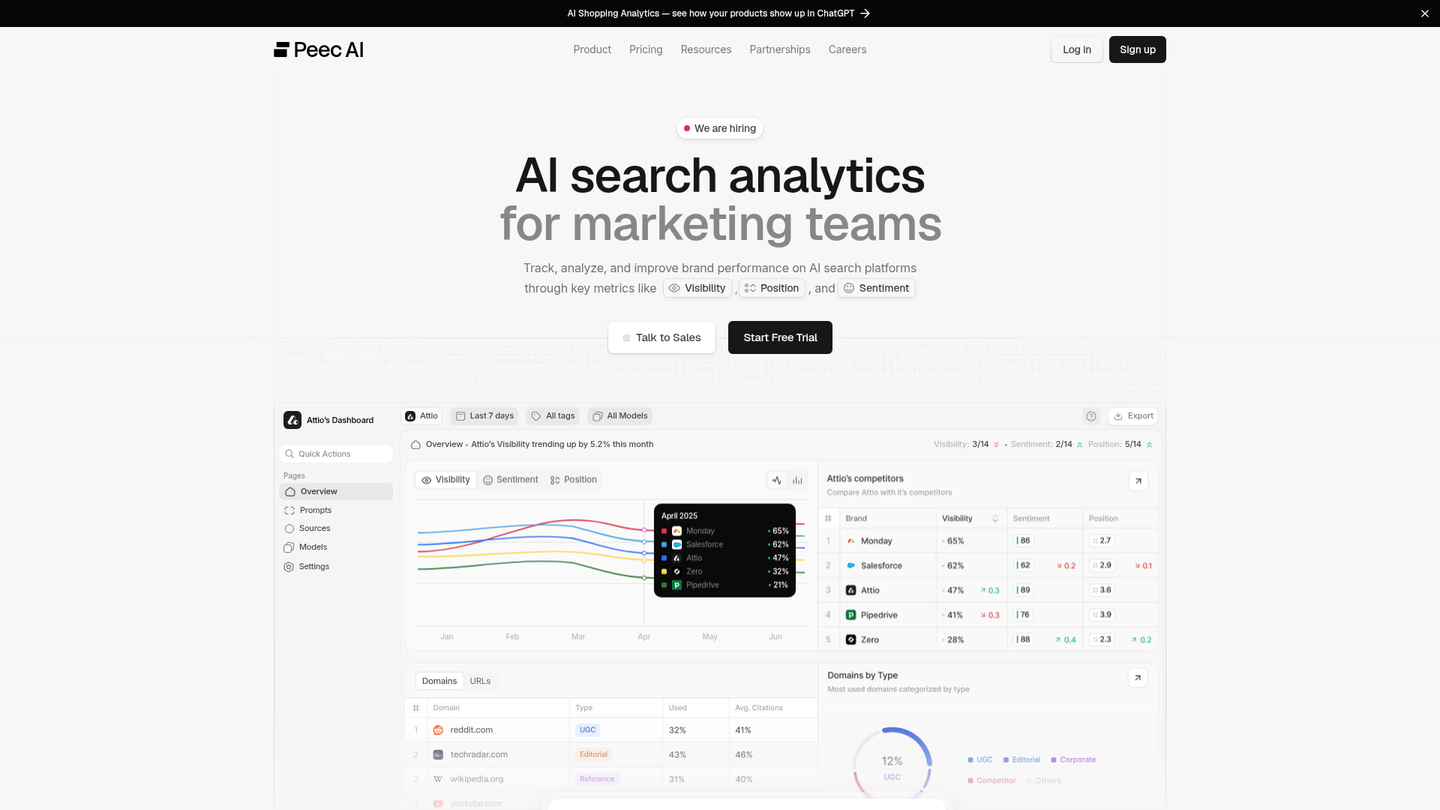
If your main constraint is budget, Peec AI is the lightest entry point. It's built for agencies and marketing teams that want focused AI visibility tracking without signing a big contract. The Starter plan runs $95/month for 50 prompts across 3 models of your choice; multi-country tracking and Looker Studio integration land at the Advanced tier ($495/month). For a fuller breakdown, see Maintouch vs Peec AI.
Good for: agencies that want cheap, focused monitoring and already have execution covered.
Key limitation: analytics only. Maintouch offers a 5-day free trial on any self-serve plan and actually runs the work Peec only reports on.
3. AirOps
AirOps is built for teams that already have existing content processes and want to wire AI into them. It's a workflow builder, sold mostly through implementation agencies who configure and maintain the pipelines for you. The feature set includes content workflows, multi-engine visibility on the Pro plan, drag-and-drop configuration, and API automation. Hands-on AirOps reviews note that teams already running proven manual processes get the strongest ROI, but the learning curve and setup complexity are consistent friction points.
Good for: technically resourced teams that have the dev bandwidth to build and maintain custom workflows.
Key limitation: every workflow change needs a developer, which means 2-3 week delays for updates Maintouch ships through a no-code interface. Task-based pricing gets unpredictable at scale, and meaningful multi-engine visibility starts near $2,000/month. There's no automated backlink layer and no self-learning content engine. Most importantly: AirOps reintroduces the agency dependency it claims to remove. See the full Maintouch vs AirOps comparison.
4. Semrush
Semrush is the broadest data toolkit in SEO. Keyword research, site audits, rank tracking, backlink analysis, competitive intelligence: it covers more surface area than any single competitor in this list. Semrush added AI visibility reporting for Google AI Overviews in 2025, now available across its Guru and Business tiers. Pricing starts at $139.95/month (Pro) and scales to $499.95/month (Business), with AI Overviews data available at the Guru tier ($249.95/month) and above.
Good for: teams that already have writers, developers, and link-builders in-house and want a single data layer covering both traditional SEO and AI Overview visibility. If you're comparing the broader category, see the best AI visibility trackers roundup.
Key limitation: Semrush tells you what to do. It doesn't do it. No content creation, no CMS publishing, no backlink procurement, no technical fix execution. AI visibility tracking is limited to Google AI Overviews only (no ChatGPT, no Perplexity, no Claude, no Gemini citations). You're paying for a dashboard that opens loops your team still has to close. Maintouch tracks all five engines from Hypergrowth upward, offers a 5-day free trial on any self-serve plan, and runs the execution layer Semrush assumes you'll staff yourself.
5. Ahrefs
Ahrefs owns the best backlink index in the industry, and that's the reason most teams buy it. The broader toolkit covers keyword research, site audits, rank tracking, and competitive analysis, but the crawl data and link intelligence are where it earns its reputation. Pricing starts at $129/month (Lite) and scales to $1,499/month (Enterprise). Ahrefs added AI Content Helper features and basic AI Overview tracking in 2025; coverage remains limited to Google's AI results.
Good for: teams that need deep backlink intelligence, competitive link gap analysis, and a mature keyword research database alongside their existing content operation.
Key limitation: Ahrefs gives you data, but someone still has to act on it. There's no content creation engine, no CMS publishing, no automated backlink procurement, and no technical fix execution. AI visibility tracking covers Google AI Overviews only (no ChatGPT, no Perplexity, no Claude). Like Semrush, it's a data layer that assumes you have people or an agency to turn those insights into results. Maintouch is the execution layer that makes Ahrefs-grade data actionable without the extra headcount.
Feature Comparison: Profound vs Top Alternatives
The question underneath every row in this table: does the tool ship the work, or just surface what needs doing?
| Feature | Profound | Maintouch | Peec AI | AirOps | Semrush | Ahrefs |
|---|---|---|---|---|---|---|
| AI Engines Tracked | 3 on free trial (7 days only); 10+ on Enterprise only | 5 engines on Hypergrowth and Enterprise; 4 on Scale; 3 on Starter | 3 engines (user's choice) | 4 engines on Pro ($2,000/mo) | Google AI Overviews only | Google AI Overviews only |
| Claude Coverage | Enterprise-only (custom pricing) | Hypergrowth ($799/mo) and above | User selects (counts against 3-model cap) | Enterprise-only | No | No |
| Content Creation | Enterprise only; no self-serve paid plan available | Full agentic drafting, publishing, and updates | No | Yes, via workflow configuration | No | No |
| CMS Push (live publishing) | WordPress, Sanity | WordPress, Webflow, HubSpot, Ghost, Contentful, Sanity, Strapi, Storyblok, Payload, and more (Framer in beta) | No | Yes, agency-configured | No | No |
| Technical SEO Execution | No | Yes, auto-pushes fixes to CMS | No | No | No (audits only) | No (audits only) |
| Automated Backlink Procurement | No | Yes, via integrated marketplace (Hypergrowth and above) | No | No | No | No |
| Free Tier | No | 5-day free trial on any self-serve plan | No | Limited "Insights" tier (1,000 tasks, single engine) | Limited (some free tools) | Limited (Webmaster Tools) |
| Dedicated Human Strategist | Enterprise only | Custom only (dedicated forward deployed marketer) | No | Via agency partner | No | No |
| Self-Learning Content Engine | No | Yes, updates KB, Brand Voice, and Blog Rules on every human edit | No | No (static unless manually rebuilt) | No | No |
| Pricing Transparency | Opaque; routes to enterprise sales | From $149/mo (Starter) to $799/mo (Hypergrowth); Custom: contact sales | $95-$495/month | $200/month (Solo) to $2,000/month (Pro) | $139.95-$499.95/month | $129-$1,499/month |
The Real Cost of Profound vs. Alternatives: Total Cost of Ownership
The stated monthly price is the wrong number to compare. Profound's $399/month Growth plan is only the monitoring layer, and you still need people downstream to act on what it surfaces. Independent reviews are consistent on this: Profound customers frequently hire an external contractor (typically ~$2,000/month) just to extract value from the tool. Someone has to translate citation reports into content briefs, ship technical changes, and manage the execution workflow Profound doesn't touch. Add an Ahrefs seat ($229/month) or Semrush ($139+/month) for the SEO data Profound doesn't cover, and you're at $800 to $2,600/month before a single piece of work gets shipped.
Maintouch's dedicated account strategist is the direct structural substitute for that contractor layer, and it's included in every paying account at no added cost. The comparison isn't tool price vs. tool price. It's the total cost of getting the work done.
| Tool | Stated Monthly Price | Hidden Contractor Cost | Support Tier | Execution vs. Monitoring |
|---|---|---|---|---|
| Profound | Trial (free, 7 days) or Enterprise (custom pricing, contact sales) | ~$2,000/month (external contractor to act on reports) + $140 to $229/month SEO data tool | Bi-weekly check-in calls; Enterprise-only for dedicated support | Monitoring only. Reports gaps, doesn't fix them |
| Maintouch | From $149/mo (Starter) to $799/mo (Hypergrowth); Custom: contact sales | $0 on Custom - dedicated forward deployed marketer included; self-serve tiers (Starter/Scale/Hypergrowth) include a dedicated onboarding session (Hypergrowth) or self-serve support only | Custom: dedicated forward deployed marketer, regular meetings, dedicated Slack channel; Hypergrowth: dedicated onboarding session; Starter/Scale: email/chat support | Full execution: content, technical SEO, backlinks, CMS publishing, all five AI engines |
| Peec AI | $95 to $495/month | Full execution stack still required (writers, developers, link-builders) | No human support layer | Monitoring only |
| AirOps | $200 to $2,000/month | Implementation agency required to configure and maintain pipelines | Via agency partner only | Partial execution: agency-configured; developer required for every workflow change |
| Semrush | $139.95 to $499.95/month | Full execution stack still required (writers, developers, link-builders) | No dedicated support below Enterprise | Monitoring only: Google AI Overviews only for AI visibility |
| Ahrefs | $129 to $1,499/month | Full execution stack still required (writers, developers, link-builders) | No dedicated support below Enterprise | Monitoring only: Google AI Overviews only for AI visibility |
The pattern is consistent across every monitoring row: the stated price is the cheapest part of the equation. Every tool in the reporting category assumes you have people downstream to act on what it surfaces, and those people cost money that never shows up in the tool's pricing page. Maintouch is the only row where the execution and the strategist are already in the price.
Support Cadence as a Cost Line, Not a Perk
Profound's Growth plan includes bi-weekly check-in calls. That's one conversation every two weeks to diagnose what the citation reports surfaced, decide what needs doing, and hand the work back to whoever's downstream. If that handoff goes to a contractor or an agency, you're paying for their time to absorb a briefing that should have been execution already. The coordination tax is real and it compounds monthly.
Maintouch Custom accounts get a dedicated strategist with regular standing syncs, plus a Slack channel for anything that can't wait for the next scheduled call. On Custom, the strategist is the execution handoff: priorities get set, agents run the work, and there's no separate contractor layer to fund. For Custom accounts, that's a $2,000/month line item removed from your total cost.
The distinction matters when you're doing total-cost math. A bi-weekly call cadence assumes someone is already positioned to act on what gets discussed. Regular standing syncs (on Custom) paired with autonomous execution assumes no one needs to be.
The Case for Maintouch Over Profound
Profound does its one job well. For an enterprise team whose whole mandate is reporting on AI visibility, the citation intelligence and sentiment analysis hold real value, especially when agencies, developers, and writers are already handling execution downstream. That profile is narrow, though. The moment you need search marketing to actually run, the gaps compound fast: Claude tracking sits behind custom enterprise pricing, native content creation is limited and tied to Enterprise, and nothing pushes fixes live, builds backlinks, or gets sharper with each edit.
Maintouch runs every one of those workstreams under a single roof. You get more free engine coverage than Profound's paid plans, plus full content execution, live technical SEO remediation, automated backlink procurement, and a dedicated forward deployed marketer on Custom. See Maintouch pricing plans to compare tiers.
The architecture is SEO-first, which matters: AI visibility rides on a real content and authority base instead of a monitoring layer bolted onto nothing. I've watched enough teams buy a reporting tool, stare at the citation data for three months, and then ask who's going to do the work. If you want a search program that actually runs, that's the gap Maintouch was built to close.
Final Thoughts on Finding the Right Profound Alternative
Not every team needs the same thing from this category. If you've got writers, developers, and link-builders already running, Profound's citation data is genuinely useful: it tells you exactly where to point them. But if your search program still needs to run, a monitoring tool hands you the map without driving the car.
If you want the execution baked in, shoot me a message at [email protected]. I'm happy to walk you through what that looks like for your stack.
Which Profound Alternative Is Right for You?
The right tool depends on two variables: how much execution capacity you have in-house, and whether you need the work done or the data surfaced.
Lean team of 1-3 marketers who need execution? Maintouch runs content, technical SEO, backlinks, and all five AI engines autonomously, replacing $200k+ in annual SEO headcount without adding a single hire. A 5-day free trial is available on any self-serve plan. If you only need monitoring, Peec AI at $95/month is cheap enough to run alongside whatever execution you already have.
Dedicated SEO team of 5+ with developers in-house? AirOps wires AI into your existing workflows without replacing them. If analytics is the goal, Profound's citation intelligence and Prompt Volumes are genuinely useful when you have a team positioned to act on the data. Semrush adds the broader SEO data layer if AI Overviews coverage is all you need.
Trying Profound Alternatives for Free
Profound offers a 7-day free trial covering ChatGPT, Gemini, and Google AI Overviews only, with no ongoing tracking once the trial ends. If you want to see how your brand shows up in AI answers before committing to a paid plan, that window closes after a week with no data carried forward. Claude coverage still requires a custom enterprise conversation regardless of what you're spending elsewhere.
Maintouch offers a 5-day free trial on any self-serve plan, covering all five engines (ChatGPT, Google Gemini, Google AI Overviews, Perplexity, and Claude), including Claude, which Profound locks behind custom Enterprise pricing.
The practical difference: you can verify whether your brand shows up in Claude answers right now, on a 5-day trial, without negotiating an enterprise contract.
FAQ
Why do teams look for Profound alternatives in the first place?
Profound is built around reporting: it shows you where your brand is invisible in AI answers, then hands the fix back to you. Teams that need search marketing to actually run, not merely monitored, hit that wall quickly, especially when Profound is now trial-only or custom Enterprise, with all ongoing tracking and content features requiring an Enterprise contract.
When does switching from Profound to a full-execution system like Maintouch make sense?
If your team is spending meaningful time routing Profound's citation reports to writers, developers, and link-builders through separate tools and workflows, the monitoring-only architecture is costing you more than the subscription saves. The moment execution becomes its own coordination job, a closed-loop system that does the work inside a single system is worth a hard look.
What features should you focus on when comparing Profound alternatives?
The single question that cuts through every feature comparison: does the tool execute the work, or only report what needs doing? After that, check which AI engines are covered at which price tier, whether the tool pushes fixes directly to your CMS, and whether backlink procurement is built in or left to a separate workflow entirely.
Is Maintouch a good fit for teams that don't have a dedicated SEO hire?
Maintouch was built for exactly that situation: B2B SaaS startups and venture-backed brands that want a full search program running without an agency or a full-time SEO employee. On the Hypergrowth tier and above, agents handle content creation, technical fixes, and backlink procurement continuously in the background. Starter and Scale focus on AI visibility tracking and keyword strategy. Custom accounts also get a dedicated strategist, regular syncs, and a dedicated Slack channel for direct access.
Can you track Claude citations without paying for an enterprise plan?
With Profound, Claude coverage is locked behind custom enterprise pricing, and even basic ongoing tracking beyond the 7-day trial requires an Enterprise plan. Maintouch includes Claude tracking on Hypergrowth ($799/mo) and above, with a 5-day free trial available on any self-serve plan.
How is AI visibility tracking different from traditional SEO tracking?
Traditional SEO tracking measures where you rank in a list of blue links. AI visibility tracking measures whether you get cited inside an AI-generated answer. That's a fundamentally different competition. Instead of competing for position one among ten results, you're competing to be one of three to five sources an AI engine actually names. The scoreboard is citation share, not ranking position.
Do I need to replace my existing SEO tools to use one of these alternatives?
Depends on the tool. Profound and Peec AI sit on top of your existing stack: they add monitoring without removing anything, which means you're still paying for Ahrefs or Semrush to actually do SEO work. Maintouch is designed to replace that stack entirely: strategy, content, technical SEO, and backlinks run inside one system, so there's no tool you need to keep alongside it.
What does it actually cost to run Profound alongside a full SEO stack?
Profound no longer offers a self-serve paid plan. Access beyond the 7-day free trial requires a custom Enterprise contract, meaning the true cost of entry is negotiated pricing that typically runs well above the old $399/month Growth plan that was previously available. On top of that contract, you still need an SEO data tool (Ahrefs starts at $129/month (Lite), Semrush $139+/month), a content writer or agency for the fixes Profound surfaces, and a technical resource to push changes live. Realistically you're looking at a custom Enterprise fee plus $400-$600/month in supporting tools before any execution happens, and none of that coordination is automated.
Is there a free way to track how my brand shows up in AI search results?
Profound's 7-day free trial covers only ChatGPT, Gemini, and Google AI Overviews, with no ongoing tracking once it expires and no Claude access without an Enterprise contract. Peec AI and AirOps have no free trial at all. Maintouch offers a 5-day free trial on any self-serve plan covering all five engines, including Claude, which is more coverage than Profound's trial delivers before the clock even runs out.
How do these tools handle content creation after flagging a citation gap?
Most of them don't. Profound caps content output at six articles per month on the Growth plan. Peec AI has no native content creation layer at all. You get the gap report, then you're on your own. AirOps can generate content through configured pipelines, but those pipelines require agency setup and developer involvement to change. Maintouch drafts, optimizes, and publishes content autonomously, including pushing it directly to your CMS, without routing the work back to a separate team.
Which of these tools is best for a small in-house team without a dedicated SEO hire?
Maintouch was built for that situation. On Hypergrowth and above, agents handle content creation, technical fixes, and backlink procurement continuously in the background without requiring a dedicated hire. Custom accounts get a dedicated strategist with regular meetings and a dedicated Slack channel on top of that. The other tools in this comparison assume you already have people to act on their reports. Profound and Peec AI surface data but leave execution to you.
Does better Google SEO actually help with AI citations, or are they completely separate?
They're not separate. They're the same foundation. AI engines like ChatGPT and Perplexity run a web search under the hood before generating answers, which means strong domain authority, clean technical SEO, and well-structured content directly improve your chances of getting cited. A monitoring-only approach that tracks citations without fixing the underlying content and authority gaps is optimizing the scoreboard without improving the game.
Turn search into your best growth channel.
Maintouch tracks your visibility across AI and Google, creates and refreshes content, and gets your brand mentioned on the sites that shape discovery.
Book a demoRelated reading
All posts