
AEO Tool for Startups: Track All 5 Engines | Sep 2026

By Bennett Cohen
Get Maintouch
Turn search and AI visibility work into a repeatable growth system.
Most AEO tools track ChatGPT, maybe Perplexity, and call it done. That's a measurement gap dressed up as a strategy. Claude went from under 2% to 18.5% of B2B AI referrals in about eight months — and it converts better than any other engine. If you're building citation strategy without it in your data, your numbers are wrong. This post breaks down which tools actually cover all five engines, what that costs, and what you're leaving blind when they don't.
TLDR:
- Claude converted B2B buyers at 16.8%, the highest rate of any AI engine, yet most AEO tools skip it entirely
- Each of the five AI engines has its own citation logic; optimizing for one leaves you invisible to at least two others
- Content under 30 days earns 3.2x more AI citations than older pages, making freshness signals a non-negotiable tracking criterion
- Every monitoring tool in this category reports citation gaps but stops there, leaving your team to coordinate the fixes separately
- Maintouch tracks all five engines (Claude included at the Hypergrowth tier at $799/month) and runs the fixes directly through your CMS instead of handing you a to-do list
What AEO Actually Means for Venture-Backed Startups in 2026
Answer Engine Optimization is simple: structure your content so AI chatbots cite you when a buyer asks something your product answers. Get cited, you exist. Don't get cited, you don't.
For a startup, that stakes are higher than they are for a legacy brand sitting on years of search equity. You're building awareness from scratch. Buyers increasingly ask ChatGPT or Claude for vendor recommendations before they ever open Google — and if the AI names your competitor first, the consideration set is already narrowing before you're even in the room.
Coverage breadth is where most teams blow it. According to Goodie's 2026 AI Search Traffic Report, Claude went from 1.4% to 18.5% of B2B AI referrals between mid-2025 and early 2026. Tracking two engines while Claude sends nearly a fifth of B2B traffic isn't frugal. It's just bad data.
Why Claude Coverage Is No Longer Optional
Across a 30-day benchmark of 500+ B2B SaaS sites, Claude drove 18.5% of trackable AI referrals and converted at 16.8% — the highest of any engine in the study. ChatGPT sent more volume. Gemini converted at 3.0%. Claude converts more than five times better than Gemini on the same buyer traffic.
That's not a rounding error. For a startup where every qualified lead matters, the engine mix is a revenue decision. Claude's web search pulls from Brave with a strong recency bias, which means fresh, well-structured content gets surfaced harder than on other engines. It rewards the same content work you're already doing — if you're actually tracking it.
Skipping Claude isn't neutral. It means skipping the engine that converts best among B2B buyers.
How AI Engines Decide What to Cite
Each engine has its own citation logic — and they're not small differences. Conductor tracked citation behavior across seven AI engines over seven months, accumulating 1,056 data points, and found that every major engine has a persistent editorial identity: a default source type it reaches for, query type by query type, consistently over time.
The shared signals — structured content density, schema and metadata alignment, recency, cross-source agreement — influence all five. But the weights are different enough to matter. Perplexity favors recency above most other signals. Google AI Overviews leans hard on existing search ranking. Claude pulls from Brave with a recency bias. ChatGPT mixes Bing's index with on-demand fetches.
Optimize for one and you're invisible on at least two others. That's the whole argument for five-engine coverage in one sentence.
The Five AI Engines Worth Tracking
The engines don't behave the same way, and they don't serve the same buyers. Here's where referral traffic actually breaks down across a 30-day benchmark across 500+ B2B SaaS sites.

| Engine | Share of AI Referrals | Why It Matters |
|---|---|---|
| ChatGPT | ~63% | Largest volume; broad buyer awareness queries |
| Claude | ~18.5% | Highest B2B conversion rate (16.8%) |
| Gemini | ~10.6% | Quadrupled share in 8 months; Google-native buyers |
| Perplexity | Smaller share | Highest revenue per visitor at $1.42 |
| Google AI Overviews | Tied to organic | Highest-volume surface; triggers on existing search intent |
The audiences don't overlap cleanly. Perplexity skews toward research-heavy buyers who want sourced answers. Gemini captures users already inside Google's ecosystem. Claude pulls technical and professional buyers doing vendor evaluation. These are different people at different stages — and they're all arriving through different front doors.
Track two engines and you've got a partial picture. Worse, you don't know which part you're missing.
AEO Tool Categories: Monitoring vs. Execution
Two categories define this market. They're not interchangeable.
Monitoring tools track your citation share and surface where competitors appear instead of you. They tell you the score. Execution tools act on it: pushing content updates to your CMS, correcting schema drift, building backlinks from sources AI engines already trust, refreshing stale pages before they drop out of the retrieval set.
If you're just starting to explore the citation space, a monitoring tool is a reasonable first step. Lower cost, less integration work, lets you understand the data before committing to a full workflow.
Where that logic breaks for startups is resource math. A monitoring tool hands you a to-do list. Someone still has to execute it — a developer queue, a content writer, an SEO resource coordinating across three tools. That coordination overhead frequently costs more than the subscription savings. Execution-layer automation compresses the whole stack into one system. At early scale, it's often cheaper than it looks on a pricing page.
The organizing question is simple: does the tool close the loop, or open a new one?
Key Features to Look For in an AEO Tool
Six things separate tools worth your time from ones that waste it.
- Engine coverage: all five engines tracked, not just ChatGPT and Perplexity
- Prompt volume: how many prompts run concurrently and how often
- Schema drift detection: whether the tool flags mismatches between your structured data and live page content
- False claim detection: whether it surfaces inaccurate things AI engines say about your brand
- Content freshness signals: fresh content earns 3.2x more AI citations than older pages — tools that flag stale content before you lose citations are worth prioritizing
- Execution depth: whether the tool can push fixes, or only report them
That last one is where the real separation happens. A tool that surfaces schema drift and stops there is half a solution. You still own the other half.
How Citation Tracking Actually Works
Most teams understand one of the two mechanics here. Missing the second one leads to misdiagnosed problems and wasted content work.
The first is synthetic prompt tracking. The tool sends pre-configured prompts to each AI engine, parses the responses, checks whether your brand appears, and logs the outcome. Run enough prompts across enough engines and you get citation share: what percentage of relevant AI answers name you versus a competitor.
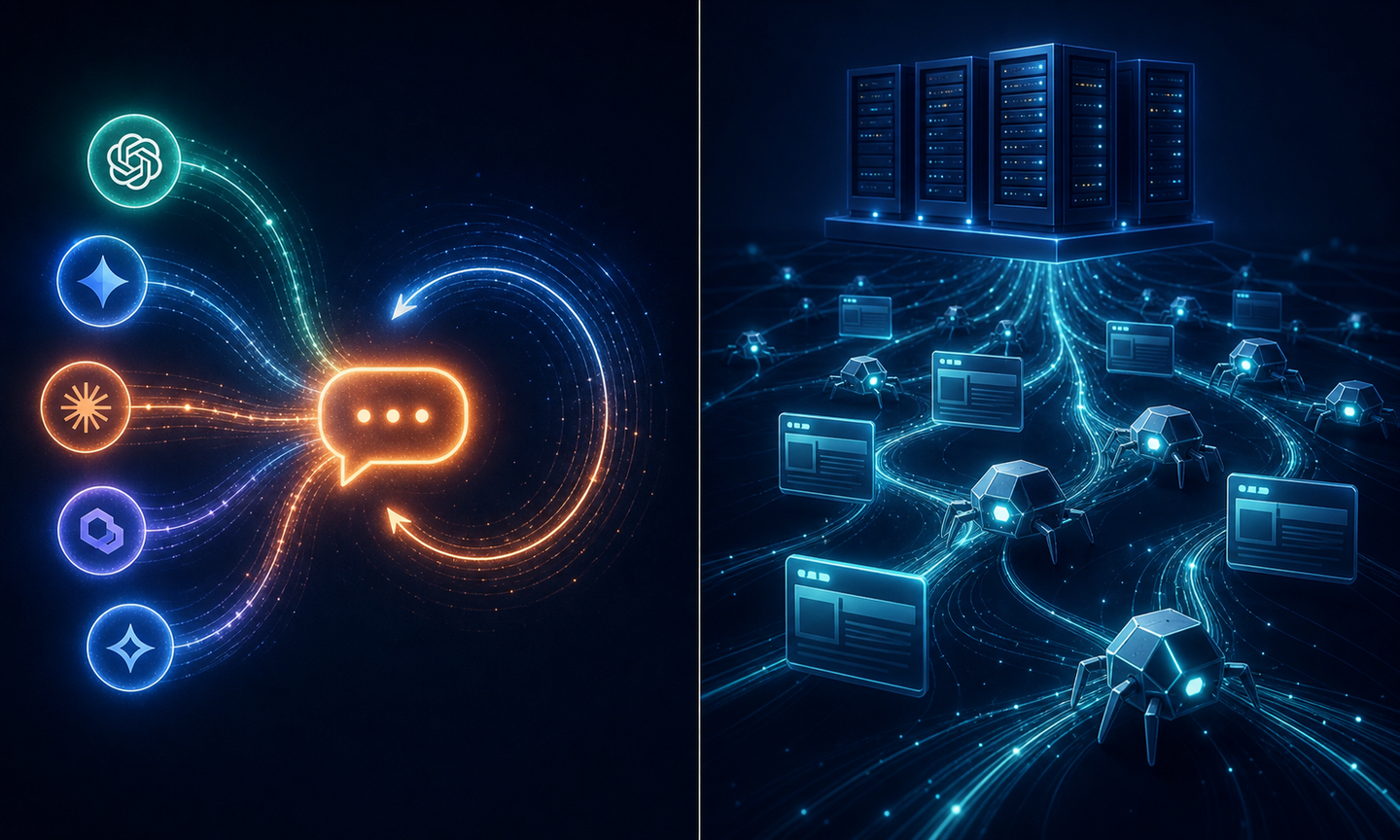
The second is AI crawler log monitoring. This approach — covered in more depth in our guide to tracking LLM visibility and AI search rankings — watches when bots from ChatGPT, Perplexity, Claude, and similar systems actually visit your pages, using request-level log data from infrastructure like Cloudflare or Vercel. It's a real-time signal: which pages AI engines are actively reading, independent of whether those pages get cited in any given answer.
Both signals matter, but they answer different questions. Synthetic prompts tell you the outcome — cited or not. Crawler logs tell you the input — which pages are being considered. A page with heavy crawler traffic and zero citations usually points to a content structure or schema problem, not a visibility problem. Catching that distinction early saves weeks of work aimed at the wrong fix.
AI Visibility Tracking vs. Traditional SEO Metrics
Traditional SEO gives you three core metrics: rankings, impressions, and click-through rate. All three assume the user clicks. Increasingly, they don't.
Roughly 68% of US Google searches ended without a click in the first four months of 2026, 80–83% when an AI Overview appears. A first-page ranking with no click is an impression. That's it.
Citation share is what replaces rank as the primary measure. If an AI engine names you, you exist in that buyer's consideration set — regardless of where you rank below it on the SERP. If it names a competitor instead, your position-two ranking is invisible to that buyer. AEO and SEO are now measuring different things.
There's a third layer worth understanding: AI engines break a single prompt into sub-questions before generating an answer. Tracking the right AI visibility metrics and KPIs — including whether you appear for those sub-questions — is where citation gaps actually get diagnosed.
AEO Tool Comparison: Monitoring-Only vs. Full-Stack Options
Most tools in this category track a subset of engines and stop at reporting. Here's how the major options compare.
| Tool | Engine Coverage | Execution | Starting Price |
|---|---|---|---|
| Profound | ChatGPT, Gemini, Perplexity, Claude, AI Overviews, Copilot (Enterprise only) | No | Custom (enterprise) |
| AthenaHQ | Limited coverage | No | ~$400/month |
| Semrush | Google AI Overviews only | No | Varies |
| Ahrefs Brand Radar | Google AI Overviews only, data-only | No | Varies |
| Peec AI | Partial | No | Varies |
The pattern holds across every row. Five-engine coverage including Claude is either locked behind enterprise pricing or absent entirely. Semrush and Ahrefs cover AI Overviews and stop there — no ChatGPT, no Claude, no Perplexity. Profound reaches all five engines, but only through custom enterprise pricing with no self-serve path. And none of these tools push fixes. None update schema. None build backlinks. They report. You figure out the rest. Among the tools reviewed in our AEO tools roundup, the execution loop reopens every single time.
What Venture-Backed Startups Need That Enterprise Tools Miss
Enterprise AEO tools were built for orgs with a dedicated SEO lead, a content team, and an agency relationship to absorb implementation overhead. That's not a startup, and retrofitting those tools into a lean team is where most of the hidden cost lives.
Profound's support model runs bi-weekly check-ins at best. Teams migrating from it have reported needing an external contractor just to extract value from the data. Add that contractor cost to the subscription and the real monthly number is materially higher than the pricing page suggests.
Custom enterprise pricing also means a sales cycle before you can track anything. That's weeks a founder-led team doesn't have.
The support gap is the one most teams don't see coming. Monitoring tools assume you know what to do with citation data once you have it. A lot of startups don't. When an AI engine stops citing you, the tool surfaces the drop — but it won't tell you whether the cause is schema drift, stale content, a competitor backlink surge, or a prompt formulation issue. Diagnosing that without internal SEO expertise means bringing in someone external, which recreates exactly the agency dependency the tool was supposed to eliminate.
What startups actually need:
- Self-serve access with trial-and-learn flexibility, not a sales cycle gating your first data point
- Five-engine coverage from day one, so Claude and Perplexity aren't blind spots you discover after the fact
- Execution built into the same system as tracking — so a citation drop triggers a fix, not a meeting
Maintouch and Five-Engine AEO Coverage for Startups
I built Maintouch to close the loop that every monitoring tool leaves open. It tracks citation share across all five engines — ChatGPT, Google Gemini, Google AI Overviews, Perplexity, and Claude. Gemini tracking comes in at the Scale tier ($399/month), Claude tracking unlocks at Hypergrowth ($799/month), and every self-serve tier starts with a 5-day free trial.
The difference from every monitoring-only tool in the table above is execution. When Maintouch spots a prompt your brand is missing from, it surfaces which competitors are getting cited instead — then runs the fixes directly: content updates pushed through your CMS, schema corrections, backlink procurement from sources AI engines already trust. No developer queue. No separate workflow to spin up. Enterprise accounts also get a dedicated forward-deployed marketer embedded in your growth motion, but the autonomous execution loop runs at every tier.
For B2B SaaS startups specifically, Maintouch pairs zero-volume query discovery with first-party context from sales call recordings, Slack channels, and your Knowledge Base. Queries sitting at 1–2 Search Console impressions are proxies for what buyers ask Claude and ChatGPT before they ever open Google. That's where AI brand visibility strategy actually starts.
Final Thoughts on AI Visibility Tracking and Claude Coverage
I've watched enough teams run two-engine citation tracking for six months, feel good about their numbers, and then realize their Claude data was a blind spot the whole time. The fixes they made were real. They just weren't fixing the right thing.
Citation share across all five engines is the metric that tells you where you actually exist in a buyer's consideration set. Two engines gives you a partial read. A partial read leads to the wrong fixes. The gap compounds quietly until a pipeline review makes it obvious.
If you want to talk through what full-engine coverage looks like on your stack, shoot me a message at [email protected].
FAQ
What's the difference between Maintouch, Profound, and AthenaHQ for AI visibility tracking across Claude, Gemini, ChatGPT, and Perplexity?
Maintouch tracks all five engines (ChatGPT, Gemini, Google AI Overviews, Perplexity, and Claude) on self-serve plans starting at $399/month for Gemini and $799/month for Claude, with no sales cycle required. Profound reaches all five engines but only at custom enterprise pricing, meaning a sales conversation gates your first data point. AthenaHQ offers limited engine coverage at around $400/month and, like Profound, stops at reporting: neither tool pushes fixes to your CMS, updates schema, or builds backlinks when a citation gap surfaces.
How do AI engines like ChatGPT and Claude actually decide what to cite, and does optimizing for one engine carry over to the others?
Each engine pulls from a different index with different weighting: Claude uses Brave Search with a strong recency bias, ChatGPT mixes Bing's index with on-demand fetches, and Google AI Overviews leans on existing search ranking signals. The shared inputs that influence all five are structured content density, schema and metadata matching, recency, and cross-source agreement, but the weights differ enough that single-engine optimization leaves you invisible on at least two others. Optimizing passage structure, keeping schema in sync with live page content, and refreshing pages within 90 days moves the needle across engines simultaneously because those signals are universally weighted.
How is an AEO platform like Maintouch different from a traditional SEO agency or a freelance content hire?
A traditional agency or freelance hire surfaces the work and coordinates people to do it, typically running $3,000 to $10,000 per month for an agency or $60,000 or more annually for a full-time content or SEO employee. Maintouch replaces that labor stack by running content creation, technical SEO fixes, schema updates, backlink procurement, and citation tracking inside one system. Enterprise and contracted plans add a dedicated forward deployed marketer, a content engineer, and regular meetings with an AEO specialist for teams that want ongoing human strategy support alongside autonomous execution. The cost comparison is the primary argument: the software runs continuously at a fraction of the annual headcount cost, and the execution loop closes inside the same system instead of reopening across a developer queue, a content writer, and an agency account team.
What's the best AEO tool for a venture-backed startup that needs all five AI engines tracked without an enterprise sales cycle?
Maintouch is the only self-serve option that covers all five engines including Claude at a defined price point, with a 5-day free trial and no sales call required to start. Profound covers all five engines but only through custom enterprise pricing, making it inaccessible to early-stage teams that need to learn before committing. The gap matters because Claude drove 18.5% of trackable B2B AI referrals in early 2026 and converted at 16.8%, the highest conversion rate of any engine measured, so skipping it produces citation data that systematically understates where you're losing qualified buyers.
How does AI crawler log monitoring work, and how is it different from synthetic prompt tracking?
Synthetic prompt tracking sends pre-configured prompts to each AI engine, parses the responses, and logs whether your brand appears, giving you citation share as an outcome metric. Crawler log monitoring tracks when bots from ChatGPT, Perplexity, Claude, and similar systems actually visit your pages using request-level log data from infrastructure like Cloudflare or Vercel, showing which pages AI engines are actively reading before any answer is generated. A page with heavy crawler traffic but no citations points to a content structure or schema problem, not a visibility problem, and catching that distinction early saves weeks of misdiagnosed content work.
How quickly can a startup expect to see results after starting AEO or AI visibility tracking?
In practice, most sites see initial citation data within the first week of tracking, once prompts are live and AI engines have indexed recent content. Actual citation share improvement typically takes 30 to 90 days, tied to how quickly you can refresh stale content, fix schema drift, and build backlinks from sources the AI engines already trust. Don't expect citation wins in week one. Expect data that tells you exactly where to focus.
Does improving your AI citation share hurt your traditional Google rankings?
No. The content signals that earn AI citations, structured passages, accurate schema, recency, and cross-source authority, also strengthen traditional Google rankings. AEO and SEO share the same technical foundation. The work compounds in both directions, which is why treating them as separate channels is a false choice that costs you efficiency without buying anything.
What's schema drift, and why does it cause citation drops even when your content is good?
Schema drift happens when your page content changes but your structured data doesn't update to match. AI engines check the schema signal against the live page content, and when they don't align, the page gets deprioritized from the retrieval set regardless of how good the writing is. A common example: you update a pricing section but the JSON-LD still shows the old number. The engine encounters a mismatch and moves on to a competitor page that's internally consistent.
How many prompts should I be tracking across the five AI engines?
The right number depends on your product surface area and competitive density, but the floor for a meaningful citation picture is typically 50 to 100 prompts covering your core use cases, top competitor comparison queries, and buyer-intent questions. Maintouch supports over 1,000 concurrent prompts on the AI Visibility standalone product, and prompts can be discovered automatically by the platform's agents rather than entered manually, which removes the most time-consuming part of the setup for most teams.
Can I track AI visibility without connecting my CMS?
Yes. Citation tracking runs on prompt data and crawler log signals independently of any CMS connection. Where the CMS integration matters is on the execution side: without it, the tool can surface citation gaps and schema issues but can't push the fixes live automatically. You get the diagnosis without the treatment. For teams that want to start with monitoring before committing to full execution, that's a reasonable first step, but the loop reopens every time a fix needs to ship.
Why does Perplexity have high revenue per visitor if it sends smaller traffic volume than ChatGPT?
Perplexity's audience skews toward research-heavy buyers who are actively evaluating options before a purchase, not passively browsing. That intent gap explains the revenue premium. A smaller cohort of buyers who show up because they asked a specific vendor comparison question converts at a higher rate than a larger cohort doing broad awareness queries. That's why engine-level conversion context matters more than raw referral share when you're deciding where to invest optimization effort.
Turn search into your best growth channel.
Maintouch tracks your visibility across AI and Google, creates and refreshes content, and gets your brand mentioned on the sites that shape discovery.
Book a demoRelated reading
All posts